
 E-Paper



The A that made America great again | Number Theory
All this, Trump and his supporters claim, is towards the goal of Making America Great Again or MAGA
Updated on: Nov 12, 2025, 08:31:32 IST

 Prefer HTon Google
Share via


Copy link

From tariffs to curbs on H-1B visas, the US under Donald Trump has been closing its doors to the movement of goods and people. All this, Trump and his supporters claim, is towards the goal of Making America Great Again or MAGA. While the ill-effects of tariffs on the US economy have been highlighted by many economists and institutions, a recent National Bureau of Economic Research (NBER) working paper by Gaurav Khanna, an economist at the University of California, San Diego, shows that the American skilled work force has gained a lot from Asian immigrants and this process is inseparable from the American growth story as well as positive spillovers in countries which sent such migrants.

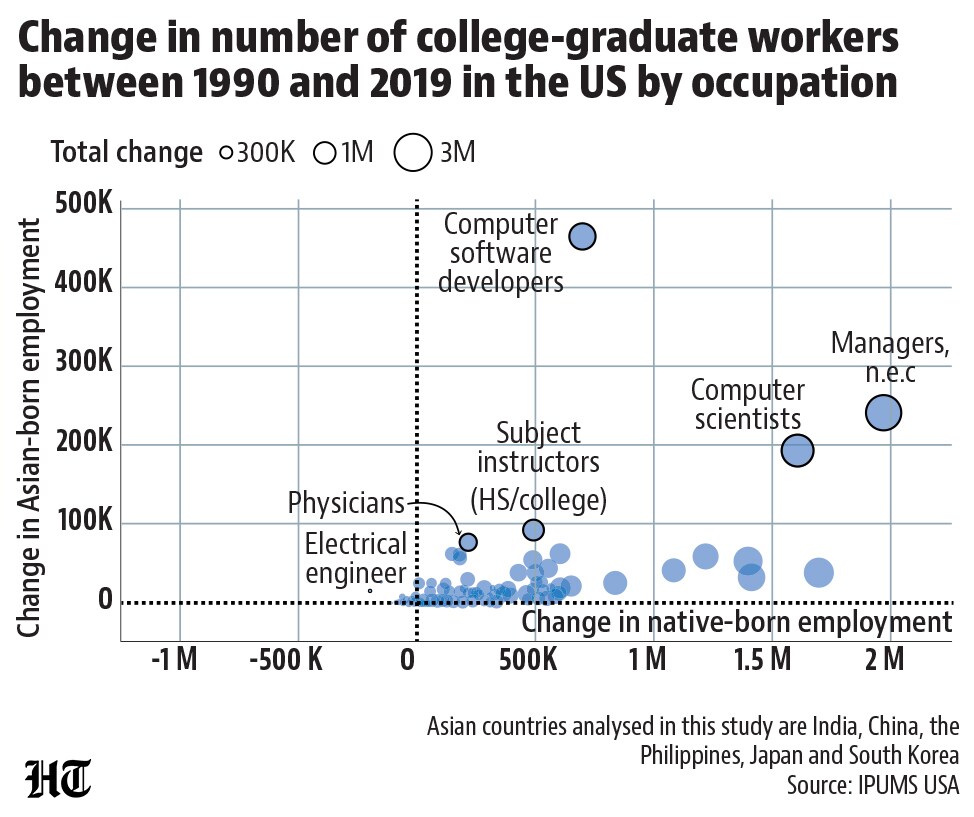
 Handful of Asian countries have accounted for significant growth in high-productivity occupations for the USBetween 1990 and 2019, the backbone of America’s high-skilled workforce changed in both scale as well as origin. The number of college-educated workers surged across almost every major occupation, but the biggest jumps came in those defining the digital age: software development, computer science, and management. Software alone added more than a million college-educated workers during this time, and more than 33% of this growth was due to workers from India, China, Japan, South Korea and Philippines. From the late 1990s onward, as the tech boom gathered pace, engineers from these five countries became an integral part of the US innovation economy, filling roles that domestic supply simply couldn’t meet fast enough. The pattern extended beyond tech: Asian-born professionals also accounted for a sizeable share of new physicians, scientists, and managers, embedding themselves at the core of industries that drove America’s growth.
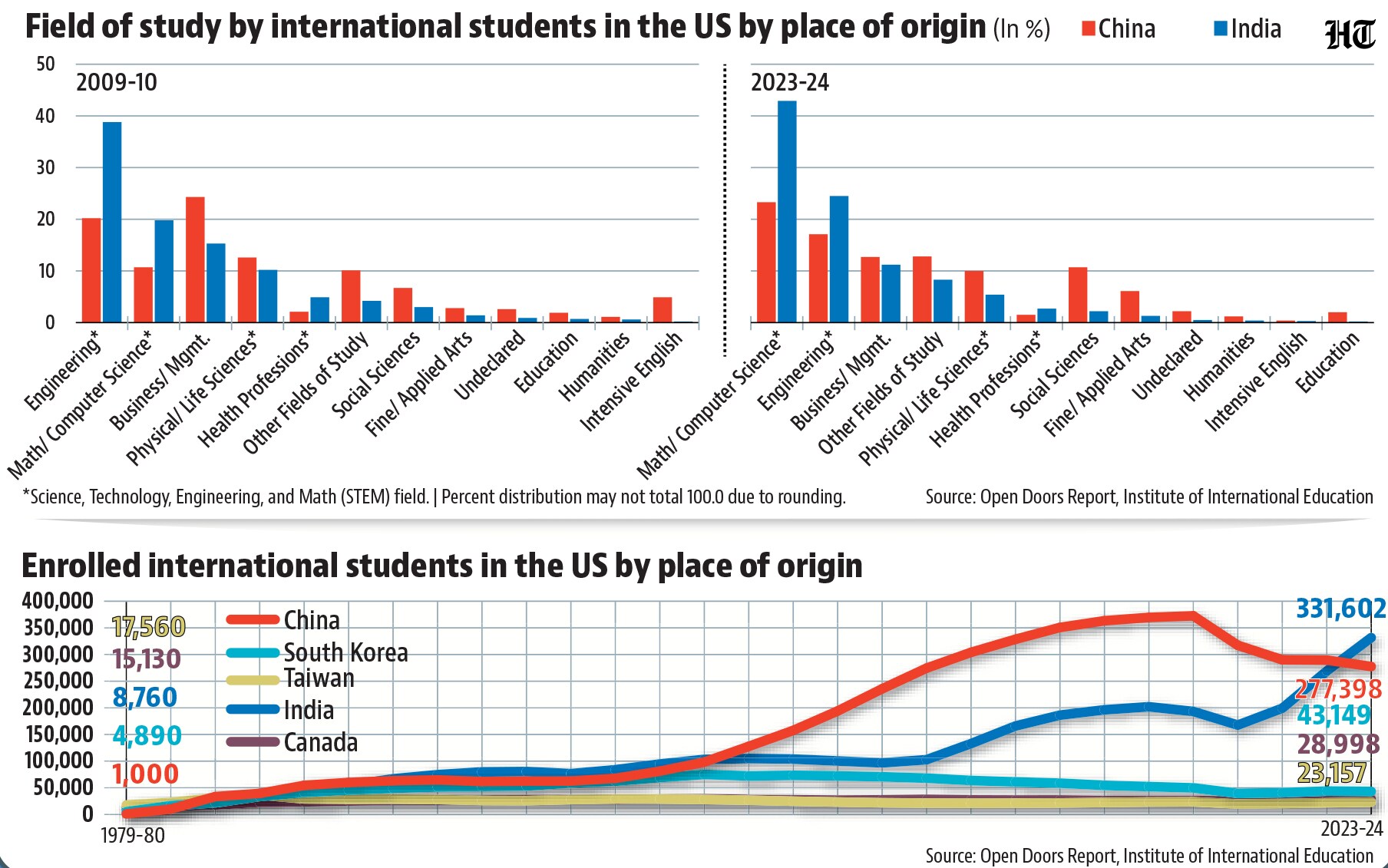
- Asian students have become the main pipeline of US STEM talentOver the past three decades, students from Asia have come to dominate US universities, especially in science and engineering. Data on international enrolments show that India and China now account for more than half of all foreign students in the United States, with India recently surpassing China as the largest source. Much of this rise, the paper notes, stemmed from the “export-led boom in incomes” following China’s entry into the WTO, and “a burgeoning youth body” in India that could afford to go abroad as “constraints in the Indian higher education sector led to increasing competition for limited seats at high-quality Indian universities”. Roughly two-thirds of students from India and over half from China are enrolled in STEM programmes, reflecting how the education pipeline itself has become increasingly technical. That educational tilt has fed directly into the US’s high-skill labour force. As the paper observes, “Over 60% of undergraduate and 90% of master’s students from India move to work under Optional Practical Training (OPT),” a pathway that leads many into H-1B employment. However, a recent report by the New York Times showed that there has been a 44% drop in international students from India studying in the US this year.
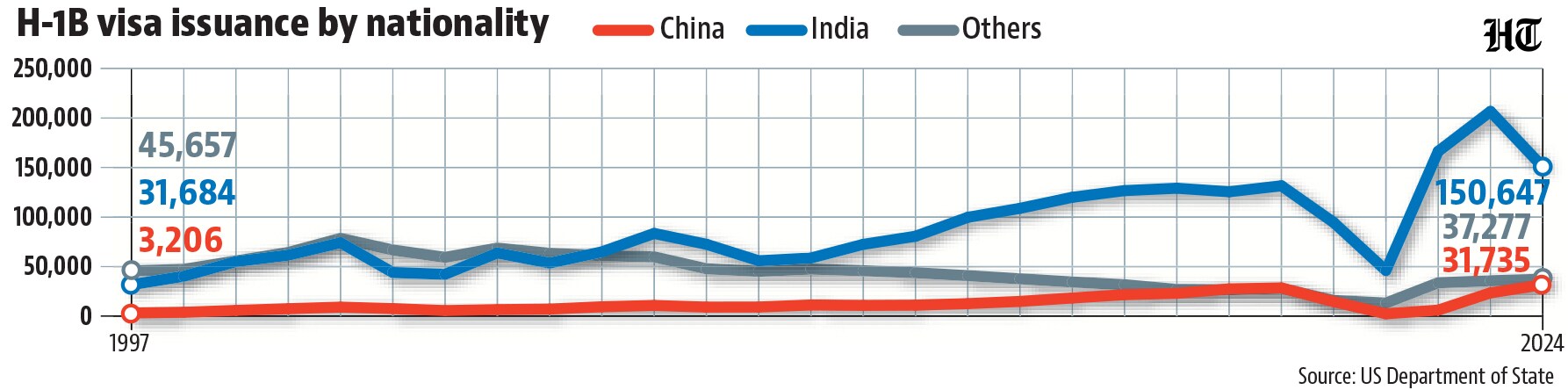
- Asian-born workers make up the bulk of America’s high-skill migrantsThe rise of Asian students in US universities has been mirrored by a surge in high-skill work migration. In recent years, India has consistently received more than two-thirds of all H-1B visas, while China accounts for about one in ten. The rest of the world combined makes up less than 20%. These flows are not isolated events but part of a longer chain that begins in education and ends in the labour market. Much of this talent pipeline is sustained by strong training systems at home. The paper notes that the Philippines and India have built extensive education infrastructure in nursing and medicine, aided by English-language instruction and US-modelled curricula. The Philippines has become “the world’s largest exporter of nurses, accounting for roughly 25% of all overseas nurses globally,” while India hosts “the largest number of medical schools globally and is the leading source of internationally trained physicians.” Migration prospects have, in turn, shaped domestic priorities. More than half of Filipino nurses now work abroad, and India has nearly doubled its number of medical colleges in the past decade. The study describes this as “a more complex narrative than simple brain drain.” The US gains experienced healthcare workers, while origin countries benefit from remittances, skill accumulation and incentives to expand medical and nursing education—creating a feedback loop that links both economies through shared human capital.


Unlock a world of Benefits with HT! From insightful newsletters to real-time news alerts and a personalized news feed – it's all here, just a click away! -Login Now!


