E-Paper



Soon, get blood tests done without the needle prick
The innovative model will give the blood cell count using a laser when placed on superficial veins, especially the lower lip.

 Prefer HTon Google


Four engineering students from Zakir Hussain College of Engineering and Technology, Aligarh Muslim University, have developed a unique prototype using electrical properties of the blood cells that will help count the red blood cells (RBC) and white blood cells (WBC) without a needle prick.
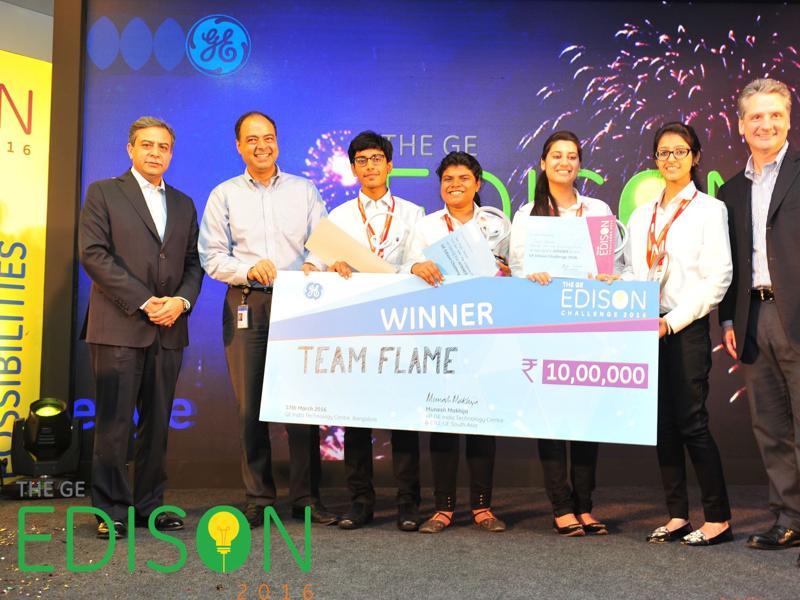
The innovative model will give the blood cell count using a laser when placed on superficial veins, especially the lower lip. The students also claimed that it is the first time that such a blood test will be conducted without a needle prick.
B Tech students Rohan Maheshwari, Simran Kaur, Somya Agarwal and Vani Dayal Sharma took around four months to build the device. While Rohan and Simran are from electrical engineering, Somya and Vani are pursuing computer engineering.
Their digital solution for domestic health check-up also won these students Rs 10 lakh prize money at the GE Edison Challenge 2016, an open innovation challenge for the university student community in India.
The event organised by the GE India Technology Centre (GEITC) was held recently wherein they received an award of Rs 2 lakh and incubation grant of Rs 8 lakh for their university.
Talking about the significance of their innovation city gynaecologist Dr Jyotsna Mehta said, “Increase in the WBC count is indicative of acute bacterial infection. The prototype can be of great help in detecting such infections.”
“Once the data is collected it will be transferred to a software that analyses and compares the blood cell count with the standard data. Using the concept of cloud computing, the software will send a text message to the patient’s phone. If it detects some considerable deviation, the doctor concerned will receive the acquired data. The doctor will be able to treat the patient from home and notify the pharmacy about the prescribed medicines that have to be delivered to the patient’s home,” explained Rohan Maheshwari, a second year student of electronic engineering.
According to these engineering students the physical, chemical, structural and other properties of the blood have been studied in detail but not the electrical properties. “So we tried to explore this particular property,” said Simran.
During their research they visited paediatricians and pathology labs to which they referred their patients for blood tests. Simran said, “We found that only few patients actually go to the laboratories recommended by doctors to get these tests done. We decided to solve this problem. It took us four months to complete the research.”
After winning GE Edison, the students are now working on the execution of their concept.
Read more: Make in India could hold key to innovation of immunisation technologies
“The competition was tough because the second engineering students competed with India’s finest technical minds. We also got the opportunity to prove our mettle before senior scientists and engineers from GE, as well as innovation leaders from the industry,” said Somya.
Shukla Chandra, MD, Global Research Centre said: “The team from Zakir Husain College of Engineering and Technology, Aligarh, UP impressed the judges through their digital solution for Domestic Health Check Up. The innovation involves counting blood cells, using only their electrical properties. We are extremely proud of what these young minds have come up with; it has the potential to create a revolution in the healthcare sector. This bears testimony to the kind of talent, platforms like GE – Edison Challenge is able to reap”.
The winners also got an opportunity to visit GE John F Welch Technology Centre in Bengaluru and see the R&D laboratory. They also interacted with GE experts and attended a Predix platform workshop during their visit.