
 E-Paper



Dhami releases book on Uttarakhand’s recent political history, urges focus on reading and local languages
At a book launch in Dehradun, CM Dhami says AI cannot replace books and calls for stronger promotion and digital preservation of Garhwali, Kumaoni and Jaunsari.

 Prefer HTon Google


Uttarakhand Chief Minister Pushkar Singh Dhami on Saturday released a book titled “Uttarakhand Rajya ka Naveen Rajnitik Itihaas” (Recent Political History of Uttarakhand State), authored by senior journalist and writer Jai Singh Rawat, at his official residence in Dehradun.
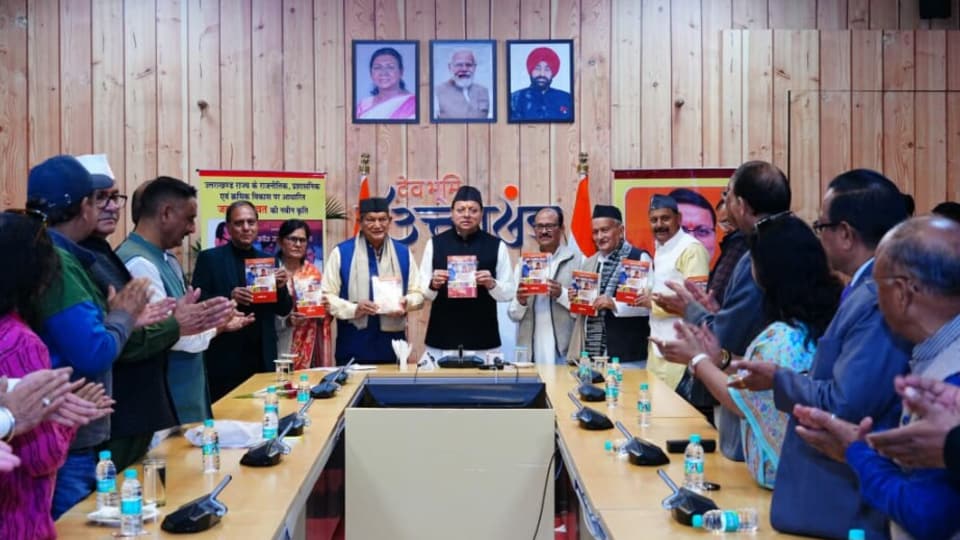
The book documents the state’s political, administrative and institutional developments since its formation, with a particular focus on the 25-year period after statehood. According to the author, the volume is divided into five sections and draws on official records, press reports and contemporary documents.
Addressing the gathering, which included former chief ministers Bhagat Singh Koshyari and Harish Rawat, legislators, journalists, writers and other guests, Dhami described the work as a structured account of Uttarakhand’s post-statehood politics, including phases of instability and their impact on governance and development. He said the compilation would be useful for researchers, students and candidates preparing for competitive examinations.
“Writing history is a serious responsibility that requires facts, perspective and integrity,” Dhami said, adding that the book seeks to present the political trajectory of the state using verifiable sources such as archival material and newspaper clippings.
The chief minister used the occasion to underline the importance of reading in an era of rapid technological change. “In today’s internet age, information is available instantly, but the importance of books can never decline. Books deepen our thinking and preserve knowledge in a lasting way,” he said.
Calling for a shift in social practices around events and ceremonies, Dhami appealed to people to gift books instead of flower bouquets. “At any function, ‘buke nahi, book dijiye’ (give a book, not a bouquet). This will increase interest in reading and also encourage authors,” he said.
Dhami also linked the discussion on books and reading to the preservation of local languages and cultural traditions. He said that while the use of artificial intelligence (AI) and digital tools is expanding, it remains essential to safeguard and promote regional languages such as Garhwali, Kumaoni and Jaunsari.
“However advanced AI may become, there is no replacement for books,” he said, adding that language, culture and customs are “not just modes of expression but the foundation of our identity and heritage”.
The chief minister said the state government is working on initiatives to encourage the creation of language content, literature and digital material in local tongues. This includes contests and recognition for students and young content creators who produce writing, song collections, research and online content in regional languages.
Dhami urged families and schools to increase the use of local languages at home and in community spaces so that younger generations remain connected to their linguistic and cultural roots. “When children understand their own roots, their self-confidence and cultural awareness are strengthened,” he said.
The government, he added, is focusing on digitising material related to local dialects, literature and traditional oral forms so that Garhwali, Kumaoni, Jaunsari and other regional languages can be preserved and accessed more easily through digital platforms. Making such content available online, he said, would both protect linguistic heritage and adapt it to contemporary modes of learning and communication.
The event concluded with remarks from invited guests and members of the literary and media fraternity, who underlined the need for systematic documentation of the state’s political evolution and for sustained efforts to transmit literature and folk traditions to younger readers.


