
 E-Paper



KENT RO enters home energy market with ₹250-crore Noida manufacturing investment
KENT has entered residential energy storage and backup, adding lithium batteries and solar hybrid inverters to its product lineup.

 Prefer HTon Google


KENT New Energy will offer lithium battery storage and power backup systems as the company expands beyond water and air purification. KENT RO Systems Ltd. has entered the residential energy storage and power backup market with the launch of KENT New Energy, backed by an investment of nearly ₹250 crore in a manufacturing facility in Noida.
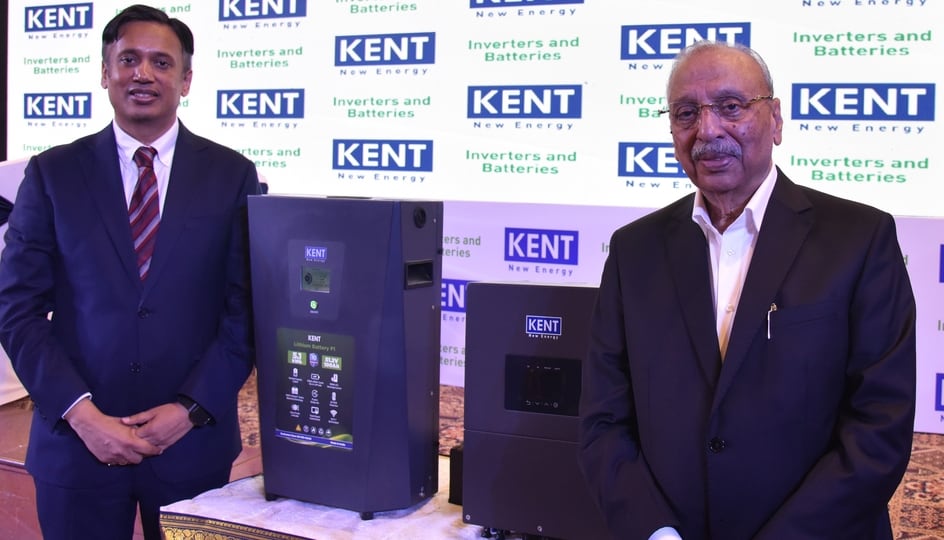
Announced in New Delhi on October 21, 2026, the new division will cater to households adopting rooftop solar as well as those seeking alternatives to conventional lead-acid batteries used in home inverters and uninterruptible power supply (UPS) systems.
The company's manufacturing facility in Sector 159, Noida, has an installed annual capacity of 3.5 gigawatt-hours (GWh), which KENT plans to increase to 10 GWh over the next six months. Spread across six acres, the facility covers 3 lakh sq. ft. The company sources battery cells from manufacturers including EVE and REPT.
The launch extends KENT's presence beyond its established water purification business and its air purifiers and Kühl BLDC fans into household energy management.
“We began by helping families access purified drinking water. Now we want to empower them to generate, store and manage electricity in their own homes,” said Mahesh Gupta, chairman and managing director of KENT RO Systems Ltd.
Products target solar adoption and power backup
KENT New Energy's portfolio comprises lithium batteries and solar hybrid inverters for energy storage, alongside batteries and inverter systems for conventional household backup requirements.
For homes with rooftop solar installations, the company has introduced battery storage systems in 5.1 kWh, 11.8 kWh and 16 kWh capacities. According to KENT, the batteries can store electricity generated by solar panels and power drawn from the grid. They are rated for more than 6,000 charge cycles and carry a 10-year warranty.
The accompanying hybrid inverters combine solar, grid and battery power. The single-phase range includes 3 kW, 5 kW and 6 kW models, while the three-phase range offers capacities of 10 kW, 12 kW and 15 kW. Depending on the system configuration and connected load, these products are designed to support appliances such as air-conditioners and pumps during power outages.
For households using existing inverter systems, KENT has introduced 12V and 24V lithium batteries with capacities ranging from 1.28 kWh to 3.84 kWh. The 12V range starts at ₹22,000. The company states that these batteries have a design life of 10 years, support 90% depth of discharge and do not require water top-ups.
The portfolio also includes an all-in-one inverter that combines a lithium battery and inverter in one enclosure, along with the H1 series home UPS. Both product lines are available in 1100 VA and 2400 VA models.
Remote monitoring included with solar inverters
The solar hybrid inverters come with a 4G data logger and a five-year data pack included in the price. Through the KENT central command mobile application, installers can monitor installed systems and change settings remotely.
According to the company, the system uses mobile network connectivity rather than home Wi-Fi, and data is stored on its servers in India.
KENT plans to distribute the products through its dealer network, retail stores and online channels. Solar hybrid inverters and larger battery packs will also be available through solar system integrators and engineering, procurement and construction (EPC) partners. The company said its distribution plans include installer training, professional installation and after-sales support.
Residential solar expansion provides market context
The launch comes as rooftop solar adoption increases in India, creating demand for systems that can store electricity for use outside daylight hours and provide backup during grid outages.
According to Mercom India Research, residential consumers accounted for 82 per cent of the 2.7 GW of rooftop solar capacity installed in India in the first quarter of 2026. The government's PM Surya Ghar: Muft Bijli Yojana aims to extend rooftop solar installations to one crore households.
KENT's entry into energy storage places it in a market serving both solar-equipped homes and households looking to upgrade conventional backup systems. The company said the new division is intended to expand its role in household energy generation, storage and management.


