
 E-Paper



What to Do If You Get Scammed: The First Steps That Matter Most
Do not let panic or embarrassment delay action after a scam. Contact your financial institution, call 1930 and file a report at cybercrime.gov.in.

 Prefer HTon Google


There is usually a moment when the entire story falls apart. The investment platform no longer allows withdrawals. The person claiming to be a police officer ends the call. A transaction alert appears for a payment that was never intended. Or someone realises that the “bank executive” they trusted was never from the bank at all!
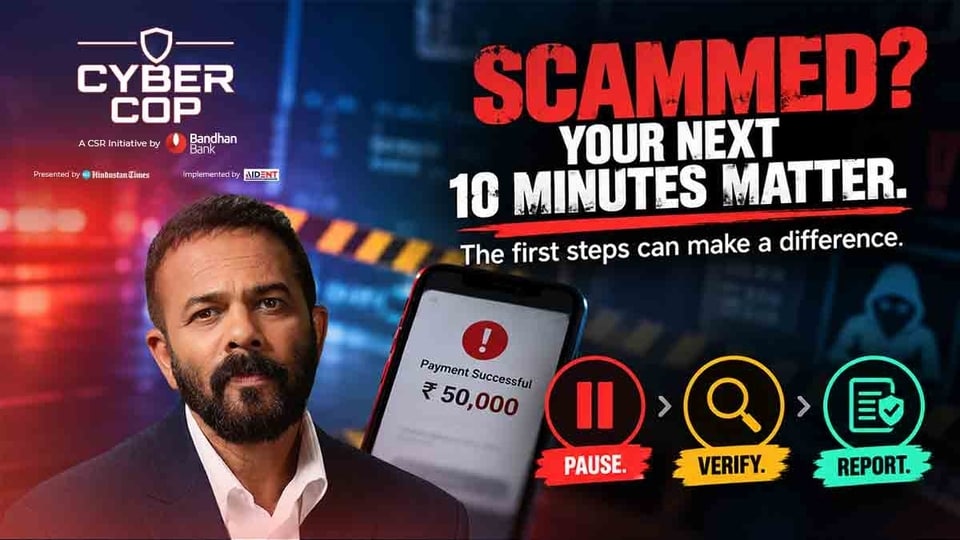
Panic is a natural response, so is embarrassment. But neither should be allowed to consume the minutes that follow.
Cyber fraud can happen to anyone, including people who are otherwise careful with money and technology. Once it does, the priority is no longer to work out how the scammer was so convincing. It is to contain the damage, report the transaction and secure anything else that may have been compromised.
The order in which these steps are taken matters. So does speed.
Cyber Cop, Bandhan Bank’s CSR initiative promoted by Hindustan Times and implemented by Aident Social Welfare Organisation, begins at that exact point: after the deception has worked, but while there may still be time to limit the damage.
First, stop any further movement of money
The bank, card issuer or payment service provider should be contacted immediately through its official helpline, mobile application, website or branch. Avoid calling a number supplied by the fraudster or one taken from an unverified online listing.
Explain what happened and ask the institution to block the affected card, UPI facility, net-banking access or account transactions, as appropriate. If login details, a PIN, password, OTP or card information were exposed, say so clearly. The bank needs to understand whether it is dealing with a single disputed transaction or an account that may still be accessible to someone else.
Ask whether the beneficiary account or transaction can be flagged, recalled or frozen. A completed payment cannot simply be reversed on request, but an early alert may allow the bank and other institutions in the payment chain to intervene before the money is moved again.
Always take down the complaint or service-request number. The Reserve Bank of India advises customers to notify their bank immediately and obtain an acknowledgement. Its guidance also makes the reason plain - the longer an unauthorised electronic transaction goes unreported, the greater the risk of loss to the customer or bank. Banks are required to provide multiple round-the-clock channels for reporting such transactions.
Call 1930 without waiting
The next call should be to 1930, India’s national cybercrime helpline for financial fraud. It operates across all States and Union Territories and is designed for immediate reporting.
The helpline is connected to the Citizen Financial Cyber Fraud Reporting and Management System (CFCFRMS), which brings law-enforcement agencies, banks, payment intermediaries, wallets and other financial entities onto a common platform. When a complaint is received quickly enough, the system can trace the flow of money and alert the institutions through which it is moving.
The scale at which this system is working shows why the call should not be postponed. By 30 June 2026, CFCFRMS had prevented more than ₹11,158 crore from being siphoned off across over 32.80 lakh complaints, according to information placed before Parliament. From 2021 to 2025, the national reporting systems recorded over 65.89 lakh financial-fraud complaints, with the reported amount exceeding ₹55,050 crore. More than ₹8,189 crore was marked as lien, meaning the funds were flagged or held within the financial system.
These figures do not mean that every reported rupee is automatically returned. Money placed on hold may still have to pass through investigation and legal processes before it can be restored. They do, however, show that rapid reporting gives the system an opportunity to act.
Complete the complaint online
Calling 1930 begins the reporting process, but the complaint should also be completed on the official National Cyber Crime Reporting Portal at www.cybercrime.gov.in.
Keep the following information ready:
- The date and approximate time of the incident
- The name of the bank, wallet or merchant involved
- The transaction amount
- The transaction ID or UTR number
- The fraudster’s phone number, email address, UPI ID, bank details, website or social-media handle
- A clear account of what happened
- A soft copy of an accepted identity document
- Any available supporting evidence
These details are part of the portal’s official checklist for financial-fraud complaints. Relevant evidence files can also be uploaded with the complaint.
Save the acknowledgement number after filing. It can be used to track the complaint on the portal. If the response is not appropriate, the portal also publishes the contact details of State and Union Territory nodal and grievance officers.
Preserve the trail, even if it feels embarrassing
The instinct to delete messages, leave fraudulent groups or clear call logs is understandable. But embarrassment after a scam should not come at the cost of evidence. That is an important message behind Cyber Cop, Bandhan Bank’s CSR initiative promoted by Hindustan Times and implemented by Aident – falling for a scam is not a reason to hide what happened. Resist the urge to delete anything until the evidence has been saved.
Take screenshots of conversations, profiles, advertisements, payment requests, transaction confirmations and error messages. Preserve emails with their original details, call records, URLs, account numbers, QR codes and any documents sent by the fraudster. Write down the sequence of events while it is still fresh, including what was said, what information was shared and when each payment was made.
Do not edit screenshots or crop away dates, usernames and phone numbers. Small details that appear unimportant to the victim may help investigators connect the complaint with other cases. More than 1.95 lakh FIRs were registered in connection with financial-fraud complaints reported between 2021 and 2025. Responsibility for investigating cybercrime complaints, converting them into FIRs and taking subsequent action rests with the relevant State and Union Territory law-enforcement agencies.
Depending on the nature and seriousness of the incident, the victim may also need to approach the local police or cybercrime police station with the acknowledgement number and evidence.
Secure the accounts behind the transaction
A stolen payment may not be the end of the fraud. If the victim shared credentials, installed an unknown application or allowed remote access to a device, the scammer may still have a way back in.
Using a different, trusted device where possible, change the password of the primary email account first. Email is often the route through which passwords for other services are reset. Then update banking, payment, social-media and other important accounts. Each password should be strong and unique, and multi-factor authentication should be enabled wherever available.
Review active login sessions and remove unfamiliar devices. If a suspicious application was installed, disconnect the affected device from the internet and seek reliable technical assistance before using it for further financial activity. If a mobile connection has stopped working unexpectedly or SIM misuse is suspected, contact the telecom provider immediately. CERT-In recommends using unique passwords, enabling multi-factor authentication and reviewing account security and privacy settings to reduce the risk of continuing compromise.
Follow the complaint rather than assuming the matter is closed
Keep every acknowledgement, email and reference number in one place. Follow up with the bank in writing and track the cybercrime complaint online.
If a grievance against a bank or another RBI-regulated entity is rejected or remains unresolved, the complainant must first complete the institution’s own grievance process. If there is no reply within the applicable period (generally 30 days) or the response is unsatisfactory, a complaint may be taken to the RBI Ombudsman through the Complaint Management System.
Be cautious during this period. Fraudsters sometimes return posing as recovery agents, police officers or officials who claim they can retrieve the money for a fee. No further payment should be made merely because someone promises a refund.
Shame helps the scammer, not the victim
Many people delay reporting because they feel foolish or fear being judged and that silence gives criminals more time. Reporting quickly may protect not only the victim’s remaining funds but also other people targeted through the same phone numbers, accounts and websites.
Cyber Cop, Bandhan Bank’s CSR initiative promoted by Hindustan Times and implemented by Aident, has consistently focused on replacing fear with practical awareness. That becomes especially important after a scam, when clear instructions are more useful than blame.
The response can be remembered in four words: block, report, preserve and secure. Contact the financial institution, call 1930, file the complaint at cybercrime.gov.in, preserve every piece of evidence and protect the accounts or devices that may still be exposed.
The scam may have already happened, but the damage does not have to continue.
Note to the reader: This campaign is run by HT Brand Studio on behalf of Bandhan Bank’s CSR Activity.


