
Sign in

Gurgaon bars can serve liquor in open but glasses must not be visible

To serve liquor in the open, the pub and bar owners will have to ensure that the open space does not have a direct access/opening to the main road and should have a six feet immovable boundary wall.

Updated on: Mar 7, 2017, 13:15:43 IST
Hindustan Times | By , Gurgaon
Share
Share via
  • facebook
  • twitter
  • linkedin
  • whatsapp
Copy link
  • copy link

Around 100 pub and bars will start serving liquor in open areas starting April 1 in Gurgaon. The ban on serving liquor in the open, imposed nine months ago, has finally been removed.The permission, however, comes with certain riders.
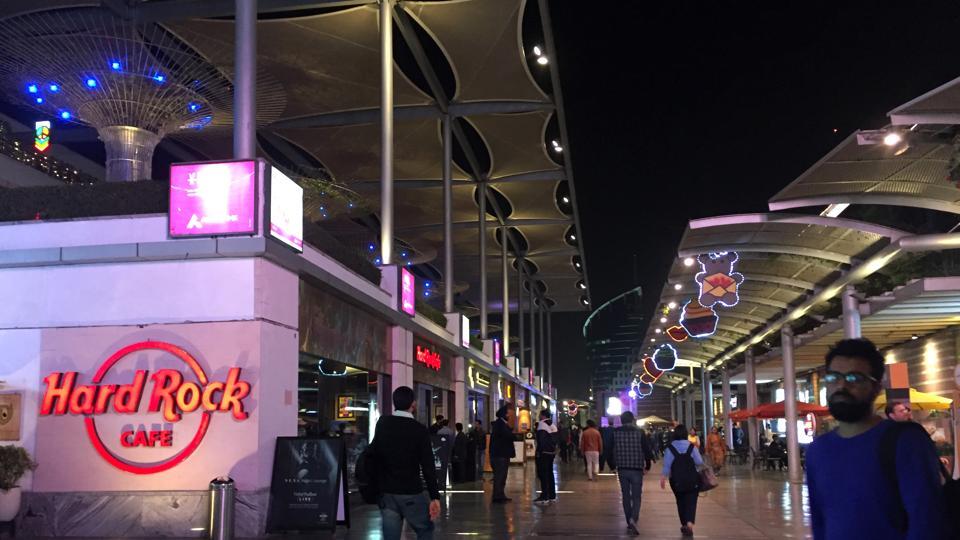
The excise department has said that pub and bar owners can start applying for licences to serve liquor in open areas at CyberHub. (Parveen Kumar/HT)
THE RIDERS
  • The space should not be open to passersby and it should be surrounded by wall with a provision for regulated entry/exit
  • The open space should not have a direct access/opening to the main road
  • If the open space happens to be a rooftop/terrace/ balcony, it should be surrounded by a wall/strong immovable fencing of a minimum height of six feet
  • The act of drinking in the open, by the person sitting therein, should not be visible to passerby. In addition, if the open space is visible from other nearby highrises, additional measures should be taken to obstruct the view
  • The licensee shall ensure that the person using the open space does not indulge in any activity such as throwing articles outside
  • No music or performance is allowed in the open space and no one aged below 25 years shall be given entry.

As per the new policy, pub and bar owners will have to ensure that the open space does not have a direct access/opening to the main road and should have a six feet immovable boundary wall.

No music or performance shall be allowed in the open space and no person aged below 25 years shall be allowed to enter in such space. Such open bars will not be allowed in residential areas.

The licences will only be granted after the recommendation of the deputy excise and taxation commissioner of the district personally certified the map of the area and visit the pub/bar

The excise department had on December 23 removed the ban on serving liquor in open areas. But the order put on hold due to the confusion over the Supreme Court’s directive to not sell liquor within 500 metres from state and national highways.

“The decision of Haryana excise to allow restaurants to operate in enclosed open space will not only provide a fresh of breath air to the patrons of Gurgaon but will also add significantly to the state exchequer. The additional revenues should contribute around Rs 15 crore annually in the form of additional license fee, VAT, and other levies. There will be a big impact on employment as more staff will be needed to cater to the additional seating arrangements,” said Rahul Singh, Haryana chapter head, National Restaurant Association of India (NRAI).

“The smoking zone on the premises was not welcomed by the visitors, they demanded drinks along with smoking in the open. Our business was affected 30% due to the ban. Now we can run our business happily, meeting the customers’ demands,” said Praveen Yadav, director Batli 29.

“To avoid any mishap the pub/bars are directed to construct a wall or fencing to ensure the safety of the person visiting the pub/bar,” said Aruna Singh, deputy excise and taxation commissioner.

The Haryana Excise Act does not allow liquor to be served in the open but there was no clarity about the rule. However, new norms were notified in April last year and the department made it clear to pub/bar owners that they cannot serve liquor to customers on roof gardens, lawns and other open spaces. The open spaces can only be used for dining.

Following the order, several pubs had put up boards saying liquor would not be served at open spaces and should not be carried outside.

Between June and December, the department issued challans to 110 bars in the city for violating the order.

  • Leena Dhankhar
    ABOUT THE AUTHOR
    Leena Dhankhar

    Leena Dhankhar is Senior Editor and Bureau Chief, Gurugram, at Hindustan Times, where she has spent over 17 years chronicling the transformation of one of India's fastest-growing urban regions. From starting her career as a crime reporter to leading the Gurugram bureau, her journalism has been defined by investigative reporting, in-depth storytelling and an unwavering focus on public interest. Over nearly two decades, she has reported extensively across crime, politics, civic governance, elections, real estate, environment, courts, sports, education and entertainment, covering Gurugram, Faridabad, Nuh and Palwal. Her reporting has exposed several major scams and systemic failures, including insurance frauds, waste management irregularities, illegal arms manufacturing units in Nuh, illegal mining in the Aravallis, organised crime networks and governance lapses affecting millions of residents. Known for her investigative work and exclusive stories, Leena has reported on high-impact national issues, including the Nicaragua charter flight carrying Indian migrants that was turned back amid allegations of human trafficking, exposing the growing network of illegal immigration rackets. Her work has also focused on gang wars, prison administration, juvenile crime, women and child protection systems, the functioning of the Juvenile Justice Board and Child Welfare Committee, and environmental challenges such as pollution, waterlogging and deteriorating civic infrastructure. Beyond hard news, Leena has extensively documented Haryana's rich heritage, forests and wildlife, bringing attention to the state's historical landmarks, biodiversity, conservation efforts and ecological challenges through immersive reportage and feature writing. Her journalism has consistently gone beyond breaking news. She has documented Gurugram's rapid urbanisation through long-form narratives and enterprise reporting on issues ranging from pothole-ridden roads, flooding and waste management to the changing social fabric of India's Millennium City. She also writes widely read feature columns, including The Outsider, Changemaker, and Concern for Gurugram, profiling people, places and ideas shaping the city's identity. Leena is the author of Gurugram School Murder, published by Juggernaut Books, a deeply reported account of one of India's most high-profile school murder investigations. She is currently working on her second book, an investigative work exploring some of India's most significant scams and fraud investigations. Beyond print journalism, she has expanded her storytelling through public speaking and digital media. She is a TEDx speaker and has produced podcasts exploring Gurugram's transformation, civic challenges and untold stories. Her work reflects a commitment to narrative journalism that combines rigorous reporting with compelling storytelling. A law graduate with an MBA in Human Resources, Leena brings a multidisciplinary perspective to her reporting, particularly on governance, public policy and legal affairs. She has travelled extensively across India to pursue investigative assignments, often reporting from remote locations and conflict-prone areas in search of stories that matter.Read More