E-Paper



Watch out for gallstones

 Prefer HTon Google



Gallstones are pebble-like structures that develop in the gallbladder, located below the liver. They form when bile stored in it hardens into stone-like formations, Rhythma Kaul elaborates on what gallstones are. Quiz: Are you at risk for gallstones?
A routine check-up revealed Priyanka Gandhi had stones in her gallbladder, for which the 41-year-old underwent a laparoscopic surgery last week. Easily diagnosed using routine ultrasound, gallstones affect one in 10 adults in urban India.
“Of any 100 people walking down the street, 15 will have gallstones. The numbers appear to be rising suddenly because more people are getting diagnosed. Gallstones often cause mild pain and/or diarrhoea — it sometimes causes acute pain. So, before routine screening became popular, people often lived with the symptoms throughout life,” said Dr Arun Prasad, senior consultant surgeon, minimal access, at Apollo New Delhi’s Indraprastha Apollo Hospitals.
“Diets high in fat, sugar and starch contribute to the formation of gallstones,” added Dr Prasad, who has operated on children who are as young as seven years old.
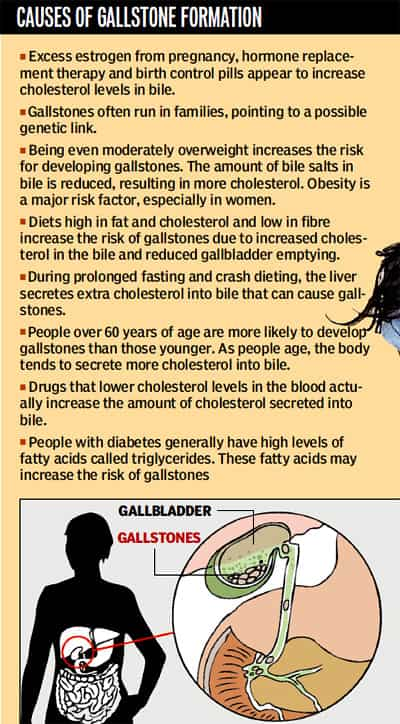
Indraprastha Apollo Hospital’s survey among 1,000 Delhiites showed about 15% women and 10% men had gallbladder stones. High cholesterol levels in bile, a digestive liquid stored in the gallbladder, account for nearly 80% of the cases. Obesity and low-fibre diet contribute, too.
Gallstones are pebble-like structures that develop in the gallbladder, located below the liver. They form when bile stored in it hardens into stone-like formations. Bile helps the body digest fats: it is pushed into the bile duct that carries it to the small intestine.
Bile contains water, cholesterol, fats, bile salts, proteins and bilirubin. If the liquid bile contains too much cholesterol, bile salts or bilirubin, it can harden into gallstones. Hardening can also happen if the bile stays in the gallbladder for too long without being used. Missing breakfasts and irregular meals can also cause gallbladder stones.
“If a person does not eat for long, the bile stagnates inside the gallbladder and becomes hard,” said Dr Ashok Mittal, senior laparoscopy surgeon, RG Stone Urology and Laparoscopy Hospital.
Family history, crash dieting and advancing age also contribute to the formation of gallstones.
Laparoscopic removal of gallbladder is very common these days. Usually, the process does not require more than a day of hospitalisation, and normal activity can be resumed after 4-5 days. It costs anywhere between Rs. 45,000 and Rs. 1 lakh to remove gallbladder laparoscopically in a private hospital. In a government hospital, the cost is under Rs. 5,000.
The removal of gallbladder does not affect the person much as the bile flows out of the liver through the hepatic ducts into the common bile duct and directly into the small intestine, instead of being stored in the gallbladder.
In most cases, gallstones cause no symptoms. In some cases, however, symptoms can last for a week and a person need to see a doctor.