
 E-Paper



Hype for Moderna’s cancer vaccine is running ahead of the math
Personalized mRNA shots may prove neither as wide-reaching nor as lucrative as hoped.


 Prefer HTon Google


Moderna has always been a stock driven by narrative extremes.
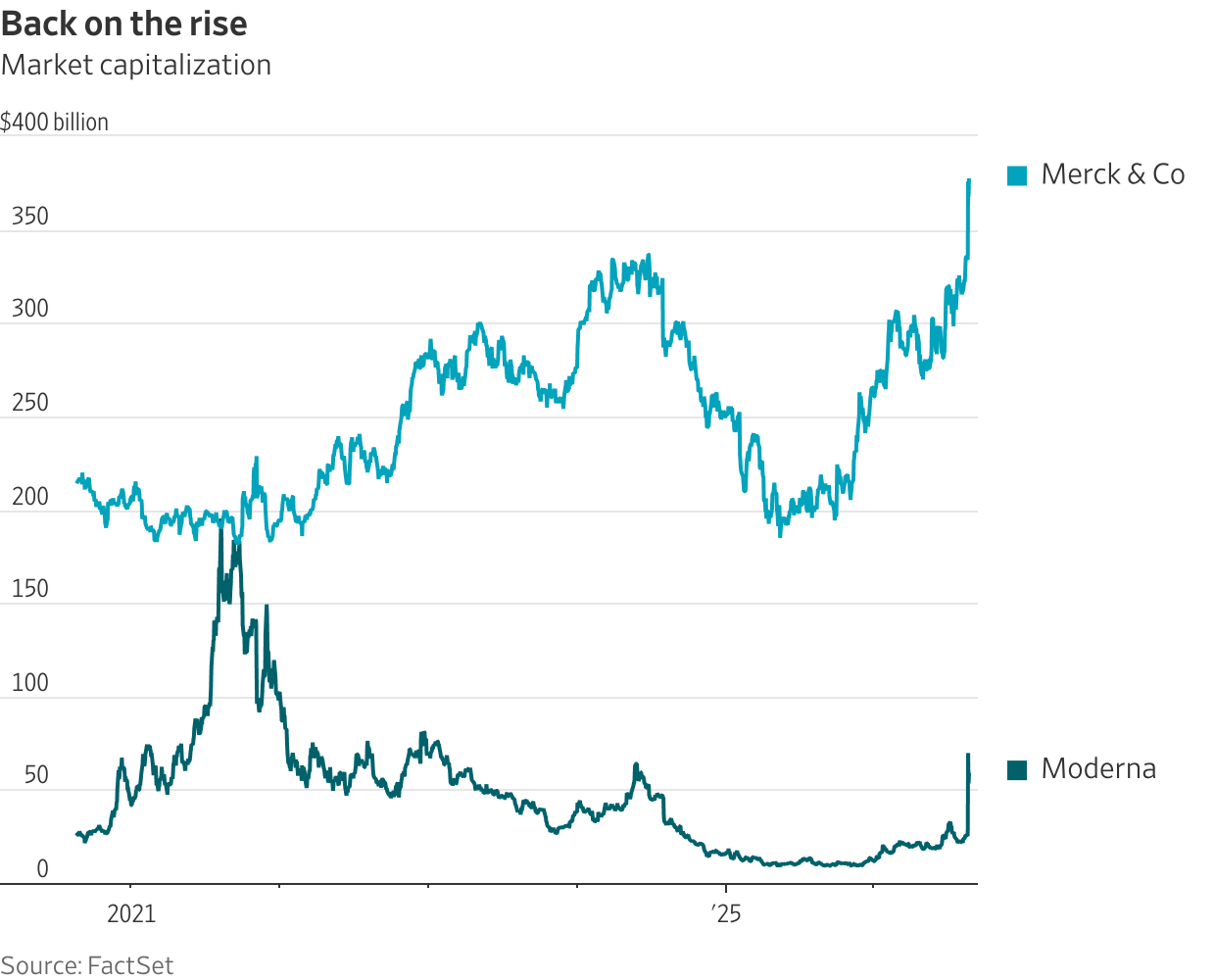
During the pandemic, it traded as if mRNA would transform medicine overnight, with its market capitalization peaking near $200 billion. Then came the hangover: Vaccine sales cratered, and investors questioned the company’s pipeline.
Now the pendulum is swinging back, and perhaps overshooting reality once again.
Shares exploded 177% in a single session on Wednesday—the largest one-day surge for an S&P 500 company in over two decades—after Moderna and partner Merck reported successful late-stage trial results for their personalized mRNA melanoma vaccine.
By week’s end, Moderna’s market value sat near $60 billion, up from about $25 billion pre-announcement. Together with Merck and BioNTech, which is testing a personalized mRNA cancer vaccine of its own, the trio added about $80 billion in market capitalization in days, implying a sweeping new era for cancer care.
The announcement marks a major leap in personalized oncology. While the trial data will be shared at a coming conference, the companies said patients given the personalized vaccine alongside Merck’s Keytruda were significantly less likely to experience melanoma recurrence than those on Keytruda alone.
As the first late-stage validation of an mRNA cancer vaccine, it provides encouraging evidence for the potential of Moderna’s broader cancer-vaccine platform.
Yet the financial math is sobering. Daina Graybosch, an analyst at Leerink Partners, models the therapy generating low-single-digit billions in annual sales by 2032. Even in a bull case where the vaccine peaks at $10 billion in annual sales for the partnership, that could support roughly $40 billion in added market value for the two companies combined, she says. That is less than the market added in a single afternoon.
The key reason for the skepticism is that success in melanoma is far from proof that the approach will work elsewhere. Every tumor is different, and melanoma is unusually well-suited for this therapy.
The vaccine analyzes a patient’s tumor, selects up to 34 mutations as targets and trains the immune system to recognize them. Yet typically only two or three generate a meaningful immune response, Graybosch explains. In melanoma, the abundance of mutations gives the vaccine more targets to work with, while the tumor’s relative sensitivity to immunotherapy gives those targets a better chance of producing an immune response.
The cancers Merck and Moderna are pursuing next are less forgiving. Kidney cancer has fewer mutations to target, while bladder cancer has a more suppressive tumor environment. And some of the hardest tumors, such as pancreatic cancer, are notoriously resistant to immune-based treatments.
Then there are the drug’s economics. Traditional drugs are made in bulk. This vaccine is different: A surgeon removes the tumor and sends it to a lab, where its mutations are sequenced and an algorithm identifies the targets for a personalized mRNA vaccine. Like other personalized therapies, it is a vastly more expensive way to manufacture a drug.
The obvious fix is to charge more. The companies haven’t said how much, but based on comparable therapies, the full treatment could cost somewhere in the ballpark of $300,000. Yet as you go up in price you run into problems in Europe, where health systems negotiate aggressively. And the companies may have less room to charge American patients more than Europeans as the Trump administration pushes policies that tie U.S. drug prices more closely to those paid in other wealthy countries.
The result could be substantially lower margins than those of conventional drugs, which can be higher than 90%. At least initially, gross margins could land somewhere between 50% and 80%, says Graybosch.
That leaves Moderna investors with a hard equation. As RBC Capital Markets analyst Luca Issi explains, the market is pricing in the possibility that the vaccine could become something like the next Keytruda or Opdivo, drugs that helped usher in the checkpoint-immunotherapy revolution and proved effective across a range of cancers. But the vaccine could instead prove effective in a much narrower set of tumors.
The bigger promise of mRNA may be using it to prevent cancer in people at high risk, before the disease takes hold. A vaccine in the truest sense of the word, as Graybosch puts it. That could be transformative. But that frontier is nowhere close.
For now, this week’s excitement is likely to run into the cold realities of tumors and economics.
Write to David Wainer at david.wainer@wsj.com
Catch your daily dose of Fashion, Health, Festivals, Travel, Relationship, Recipe and all the other Latest Lifestyle News on Hindustan Times Website and APPs.


