E-Paper



A father's legacy, a son’s government: The symbolism in Jharkhand protesters carrying Shibu Soren's portrait
As students protest, Shibu Soren's image invokes his legacy against the government led by the JMM founder’s son & chief minister Hemant Soren.

 Prefer HTon Google


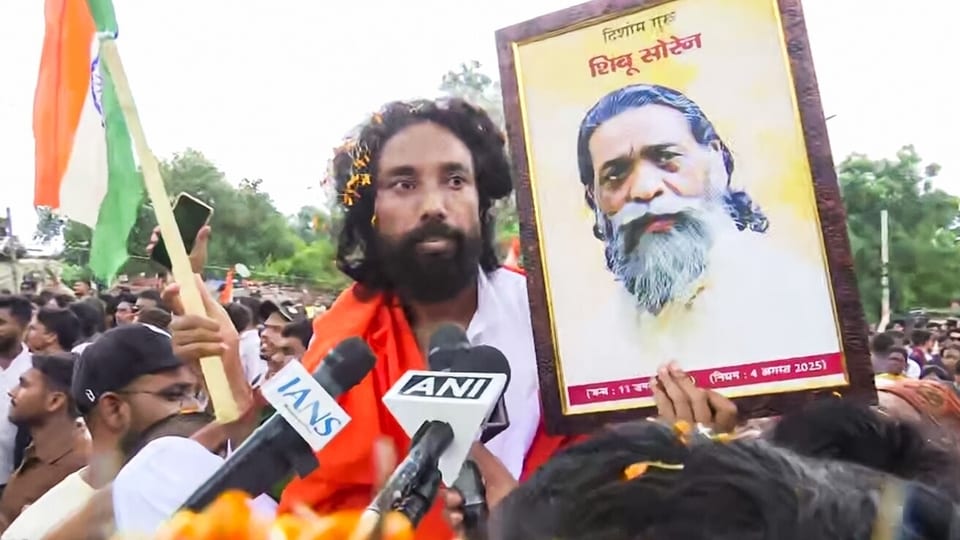
Portraits of Shibu Soren have become one of the defining images of the weeks-long student agitation in Jharkhand, as protesters invoke the late Jharkhand Mukti Morcha (JMM) patriarch's legacy of struggle to press demands against the government led by his son, chief minister Hemant Soren.
The agitation began on July 25 over alleged irregularities — paper leaks, discrepancies in OMR sheets and a disputed merit list in the 14th Jharkhand Public Service Commission (JPSC) preliminary examination.
Student leader Devendra Nath Mahto ended his 16-day hunger strike late on Monday, hours after the state government announced it would cancel the JSSC Combined Graduate Level (JSSC-CGL) examination along with all examinations, results and selections tied to the private agency TSR Data Processing Private Limited (TDPL).
The government had earlier agreed to cancel the 14th JPSC preliminary exam and two backlog tests. Mahto called it a "huge victory" and thanked the government, students, media, police and administration — but said the students' broader push for examination reforms would continue.
The government has framed its response as accepting "all" of the students' core demands. A state minister said the government would consult students on further reforms and that agencies would hold those responsible for paper leaks were not spared. Chief minister Hemant Soren, addressing the Jharkhand Adivasi Mahotsav, promised that "justice will be delivered with full transparency".
However, students have said cancellation of the exams is only a "first step". Another key demand — an independent CBI investigation into the alleged irregularities — is yet to be met. The JPSC-JSSC Reforms Manch has said its agitation will continue until there is clarity on that front.
Shibu Soren
Popularly known as 'Dishom Guru' — leader of the land — Shibu Soren was born on January 11, 1944, in Nemra village and grew into one of India's most prominent tribal leaders. He died on August 4, 2025, at Delhi's Sir Ganga Ram Hospital following prolonged treatment for kidney-related ailments. He was 81. His passing was widely mourned as the close of a political era that had carried the tribal statehood movement into the national mainstream.
In 1973, he joined trade unionist AK Roy and Binod Bihari Mahto to co-found the JMM in Dhanbad. The party went on to lead the movement for a separate tribal state, building deep support across Chotanagpur and Santhal Pargana.
Soren earned loyalty on the ground by leading tribal families against moneylenders who had trapped them in debt, and by helping villagers reclaim land and mobilise around water, forest and land rights. That record gave him the 'Dishom Guru' title.
Also Read | Who was Shibu Soren? Rose through struggles to become Jharkhand's 'Dishom Guru'
His electoral career began in 1980, when he was elected to the seventh Lok Sabha from Dumka — a seat he would hold multiple times. He entered the Rajya Sabha in June 2020 and joined the Consultative Committee for the Ministry of Tribal Affairs in October 2024. At the Centre, he served as Union coal minister during UPA-1 across three stints between 2004 and 2006, though his career was dogged by legal challenges — most notably a 2006 conviction in the murder of his private secretary Shashi Nath Jha, which was set aside on appeal the following year.
In state politics, Soren was Jharkhand's chief minister three times — briefly in March 2005, from August 2008 to January 2009, and again from December 2009 to May 2010.
Protesters demand Hemant Soren’s resignation
By raising images of the state's founding leader, the protesters drew a moral contrast between Shibu Soren's history of grassroots struggle and what they describe as the administrative shortcomings of the government now run by his son.
Displaying portraits of a movement's founding or martyred figures is a documented method of demonstrations, one that a Museum of Protest series on nonviolent action catalogues across contexts worldwide.
Activists hold up images of revered leaders, victims of injustice or missing loved ones to personalise a cause and draw public sympathy toward it — putting a face to an argument that slogans alone cannot make.
Also Read | New JMM chief Hemant Soren's achievements, challenges | Number Theory
A 2022 peer-reviewed study by sociologist Satendra Kumar, published in Sociological Bulletin, said that Bharatiya Kisan Union (BKU) leaders and activists organising the 2020-21 farm-law protests in western Uttar Pradesh deliberately invoked the memory of Chaudhary Charan Singh and BKU founder Mahendra Singh Tikait at village-level meetings — reviving the two farmer leaders' legacy decades after their deaths.
This, the study said, helps rally a new generation to lend continuity and moral weight to a movement led by their political heirs, including Charan Singh's grandson and Tikait's son, Rakesh Tikait.
Political leaders' portraits carry this weight partly because of how deeply their iconography embeds itself in public memory. An Economic and Political Weekly (EPW) study on Mahatma Gandhi's visual legacy says that his image was iconised long before his assassination — a transformation that let his portrait travel far beyond any single movement and be invoked by causes he wasn't personally involved in.
Also Read | Jharkhand protesters threaten to gherao CM Soren's residence, demand his resignation
The device also cuts the other way — as a charge of betrayal rather than a show of continuity. The Jammu and Kashmir National Panthers Party, a regional outfit formed in 1982 to campaign against corruption and for a separate status for the Hindu-majority Jammu, has no organisational link to the Bharatiya Janata Party (BJP) — but its leaders have used the memory of BJP's founder, Syama Prasad Mookerjee, to attack the party.
The Jharkhand protesters' use of Shibu Soren's image is perceived to carry a similar charge: an implicit argument that the party he built has drifted from the values that built it.
What distinguishes the Jharkhand case is perhaps its specific symbolism. Most precedents invoke a founder's legacy in the abstract, against an institution or an ideological drift. Here, the successor is not abstract — he is the founder's own son.