E-Paper



Saudi airport attack: Why are Yemen’s Houthis targeting Riyadh?
A deadly Houthi attack on Riyadh airport has escalated tensions between Saudi Arabia and Yemen, raising fears of wider conflict and possible US military action.

 Prefer HTon Google


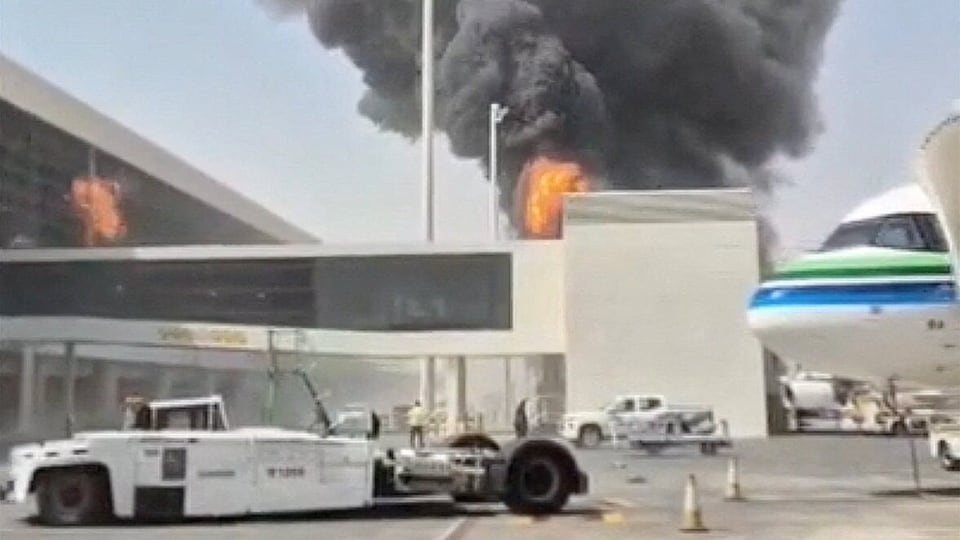
A missile strike on Saudi Arabia’s King Khalid International Airport in Riyadh killed at least 13 people and injured 309, marking a major escalation in the conflict between Saudi Arabia and Yemen’s Houthi rebels. The Indian Embassy in Riyadh said 11 Indian nationals were among those injured, with one later succumbing to his injuries. The attack, which hit a passenger terminal, prompted the suspension of airport operations, flight cancellations and fresh security warnings to foreign nationals.
Saudi Arabia’s General Authority of Civil Aviation confirmed that the victims included four Saudis, two Bangladeshis and one person each from the US, Jordan, Palestine, Syria, Sudan and Egypt. Some of the injured were in critical condition, authorities said, according to the BBC and Al Jazeera.
The strike was the third attack on Riyadh’s airport that week, according to CNN, which reported that the airport would remain closed until at least late Sunday. A separate projectile struck the airport again on October 11, killing one Pakistani national and injuring 11 others, according to Saudi aviation authorities. Saudi authorities also moved schools in the capital to remote learning for the remainder of the week, the Associated Press (AP) reported.
The Saudi-led military coalition blamed Yemen’s Houthis for the attack and threatened a response. The incident has also raised concerns about the possibility of direct US military involvement, with President Donald Trump saying Washington was considering joining Saudi strikes against the Iran-backed group.
What happened at Riyadh airport?
The October 10 attack struck a passenger terminal at King Khalid International Airport, killing civilians and injuring passengers and airport staff, according to the Saudi-led coalition’s spokesperson, Major General Turki al-Maliki, as reported by the BBC.
Eyewitnesses described scenes of destruction inside the terminal. One traveller told Reuters, as cited by CNN, that they saw something move across the sky before part of the ceiling near a departure gate collapsed. Another recalled hearing an explosion and subsequently seeing injured people on the ground.
Video footage released by Reuters showed debris and large boards scattered across the terminal floor, with people moving through a dust-filled hall, CNN reported.
The Saudi civil aviation authority said the extent of the damage was being assessed. More than a dozen ambulances were seen heading towards the airport following the strike, an eyewitness told Reuters, according to the BBC.
The attack disrupted operations at one of Saudi Arabia’s major international aviation hubs. CNN reported that more than 600 flights had been cancelled following the airport’s closure. Saudi authorities extended the closure until at least 9 pm on October 11, according to AP.
Foreign governments also issued security warnings. The UK Foreign Office advised British nationals to avoid the area until the airport was secure, while the US embassy restricted staff access to airports in Riyadh, Jeddah and Dammam, the BBC reported.
Was this the first Houthi attack on a Saudi airport this week?
No. The October 10 strike followed two earlier attacks on Riyadh’s airport during the same week, according to CNN and Al Jazeera.
The Houthis had acknowledged responsibility for earlier strikes on the airport, which reportedly killed three people and damaged a Saudi commercial aircraft, CNN reported. The BBC also reported that separate Houthi attacks on two other Saudi airports on October 6 and 7 killed three people.
A projectile also fell near King Fahd International Airport in Dammam in eastern Saudi Arabia on October 10, according to the Saudi-led coalition, as reported by the BBC.
The Houthis had not immediately issued a formal claim of responsibility for the latest attack. However, senior Houthi official Nasr al-Din Amer appeared to acknowledge it in a post on X, writing, “We shut down Riyadh international airport,” CNN reported.
The group’s military spokesman, Brigadier General Yahya Saree, subsequently urged people to take its warnings seriously, according to AP. The Houthis have also threatened further attacks against Saudi airports and warned airlines against using Saudi airspace.
Who are Yemen’s Houthis, and why are they targeting Saudi Arabia?
The Houthis are an armed political and religious movement originating in northern Yemen. They are associated with the country’s Zaidi Shia Muslim minority and control large parts of Yemen, including the capital, Sanaa, according to the BBC.
The group has fought Yemen’s internationally recognised government, which is backed by Saudi Arabia. Iran supports the Houthis, although the nature and extent of that support vary across military and political activities.
The Houthis say their attacks against Saudi Arabia are retaliation for the kingdom’s military campaign in Yemen and what they describe as a blockade of the country.
According to the BBC, the group announced a “maritime embargo” against Saudi Arabia in July and began launching missile and drone attacks against Saudi airports, oil facilities and shipping in the Red Sea. It also cited a Saudi air strike on Sanaa airport, which is under Houthi control, as part of its justification for retaliatory action.
Following the October 10 attack, the group reiterated its warning to airlines and travellers against using Saudi airports and airspace, according to CNN. Its military statement said Saudi Arabia would be responsible for failed attempts to intercept missiles and vowed to respond to what it described as blockades and escalation.
The Saudi-led coalition, meanwhile, described the strike on Riyadh airport as a “full-fledged war crime”, according to the BBC. The United Nations has also condemned the attacks on civilian infrastructure.
How did the Yemen war escalate again?
The latest attacks are part of a conflict that has drawn in regional powers for more than a decade.
Saudi Arabia led a military coalition in 2015 to support Yemen’s internationally recognised government and prevent the Houthis from consolidating control over the country. Years of air strikes and ground fighting contributed to a humanitarian crisis in Yemen, with hundreds of thousands of deaths linked to the conflict and its wider consequences, the BBC reported.
A temporary ceasefire was brokered in 2022, reducing fighting after years of violence. However, the informal truce subsequently weakened, and hostilities have intensified again in recent months.
The latest escalation has involved Houthi attacks against Saudi targets and renewed fighting between the group and Saudi-backed Yemeni government forces.
According to CNN, the Houthis carried out an offensive along Yemen’s Red Sea coast last month, capturing the port of Mokha and advancing towards Taiz, one of the country’s largest cities. The Saudi-backed government subsequently launched an offensive to regain territory but struggled to make significant progress, CNN reported.
The fighting has also coincided with wider tensions involving Iran and the US. AP reported that the latest Saudi airport attack could complicate efforts to halt the US-Iran war, as Washington weighs its response to the escalating violence.
The renewed hostilities have therefore placed additional pressure on regional efforts to contain the conflict and prevent it from spreading.
Why does the Red Sea matter?
The conflict has implications beyond Yemen and Saudi Arabia because of the strategic importance of the Red Sea to international trade.
The Bab al-Mandab Strait, at the southern entrance to the Red Sea, connects the Red Sea with the Gulf of Aden and the wider Indian Ocean. It is a key maritime chokepoint for commercial shipping travelling between Europe and Asia.
The Houthis’ threats against shipping and Saudi-linked maritime activity could put additional pressure on vessels using the route. The group has also targeted Saudi oil facilities and threatened further attacks against infrastructure, according to the BBC.
Any sustained disruption to maritime traffic could affect shipping schedules, transport costs and energy markets. The consequences would depend on the extent and duration of the disruption, as well as whether attacks spread to other routes.
The stakes could rise further if the US joins Saudi Arabia’s military campaign. AP reported that such an intervention could prompt the Houthis to disrupt shipping through a crucial waterway and further restrict the movement of oil from the Persian Gulf.
The October 10 attack has consequently raised concerns not only about Saudi Arabia’s security but also about the vulnerability of regional transport and energy infrastructure.
Also read: Saudi Arabia is increasingly under siege
Could the US join Saudi Arabia’s strikes against the Houthis?
US President Donald Trump has said Washington is considering direct military involvement following the attack on Riyadh airport.
Asked whether the US would join Saudi strikes against the Houthis, Trump told reporters outside the White House, “We may. We’re going to look at it,” CNN reported.
He also said he planned to speak with Saudi Crown Prince Mohammed bin Salman following the attack. According to CNN, Trump had previously rejected requests from the Saudi crown prince for US strikes against the Houthis.
US Secretary of State Marco Rubio confirmed that an American citizen had been killed in the latest attacks. In a post on X, Rubio condemned the strikes as demonstrating “a blatant disregard for innocent civilian life”, CNN reported.
Direct US involvement could broaden the conflict and increase the risk of retaliatory attacks against Saudi Arabia or other regional targets. It could also deepen the confrontation involving Iran, which backs the Houthis.
However, Trump’s comments indicate that a decision on US participation had not yet been announced at the time of reporting.
How has the international community reacted?
The attack has drawn condemnation from the United Nations, India and several governments across the Middle East and beyond.
UN Secretary-General António Guterres said he was “deeply shocked” by the attack and called for an immediate end to strikes against civilians and civilian infrastructure. He described such attacks as violations of international law, according to the BBC and Al Jazeera.
Hans Grundberg, the UN special envoy for Yemen, described the strikes against civilian airports in Saudi Arabia as “a grave escalation”. He warned that the attacks threatened regional security and made efforts to secure peace in Yemen more difficult, Al Jazeera reported.
India’s Ministry of External Affairs described the attack as “dastardly” and said attacks on civilians were completely unacceptable and must cease immediately, according to Al Jazeera.
Qatar condemned the strike as a threat to Saudi sovereignty, civilian safety and regional security. Egypt, Jordan, Palestine and Syria also condemned the attacks, while Pakistan reaffirmed its support for Saudi Arabia’s sovereignty and territorial integrity, Al Jazeera reported.
Canadian Prime Minister Mark Carney described the attacks as “abhorrent” and said there could be no justification for attacks against civilian infrastructure.
What happens next?
The immediate concern is whether the attacks will continue despite airport closures and heightened security measures. The Houthis have threatened further strikes against Saudi airports and airspace, while Saudi Arabia’s military coalition has vowed to respond.
The possibility of US involvement adds another layer of uncertainty. Any expansion of the military campaign could intensify the fighting in Yemen and increase the risk of further attacks against Saudi infrastructure and regional shipping.