
 E-Paper



Disaster response: Building animal-inclusive preparedness
This article is authored by Praveen Suresh, manager, disaster response, Humane World for Animals, India.

 Prefer HTon Google


The flooding in Maharashtra’s Raigad district this July was only part of the problem. A delayed monsoon had already depleted household fodder reserves. When the water arrived, it destroyed what little remained and left grazing areas covered in mud and silt. In just four villages we assessed in Mahad, more than 5,500 animals were severely affected, with at least 20 deaths reported amid inadequate feed availability and deteriorating conditions. During our assessment, farmers were cutting leaves from trees simply to keep their animals alive.
By then, the water had receded. But for many families and their animals, the disaster had not.
We saw different versions of the same cycle repeatedly in our work this year. Floodwater submerged grazing areas and destroyed stored fodder. As water receded, contaminated land, inadequate feed, prolonged exposure to water and animals’ health-related problems. What looked like four separate flood responses increasingly looked like variations of the same preparedness challenge.
Sujitha, Thiruvarp from Kottayam says, “We had to run from our home with our children through shoulder-level water. We came back for the animals immediately after securing our kids. The water rose much faster than we expected and even crossed the level of the 2018 floods. We had raised our cattle shed after 2018, but this time the water went above it, and we had to use laterite stones to keep the animals elevated.
We could not leave our animals behind and go to relief camps when our neighbors without animals went to camps. With grazing areas submerged and no stored feed, finding grass became a full-day effort using the small boat we bought after the 2018 floods. Our biggest worry now is keeping our animals safe from disease.”
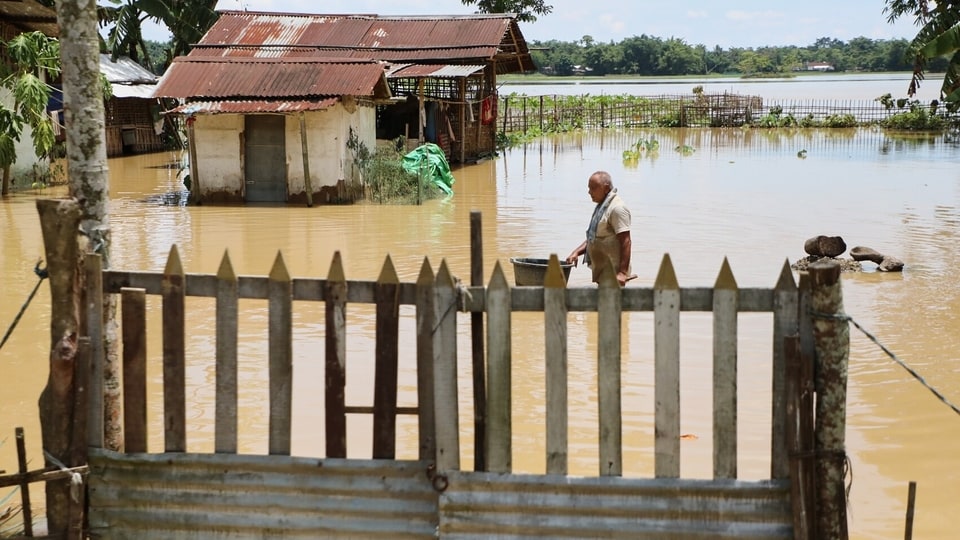
In Assam, prolonged inundation left animals weak, dehydrated and without usable grazing land. As the National Database for Emergency Management related, this monsoon alone claimed the lives of over 20,000 animals in India across 15 states. Out of which 80% was from Assam.
In Kerala, veterinary infrastructure itself was compromised while animals were shifted to roads and other higher areas for their safety. In Kerala’s Kottayam district, floodwaters had risen beyond the levels experienced in 2018. There was almost no dry space left to move animals to safety. Some cattle remained standing in water for six days or more; their feet had turned pale and waterlogged after days of constant immersion. During our field assessment, we observed cattle already severely weakened by the conditions. When our team returned with feed the following day, one of the animals had passed away. There was simply no safe place to take these animals.
These experiences point to an emerging imperative in India’s approach to animals in disasters.
The challenge today is no longer simply to make animals visible in disaster policy. India has already moved significantly in that direction. The National Disaster Management Plan, 2019, recognises farmed and domestic animals within disaster management. This year, the National Disaster Management Authority went further by releasing dedicated Animal-inclusive disaster risk reduction guidelines, creating a national framework for building disaster resilience in respect to the care of animals.
The next step is turning these provisions into preparedness that pays off when it counts.
Sivasagar district in Assam offers an instructive example. According to the Sivasagar flood contingency plan, in 2024 the floods affected 56,899 big animals, 33,379 small animals and 31,494 poultry in the district. The plan, issued in May this year, recognises animals throughout the preparedness and response system. It identifies farmed animals as vulnerable to floods, provides for safe locations at which to shelter animals, assigns responsibilities to the animal husbandry and veterinary department, and calls for veterinary teams, medicines, vaccines and fodder arrangements in anticipation of the monsoon season.
The plan also recognises the importance of early warning. It notes that flood forecasts are received through the state’s warning system and describes efforts to extend communication to the village level through local officials and village heads. It calls for vulnerable communities to be informed and evacuated to pre-identified safe locations when high-intensity flooding is expected.
This is exactly the kind of district-level architecture that animal-inclusive disaster risk reduction needs.
But the devastating floods that hit the people and animal of Sivasagar with such surprising force demonstrates why preparedness cannot end with the development of a plan.
Some people in communities affected by the Assam floods told us they had not experienced flooding of that magnitude for decades. When people have never seen water reach a certain level, even an accurate early warning may not immediately communicate how serious the situation could become. Households need to understand the warning, trust it, know where to go and recognise when it is no longer safe to wait.
This is where disaster plans must move beyond documents and come alive in the form of preparedness that communities can understand, practise and act upon. That is the core of community-based disaster risk reduction: preparedness must be built around people’s actual lives, capacities, constraints and priorities.
It has to be practical, affordable and connected to everyday livelihoods. It should build on existing local knowledge and capacities, while institutions provide the support communities cannot create on their own. This includes early-warning systems, safe evacuation spaces, animal shelters, emergency fodder arrangements and regular mock exercises.
Preparedness becomes meaningful when communities are not simply told what to do, but are involved in deciding what is realistic, practising so as to be ready for the worst and knowing with confidence that the systems around them will work when they need them.
- Build awareness of warning levels long before any warning becomes necessary: Early warning is only effective when communities know what different warning levels mean and what action they are expected to take. Regular awareness programmes, intelligible communication suited to the target communities and mock exercises are essential, particularly in places that have not experienced a major disaster in recent memory.
- Support community-based capacity building programs: Preparedness should build on existing community institutions. In Wayanad, Kerala we work with a women self-help group (Kudumbashree) where experiential learning with women from vulnerable, animal-owning households helps to identify relevant priorities. These include local risks, map hazards and resources, evacuation protocols, emergency kits and first aid, and the joining of existing local knowledge and experience to practical disaster preparedness for both people and animals. In a similar vein, we work with schools to build preparedness among children for themselves and their animals through experiential learning. This is the path from public policy to the real lives of people at the household and community level.
- Practice evacuation with animals, not without them: Our work and experience repeatedly show that families are reluctant to leave farmed and companion animals behind. For many households, a cow or buffalo is a major livelihood asset, a source of milk and income, as well as an animal with whom the family shares a deep emotional bond. Asking people to evacuate without answering the question, “What happens to my animals?” can undermine evacuation itself. Losing animals or being forced to watch them suffer or perish during and after a disaster can also cause significant emotional distress, exhaustion and trauma for families already coping with displacement and loss. Animal-inclusive preparedness is, therefore, also human-centered preparedness.
- Identify safe places before the flood: Communities need to know which animals can be moved, which routes are safe and where elevated ground or temporary shelters are available. Human relief camps should, where feasible, have evacuation shelters for animals nearby. Building shelters or facilitated elevated areas at a distance or away from human relief camps makes it practically impossible for people to take care of their animals on a daily basis.
- Prepare for events beyond past experience: Preparedness cannot be based only on the last flood. Recent events in Assam and Nepal demonstrate how hazards can exceed a community’s prior experience or unfold in unexpected ways. Nepal’s recent flash flood, triggered by a collapse of glacier, rock and sediment, for example, caused extremely rapid downstream flooding. Such events underline the need for risk assessments, warnings and evacuation plans that consider plausible extremes, and uncertainties, not only historical experience.
The unfolding situation across the Himalayan region also underlines a larger reality: Disaster preparedness and climate action need to move together. As the climate crisis and environmental pressures reshape risk, communities need stronger preparedness for emerging extremes alongside sustained efforts to reduce future climate-related risks.
- Turn district plans into operational systems: The new national Animal-inclusive Disaster Risk Reduction guidelines provide an important foundation. States and districts can work towards its implementation by developing practical, scalable, and field-ready systems that protect animals, strengthen community resilience, safeguard livelihoods, reduce public health risks, and improve disaster preparedness, response, and recovery.
- Animal rescue and response capacity: Response preparedness should include trained personnel, appropriate equipment, and safe protocols for rescuing both large and small animals, along with scientifically sound carcass disposal. Governments can strengthen this capacity by working with animal welfare organisations that already have field expertise in rescue, handling, and emergency animal care
The future of animal-related disaster response will not lie in the creation of a separate disaster-management system for animals. It will centre on efforts strengthen the existing disaster response systems in place across the country by recognising how closely human and animal resilience are connected, and integrating animals and their needs into the broader frameworks and strategies that underlie a good plan.
It certainly helps that preparedness makes economic sense. UNDRR’s 2025 Global Assessment Report estimates that every $1 invested in disaster risk reduction generates an average return of around $15 in avoided future recovery costs.
That said, it’s even more important that preparedness makes social, cultural and practical sense to those who face and must contend with the dangers of disaster. Disaster plans become truly operational when the people they are designed to protect know what to do when the warning arrives, to safeguard the lives of all those around them, including the animals they will not voluntarily leave behind.
(The views expressed are personal)
This article is authored by Praveen Suresh, manager, disaster response, Humane World for Animals, India.


