
 E-Paper



The missing link in India's city gas push
This article is authored by Vikas Singh, professor, IIM Nagpur and visiting faculty, Indian School of Business (ISB) and Yajna Prakash, partner, Acclime India.

 Prefer HTon Google


India's city gas distribution (CGD) network is one of the country's quieter infrastructure success stories--and one of its more urgent unfinished ones. With 307 CGD areas covering most of mainland India, 1.64 crore households are already connected to PNG, supported by a growing network of commercial and industrial users. Backed by 3.03 lakh plus inch-kilometres of CGD pipelines, PNG delivers reliable, safe and convenient energy to homes, businesses and industries.
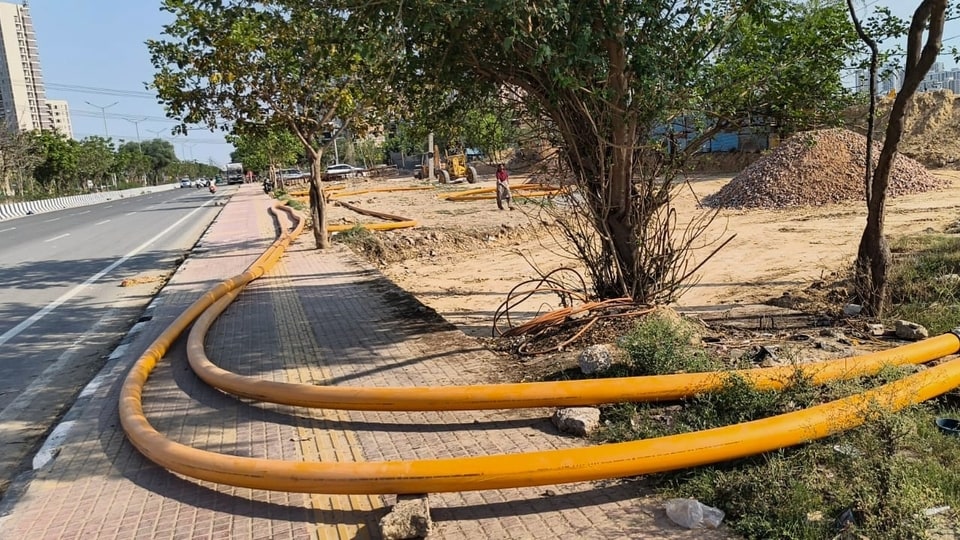
Moreover, roughly 44 active CGD companies are racing toward the Petroleum and Natural Gas Regulatory Board's (PNGRB) Minimum Work Programme target of 126 million domestic connections and 18,000-plus CNG stations by 2034.
The trouble is the pace. With 1.64 crore domestic PNG connections, India is still a long way from the PNGRB's target of 12.63 crore by 2034. Recognising this gap, the government has launched a mission-mode urban expansion drive to add 50 lakh new PNG connections. At the same time, 93 Geographical Areas still have no domestic PNG connections. India is trying to build a decade's worth of gas infrastructure in a fraction of the time but using materials and methods that have barely changed in 30 years.
The default material for last-mile PNG connections in India remains galvanized iron (GI) pipe. It is rigid, threaded, welded joint by joint, and installed largely by hand. Every bend needs a fitting, every fitting is a potential leak point, and every installation eats into the limited bandwidth of CGD companies' internal teams. GI's rigidity is also a poor match for the geography it must survive.
Indian gas infrastructure is up against several challenges. Landslides — more than 80,000 of them between 1998 and 2022, concentrated in the Himalayan foothills and the Western Ghats affect 12–13% of the country's land area. Floods hit 12.5% of India's land mass annually, submerging 7.5 million hectares and damaging around 1.2 million homes in an average year. Nearly 60% of India's landmass sits in earthquake-prone zones, with the country recording 20–30 quakes of magnitude 5.0 or higher every year across the Himalayas, the Northeast and the Deccan Plateau. GI pipes are the wrong technology for a country with such a high-risk profile: Tremors crack it, floodwater embrittles its joints, and each threaded connection is another place for a fire hazard to start.
Corrugated Stainless Steel Tubing (CSST) has spent more than three decades answering this problem in other markets. Made from 300-series stainless steel (Type 304, 316, or 321) and sheathed in a durable polyethylene jacket, CSST comes in continuous coils of up to 75 metres, which means a single run can cover long distances with a fraction of the joints a GI installation would need. It can be bent by hand around beams, corners and risers, uses mechanical fittings instead of threading or welding, and is built to flex — not fracture — under tremors, subsidence or thermal stress.
The technology's origin is itself a case study in disaster-driven engineering. Japan developed CSST in the 1980s specifically to survive its earthquakes, and the payoff was huge. Post-quake gas outages that once took weeks to resolve dropped to hours, without slowing the country's continued expansion of underground city gas networks.
CSST's flexible coils also made it practical for high-density retrofits in South Korea's apartment towers, and for threading gas lines through the UK's protected historic buildings without invasive structural work. It is now installed in more than 30 countries across North America, Europe, Asia and West Asia and China's expanding urban residential sector.
What makes CSST deployable at scale isn't the tubing itself — it's the standards architecture built around it, refined over three decades of real-world failures and fixes. Roughly 13 international codes now govern its design, testing and installation, and each one fixes a vulnerability that GI piping simply leaves open.
CSA LC1 and ANSI LC1 certify CSST for pressures up to 25 bar with high crush resistance — relevant for India's Zone IV–V seismic areas — and, critically, mandate arc-resistant jacketing and full electrical bonding. It came into being after a spate of U.S. lightning-related CSST failures in 2009, where arc strikes of up to 50,000 amps punched through unprotected stainless walls. The fix — yellow polymer sheathing and mandatory bonding — cut those failures sharply, and it matters directly for India. The National Crime Records Bureau recorded 2,558 lightning deaths in 2023, the highest toll of any country.
Europe's BS EN 15266;2007 mandates corrosion-resistant alloys rated for a 50-year service life, suited to humid coastal cities like Mumbai and Chennai. Similarly, ASTM E119 and UL 263 fire-rated assembly listings test flame spread and require CSST walls to withstand fires above 1,000°F for one to four hours. All these are meaningful safeguards as India's urbanisation pushes past 50% by 2030 and the density of high-rise buildings increases. NFPA 54 and 58 add mandatory accessible shutoff valves and seismic-rated fittings, so gas flow can be isolated within seconds during a quake or lightning strike. ISO 10380 rounds out the framework as the international benchmark for corrugated metal hose performance. All these standards anticipate compound failures — a quake followed by a gas leak followed by a fire. The pipes are designed to interrupt that chain, not just survive the first shock.
There's also a forward-looking argument for adopting CSST now. India's gas strategy increasingly includes blending hydrogen into the PNG network to achieve the 2070 net-zero target. Hydrogen is notoriously prone to embrittling rigid metal pipe over time, while CSST's features make it better positioned to handle.
As the PNGRB pushes CGD companies toward 120 million connections by 2030, the more consequential question may not be how fast the network expands, but whether the pipe going into the ground is built to the same standards the rest of the world adopted a generation ago.
(The views expressed are personal)
This article is authored by Vikas Singh, professor, IIM Nagpur and visiting faculty, Indian School of Business (ISB) and Yajna Prakash, partner, Acclime India.


