
 E-Paper


Geography of opportunity: Why Chennai–Colombo deserves a place on India’s business map
This article is authored by Thulci Aluwihare, deputy managing director, CHEC Port City Colombo (Pvt) Ltd.

 Prefer HTon Google


A Chennai-based business executive can leave home in the morning, take a direct flight to Colombo, attend a meeting by late morning and be back in Chennai the same evening. The same trip to Delhi covers nearly three times the air distance.
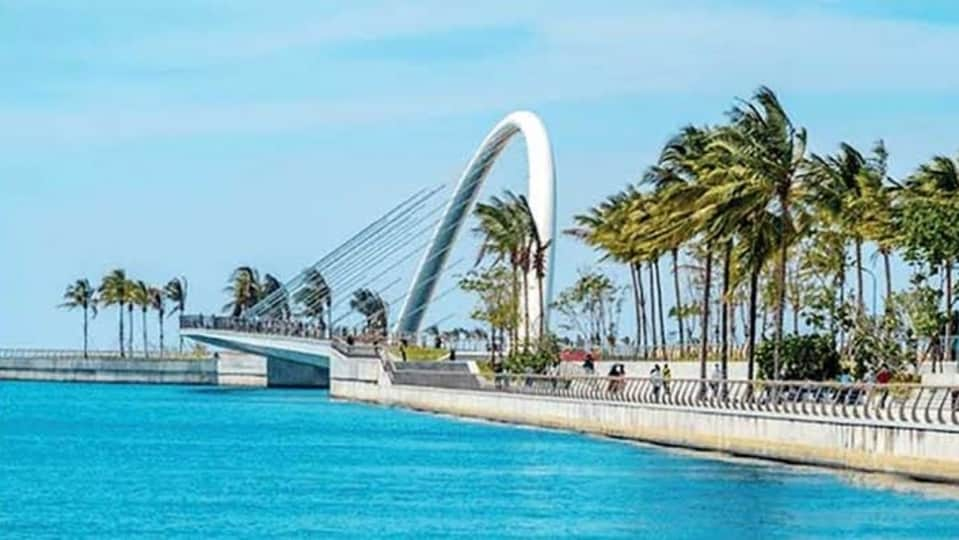
On a map, this may appear to be a minor geographical detail. In business, however, proximity shapes perception, relationships and investment decisions. For companies and investors in South India, Colombo is closer than India’s own capital. Yet India’s engagement with Sri Lanka is often viewed through a Delhi–Colombo lens: Strategic, diplomatic and national in character. Viewed from Chennai, Colombo is less about foreign policy and more about commercial opportunity.
A recent Pew Research survey offers an interesting point. Across 36 countries surveyed, Sri Lanka recorded the highest favourable view of India, with 79% of respondents expressing a positive opinion of the country, up from 65% in 2024. The finding is striking, not simply as a measure of public sentiment, but because it reflects a relationship that is increasingly acquiring economic depth.
The question is whether India turns this proximity into a business advantage, and whether Chennai-Colombo becomes a bigger part of the country’s next phase of regional engagement.
Trade, investment and tourism have already established a strong foundation. Bilateral merchandise trade reached about $7.1 billion in FY2025–26, while cumulative Indian investment in Sri Lanka has crossed $2.8 billion, spanning across energy, hospitality, manufacturing, infrastructure and financial services. India remains Sri Lanka’s largest source market for tourist arrivals, while growing direct air connectivity from cities such as Chennai, Bengaluru, Kochi, Madurai, Hyderabad and Mumbai has made Colombo increasingly accessible to Indian travellers.
The next phase of the relationship, however, may be defined less by goods crossing borders and more by capabilities moving across them. Increasingly, companies are looking beyond traditional export markets and exploring locations for research and development, product development, business continuity and specialised support functions. For South Indian companies, Colombo is emerging as a natural extension of this search.
The clearest example is the emergence of Nano GCCs. Unlike traditional Global Capability Centres employing thousands, these are specialised teams of a few dozen highly skilled professionals working in AI, product development, R&D, data analytics, treasury and cybersecurity. They compete on capability rather than headcount, which makes them well suited to a market of Sri Lanka’s scale and to companies that want a second location rather than a second head office. Proximity matters to these teams, and India and Sri Lanka share a single time zone, which is an added advantage.
Geographic proximity creates the opportunity; regulatory certainty determines whether that opportunity is realised. Sri Lanka’s Special Economic Zones (SEZs) like Port City Colombo (PCC) are already building the regulatory backbone for this – transparent rules, multi-currency banking, green channel visas up to 10 years, faster approvals and investor protection. A shared English-language business environment and a common law legal jurisdiction would encourage Indian businesses to seamlessly integrate to the SEZ framework, reducing much of the friction that typically accompanies a cross border, somewhat unfamiliar jurisdiction.
India’s economic expansion is producing a new class of outward-looking businesses - technology firms, real estate developers, regional distribution centres, family-owned enterprises, and high-net-worth individuals (HNWIs), are all scouting opportunities across the region. For many of them, the next market is much closer to home.
India’s next phase of economic expansion will not be driven solely by its major metropolitan centres. It will also be shaped by how effectively those cities connect with neighbouring economies. Converting that potential into a durable business corridor will require stronger institutional links, easier movement of people and capital, and a progressive regulatory environment that inspires confidence.
If those fundamentals are put in place, Chennai – Colombo will become one of South Asia’s most practical economic corridors.
(The views expressed are personal)
This article is authored by Thulci Aluwihare, deputy managing director, CHEC Port City Colombo (Pvt) Ltd.


