
 E-Paper



Reimagining India-Africa economic ties
This article is authored by Samir Bhattacharya, Fellow, Observer Research Foundation, New Delhi.

 Prefer HTon Google


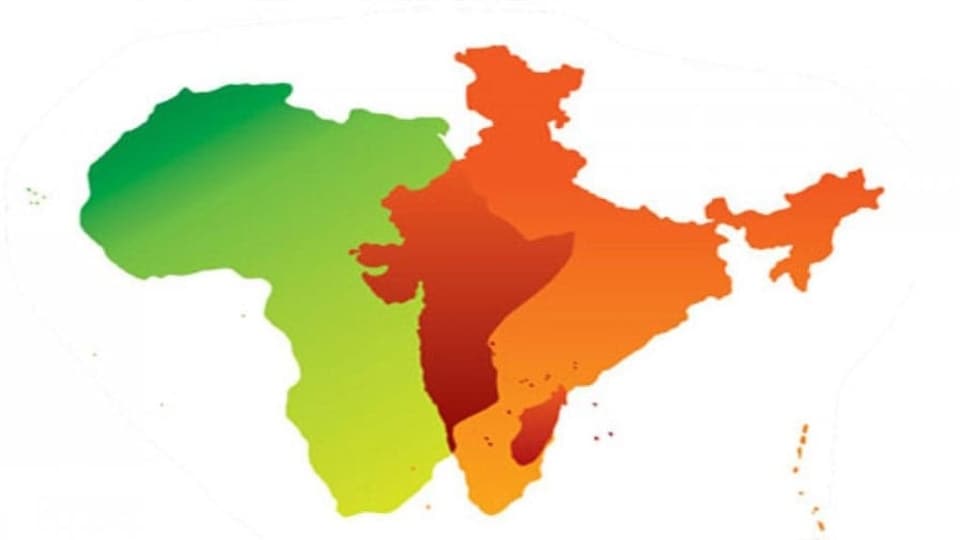
The growing economic relationship between India and Africa is entering a new phase. It is no longer defined solely by trade, development assistance or Indian companies selling products into African markets. Increasingly, Indian and African businesses are becoming partners as they are jointly building factories, infrastructure, energy systems and regional value chains. This shift reflects a deeper reality where India’s growth story and Africa’s economic transformation are becoming increasingly intertwined.
A recent example is the partnership between Africa’s richest businessman, Aliko Dangote, and India’s Engineers India Ltd (EIL). The Indian government-owned engineering company has signed a $450 million deal with Dangote to oversee the construction of a planned $16 billion refinery and petrochemical complex in Lamu, Kenya. The greenfield facility is expected to have a processing capacity of 700,000 barrels of crude oil per day. When completed, it would significantly strengthen fuel production in East Africa, reduce dependence on imported refined petroleum and contribute to regional energy security.
The project also builds on an existing India-Africa commercial relationship. EIL previously worked as a consultant on the Dangote Petroleum Refinery and Petrochemicals complex at the Lekki Free Zone in Lagos and is involved in its expansion. The Lekki refinery, one of the world's largest single-train refineries, produces gasoline, diesel, jet fuel and polypropylene, while its planned expansion will raise capacity to 1.4 million barrels per day.
The significance of these projects goes beyond the companies involved. They illustrate how Africa's industrial ambitions are creating opportunities for Indian expertise and capital, while African economic expansion is creating new opportunities for Indian businesses. Africa's industrialisation could, therefore, become one of India's most important economic opportunities in the coming decades. A more industrialised and resilient Africa means larger consumer markets, new investment destinations, diversified supply chains and greater demand for technology and services. For Africa, deeper engagement with India can provide access to industrial capabilities, affordable technologies, engineering expertise and investment.
There are many other examples demonstrating how this relationship is evolving. In September 2025, Tata Advanced Systems Limited opened a plant in Morocco to manufacture armoured combat vehicles, supporting the country's efforts to develop a domestic defence-industrial base. Earlier this year, South Africa's Tsiko Africa Logistics and Barberry Holdings awarded India's Texmaco Rail & Engineering a contract to supply 30 diesel locomotives and more than 2,235 wagons of different types. Such projects demonstrate a gradual movement away from a simple buyer-seller relationship towards industrial partnerships.
There projects provide useful examples of how African capital can be mobilised to build domestic productive capacity. If Africa invests in sectors like cement, sugar, fertiliser, logistics, power and petroleum refining it would reduce import dependence and retain greater value within the continent. The Dangote refinery, for example, can alter the familiar pattern in which African countries export crude resources while importing refined petroleum products, helping Africa move up the value chain.
Indian companies are essential in this transformation. India possesses significant capabilities in pharmaceuticals, automobiles, engineering, fertilisers, renewable energy, agricultural processing, telecommunications, logistics and financial services. Rather than supplying finished products exclusively from India, Indian companies can increasingly establish manufacturing and processing facilities in Africa.
The benefits would be mutual. African economies would gain employment, technology, skills and local value addition. Indian companies would gain proximity to consumers and access to expanding regional markets, particularly as the African Continental Free Trade Area gradually strengthens intra-African trade. Most importantly, Indian businesses would become participants in Africa's growth rather than merely suppliers to African markets.
Industrialisation, however, cannot happen without infrastructure. Roads, railways, ports, electricity and digital connectivity will determine whether African producers can connect efficiently with domestic and international markets. India's experience in developing infrastructure under resource constraints gives its companies opportunities to participate in Africa's infrastructure transformation. However, India's role should move beyond constructing individual projects. The larger opportunity lies in infrastructure-led economic development, where transport, energy, digital networks and industrial clusters reinforce one another.
Financing remains a major constraint. High borrowing costs, debt pressures and limited fiscal space make large infrastructure and industrial projects difficult across many African economies. India can contribute by broadening the financing ecosystem. Indian banks, financial institutions, development-finance agencies and private investors could work with African financial institutions to develop financing models for manufacturing, infrastructure, SMEs and export-oriented industries. This would complement traditional Indian Lines of Credit by bringing greater private-sector participation, investment and risk-sharing into the relationship.
India's relevance to Africa, however, extends beyond finance and infrastructure. India has itself confronted many of the challenges that African economies continue to face such as infrastructure deficits, large informal economies, agricultural dependence, limited access to finance and the challenge of delivering affordable services to enormous populations.
India’s experiences with digital payments, financial inclusion, affordable pharmaceuticals, agricultural technology, renewable energy and low-cost engineering can provide useful reference points. But these experiences should not be presented as templates that African countries must replicate. Africa's economies are diverse, and African governments and institutions are already developing their own solutions.
The more productive approach is co-creation. India can share its experience in areas such as Digital Public Infrastructure, while African policymakers, entrepreneurs and developers adapt technologies to local realities. The same principle can apply to healthcare, agriculture, manufacturing, education and financial services. The objective should be to build African capabilities, not create new forms of technological or economic dependency.
Ultimately, India's economic interests and Africa's development ambitions are not competing objectives. They can reinforce one another. A more industrialised Africa creates larger markets for Indian companies. Better infrastructure opens opportunities for Indian investors. Greater African value addition can create more diversified and resilient supply chains for India. A stronger African financial ecosystem can generate new investment opportunities, while a more skilled African workforce can create partnerships in technology, services and innovation.
The next phase of India-Africa relations should therefore move beyond a conventional trade partnership. It should become a partnership in which India's growth supports Africa's industrialisation, and Africa's transformation creates new engines for India's own growth. That is the foundation of a genuinely interdependent India-Africa economic partnership.
(The views expressed are personal)
This article is authored by Samir Bhattacharya, Fellow, Observer Research Foundation, New Delhi.


