E-Paper



The disorder that hides in ordinary, everyday tiredness
Most Indians with sleep apnoea are never diagnosed. Forty years after the mask, three drugs now target the specific reason the airway closes.

 Prefer HTon Google


After a certain age, snoring gets normalised in most households, and the exhaustion that comes with it goes unrecognised, put down to work or age. Sleep physicians in Delhi describe patients who reach a clinic for the first time three to six years after symptoms begin, pushed often by the person who sleeps beside them and has noticed the pauses in breathing, rather than the noise.

"They try adjusting sleep habits, cutting caffeine, buying a new mattress — everything except getting tested," said Dr Akshay Budhraja, Aakash Healthcare.
Many others turn up for something else altogether — blood pressure that will not come down on medication, diabetes that will not settle — and the apnoea surfaces while the history is being taken. "Once we treat the sleep disorder, those other conditions frequently improve too," said Dr Praveen Gupta, Marengo Asia hospitals.
How many Indians obstructive sleep apnoea affects is not known. Published estimates run from about one in twenty adults to close to one in three, and the gap is mostly method: studies that put every participant through a full overnight sleep test find far more of it than studies that screen with a questionnaire first and test only those who score positive. The largest Indian study to test everyone, run at AIIMS Bhopal on 958 adults and published in Sleep Medicine in 2025, found moderate-to-severe apnoea in close to 30%. On any of the estimates India has one of the largest affected populations in the world, and on all of them most cases go undiagnosed.
Where the airway gives way
The throat is the only stretch of the airway with nothing rigid holding it open. The nose has bone, the windpipe has rings of cartilage, and between them lies a soft tube held open by about twenty muscles and by a reflex that pulls the tongue forward whenever the airway begins to narrow.
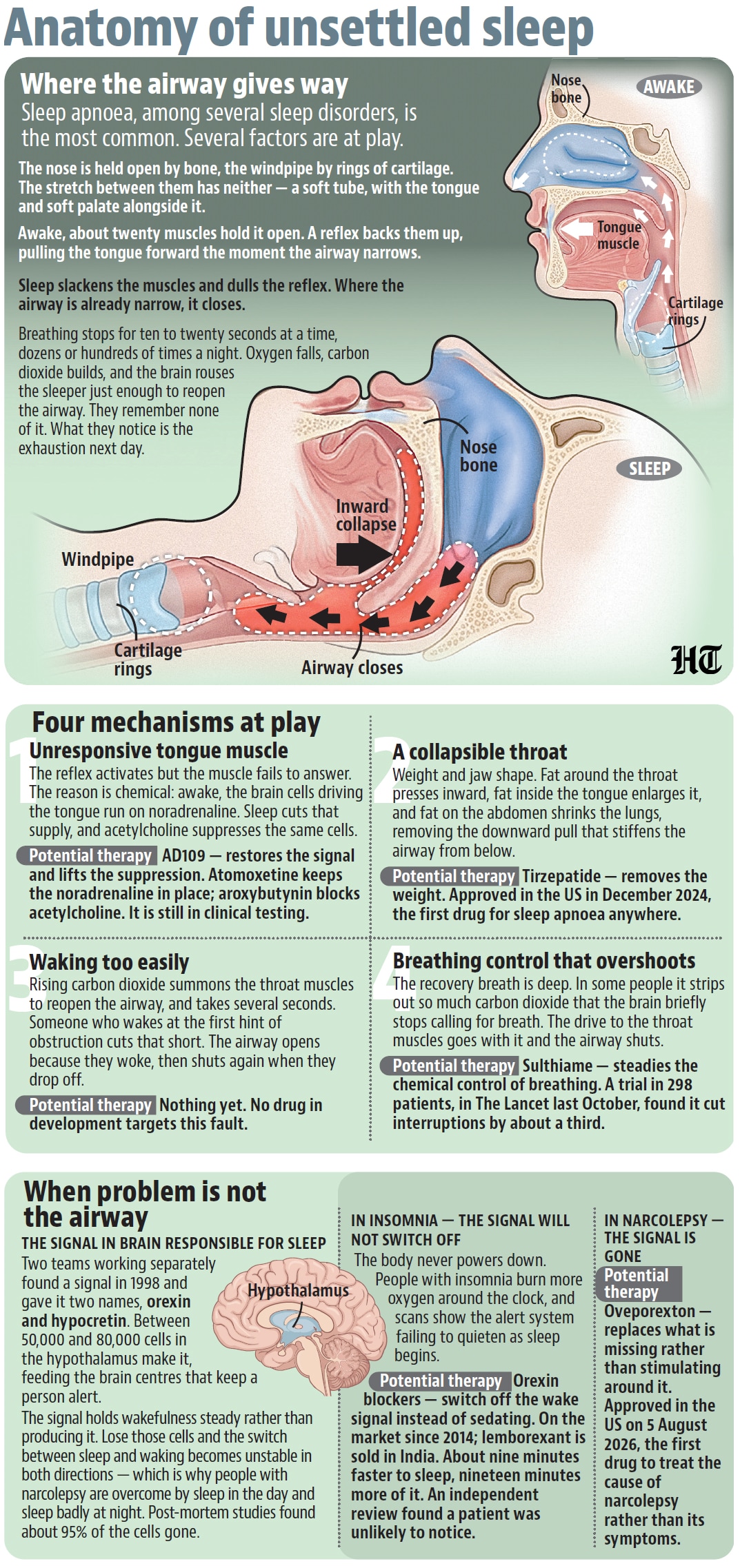
The moment sleep begins, the muscles slacken and the reflex fades. In some people the tube closes. Breathing stops for ten or twenty seconds at a time, sometimes hundreds of times a night, and the sleeper surfaces just far enough to reopen the airway without remembering any of it.
For decades the condition was treated as a problem of anatomy — a throat too narrow, usually because of weight. Weight is still the biggest single driver. But overnight measurements in 75 patients by Danny Eckert and colleagues, published in the American Journal of Respiratory and Critical Care Medicine in 2013, separated four distinct ways an airway can fail, and only the first concerns the shape of the throat.
Breathing is governed by carbon dioxide. As it builds up in the blood, the brain calls for the next breath. In someone whose airway has just closed, that same rising carbon dioxide is what summons the throat muscles to prise it open, and it takes several seconds to work.
The first problem is a throat so collapsible that no amount of muscle will hold it. The second is a tongue muscle that fails to respond when a reflex to move out of the airway triggers it. The third is the opposite of what one would expect: waking too easily. A person who surfaces at the first hint of obstruction cuts the process short. The airway opens because they woke, not because the muscles were recruited, and when they drop back to sleep it closes again. The fourth is an overcorrection. The recovery breath after an obstruction is a deep one, and in some people, it is so deep that it strips out enough carbon dioxide for the brain to briefly stop calling for breath at all. The drive to the throat muscles goes with it, and the airway shuts again.
In 56% of Eckert's patients the dominant fault was one of the last three, and most had more than one. Nothing in a pill will widen a narrow throat. A sluggish muscle, a hair-trigger waking and an overshooting reflex are all chemistry.
Indian clinics see both kinds of patient. Budhraja estimates a quarter to 30% of his apnoea patients are not overweight; Gupta puts it at about 20%. "I have seen plenty of lean patients with severe apnoea purely from structural issues," Budhraja said. Dr Rajesh Bhardwaj, MedFirst ENT Centre, uses drug-induced sleep endoscopy in selected patients — sedating them and observing directly where the airway gives way — before planning treatment.
Forty years of one answer
The standing treatment has been CPAP, or continuous positive airway pressure: a mask delivering pressurised air that splints the airway open through the night. It works, and patients stop using it. Budhraja says 70 to 75% of his moderate-to-severe patients start on it and 50 to 60% are still using it consistently a year later; Gupta's figures are lower at both ends, about half starting and roughly 40% persisting. Both name the same reasons for dropout — mask discomfort, dryness, claustrophobia — and both say the first few weeks decide it.
The alternatives are partial. Mandibular advancement devices, fitted by dentists trained in sleep medicine, hold the lower jaw forward and are better tolerated than CPAP but weaker in severe disease. Surgery works where there is a specific obstruction to remove; Budhraja and Gupta both put meaningful improvement after uvulopalatopharyngoplasty at 40 to 45%, and both note it rarely cures severe apnoea outright.
The drugs, and which fault each treats
In December 2024, the US Food and Drug Administration approved tirzepatide for sleep apnoea, the first drug approved for the condition anywhere. It is the diabetes and weight-loss injection from the GLP-1 family, sold in India as Mounjaro. In two trials across 469 patients over 52 weeks, reported in the New England Journal of Medicine, breathing interruptions fell from about 50 an hour to 25.
It works on the first fault. Fat acts on the airway in three separate ways: it presses inward on the throat from outside, it enlarges the tongue from within, and on the abdomen it reduces lung volume, which slackens the downward pull that keeps the airway stiff. Taking weight off reverses all three. It cannot alter a small jaw or enlarged tonsils, which is why the fifth to a third of patients who were never overweight see no benefit from it, and why clinicians describe it as an adjunct rather than a substitute. "It is a helpful adjunct for the right patient, not a standalone fix," Budhraja said. Neither he nor Gupta prescribes anything off-label for the condition.
Two drugs behind it target the problems that are unrelated to weight, and both remain in testing. AD109 pairs atomoxetine, prescribed for attention deficit disorder, with aroxybutynin, a bladder drug; the US decision is due on February 28, 2027. While a person is awake, the brainstem cells driving the tongue are supplied with noradrenaline. Sleep cuts the supply, and acetylcholine moves in to suppress the same cells, most heavily during dream sleep. Atomoxetine keeps noradrenaline at the synapse; aroxybutynin blocks the receptors acetylcholine acts through. In early trials neither did much alone.
Sulthiame, an epilepsy drug used in Europe since the 1960s, steadies the chemical control of breathing and treats the fourth issue. A phase 2 trial in 298 patients, published in The Lancet in October 2025, cut interruptions by about a third at the middle dose.
No therapy in development targets the third problem.
When the problem is the brain
About a fifth of patients have insomnia and apnoea together. Budhraja and Gupta independently put the overlap at around 20%, and Gupta said untreated apnoea can worsen insomnia while insomnia can mask or delay an apnoea diagnosis. "Treating one without addressing the other often leaves patients frustrated," Budhraja said.
Insomnia presents with no lesion and there are no tests to run. What clinicians treat is usually something underneath it — anxiety, depression, caffeine and alcohol habits, restless legs, reflux, or undiagnosed apnoea. Gupta describes the presentation as “racing thoughts, clock-watching, dread of another bad night.”
The one piece of hard mechanism came in 1998, when two teams working separately found the same chemical and gave it two names, orexin and hypocretin. Between 50,000 and 80,000 cells in the hypothalamus produce it, and it holds wakefulness steady rather than generating it. People with narcolepsy have lost almost all of those cells, which is why they are overcome by sleep in the day and sleep badly at night.
A class of sleeping pills that blocks orexin reached the market in 2014, switching off the wake signal instead of sedating the brain. Lemborexant, one of them, is sold in India. It gets people to sleep about nine minutes faster and adds about nineteen minutes to the night; an independent review in Canadian Family Physician with no drug-company funding concluded a patient was unlikely to notice. The same system run the other way produced oveporexton, approved in the US on 5 August 2026 for narcolepsy type 1 — the first drug to treat the cause of the condition rather than its symptoms.
Guidelines worldwide put cognitive behavioural therapy for insomnia ahead of any drug. In a meta-analysis of 20 randomised trials published in the Annals of Internal Medicine, it removed about 26 minutes of lying awake while total sleep time moved by under eight minutes and not significantly. Budhraja and Gupta both recommend it, and neither can reliably get patients into it — Budhraja because trained therapists are scarce, Gupta because "waiting lists are long, and not everyone can afford private sessions". Both fall back on app-based programmes.
The yardstick
There is a problem underneath all of these drugs: the measure they are judged by. A sleep study counts how many times an hour breathing stops or goes shallow, and that count decides who is diagnosed, who is called severe, and whether a drug has worked. It treats a brief dip and a full closure as the same event, and takes no account of how far the blood oxygen falls, which is the part that damages the heart. In AD109's trial the count improved while the fatigue score, the complaint patients actually walk in with, did not.
The awareness within Indian clinics is low. Tirzepatide is sold here for diabetes and weight management, not for apnoea. AD109 and sulthiame are still in trials. Of the orexin drugs, the insomnia one is on the Indian market; the narcolepsy drug is approved only in the US.
Until that changes, diagnosis depends on the condition being noticed at all, and the signs go unremarked for years because they are ordinary. Snoring with pauses in it — the pause being the part that matters, and almost always the part somebody else notices. Waking with a gasp, a dry mouth, a headache. Exhaustion that does not lift however long the night was. Falling asleep in the day without intending to. Blood pressure or blood sugar that will not come down however the medication is adjusted.
These are signs, not a diagnosis in themselves, but taken together they describe a mechanical problem rather than a lifestyle one — and the distinction is settled by a test, not by how tired someone feels.
"I always recommend a repeat sleep study after significant weight loss before declaring someone 'cured' and pulling them off treatment, because residual apnoea is more common than patients expect," Budhraja said.
Vital explains the science and the conversations at the frontier of healthcare and wellness. It isn't medical advice — what to do with it is a conversation for you and your doctor.