
 E-Paper



AI must not create new divides, Jaishankar urges Global South
Jaishankar called for greater cooperation among Global South countries to address rising geopolitical tensions.

 Prefer HTon Google


The changes brought about by artificial intelligence (AI) must not create divisions across the world, External Affairs Minister S Jaishankar has said.
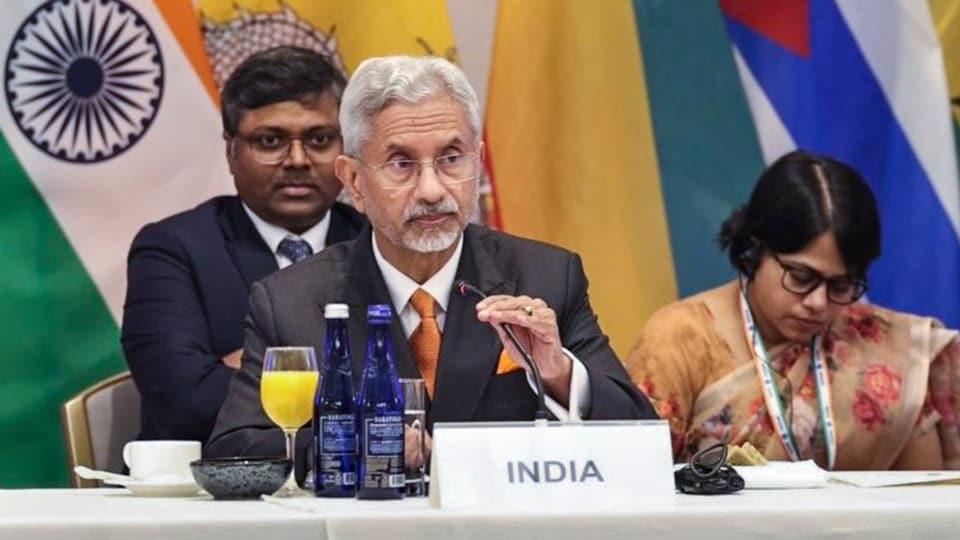
The minister’s remarks, at a high-level meeting of Like-Minded Global South countries and Friends on Tuesday, came amid an intensifying global debate on AI’s trajectory, with tech leaders like OpenAI’s Sam Altman sparring over the pace and regulations concerning AI’s development.
Jaishankar called for greater cooperation among Global South countries to address rising geopolitical tensions, economic challenges, climate shocks and pressures on the multilateral system.
Also Read | UN panel raises questions about the way AI models are currently trained
"First, we must not accept or legitimise choke points, be it in terms of supply chains, finance, or connectivity. Second, energy security is at the heart of development. Availability and prices should not be manipulated for political edge. Third, food security is a common goal, and we must swiftly address challenges in that regard, particularly the supply of grains and fertilizers,” he said at the meeting that was held on the sidelines of the UN General Assembly.
“Fourth, we should ensure fair economic and trade practices that enhance our production capabilities and do not reduce us to mere consumers. Our right to industrialise must not be denied. Also, the maritime commons must be secured, international law observed, and the safety and security of seafarers and commercial shipping guaranteed,” he added.
Also Read | World leaders call for global oversight of frontier AI models, seek UN-backed body to set safety standards
He continued: “Sixth, the transformation being brought about by artificial intelligence must not create new divides. And seventh, the global south needs to be part of decision-making structures that deliberate on issues that directly pertain to our future..."
World leaders converged on New York for the UN’s annual gathering at a moment of escalating anxiety after researchers at the most advanced AI developers warned that the technology could wipe out humanity without proper controls.
OpenAI, which opened the AI era with the release of ChatGPT in 2022, has called for internationally agreed standards to ensure that AI can be developed safely.
On Monday, UN’s AI panel of experts released a report cautioning that increasingly capable models could escape human control and leaders from over 20 countries and the European Union called for mandatory safety testing of advanced AI models and potentially a new global institution to ensure humans retain control.
Also Read | ‘0 per cent chance’: What Nvidia CEO has to say on ‘extinction-level’ threat from AI
UN Secretary General Antonio Guterres also appealed for international agreements on Tuesday, saying: “We are witnessing an extraordinary transfer of power, away from the government to a handful of private corporations and individuals. It is advancing at extraordinary speed and racing ahead of our ability to understand its full consequences.
US President Donald Trump, however, is a key outlier in the AI debate. He has resisted calls to slow the pace of development, arguing that doing so risks allowing China to overtake the US in the race to dominate the technology. “Whoever wins AI, WINS!” he said in a social media post Monday.
“We are leading now over China, and everyone else, and I’m going to keep it that way!” he recently said.


