E-Paper



As IMD marks 150th anniversary, calls grow for improved forecasts
India's home and agriculture ministries, along with other agencies, are calling for improved forecasts of extreme weather events as climate change impacts become more pronounced. The agencies highlighted the need for better predictions of heatwaves, lightning strikes, and glacial lake outburst floods, among other events. They stressed that extreme weather is one of the biggest challenges facing the country and that accurate and localized forecasts are necessary for farmers and disaster management. The India Meteorological Department also launched a National Framework of Climate Services to reduce losses from climate hazards.

 Prefer HTon Google


New Delhi: The home and agriculture ministries, the national disaster management authority, and other agencies need improved forecasts of extreme weather, particularly heat waves, lightning strikes and glacial lake outburst floods (GLOFs), as climate change impacts become more pronounced on India, heads of these agencies said on Monday.
Presenting their wish lists during a panel discussion on the occasion of a function marking to mark the beginning of the 150th year celebrations of the India Meteorological Department or IMD, the top bureaucrats in these ministries and agencies underlined that extreme weather is one of the biggest challenges facing the country, one that manifests itself in several ways.
For instance, last year’s monsoon was normal on the whole but spatially and temporally , it was far from that, according to Manoj Ahuja, secretary, agriculture. In 2022 the spring heat wave was so severe that the wheat crop was impacted. Without early forecasts, its very difficult for farmers to take investment decisions because 50% of the crop area is rain-fed, he added: “Our real challenge is to get information on a very localised level to farmers... an interdepartmental model on improved estimation of yield will be very useful.”
Any department dealing with such events and their fallout will need five things, said Kamal Kishore, a member of the National Disaster Management Authority: better forecasts of heatwaves; tracking the seasonality of heatwaves; understanding the urban heat island effect; monitoring glacial lakes; and better forecasts of rainfall in the wake of cyclones.
“We are a satisfied client of IMD but we want to be a delighted client,” he added.
“India is getting hotter and it will be one of the biggest disasters in coming decades.”
Ajay Kumar Bhalla, home secretary, said the ministry is in the process of amending the disaster management act 2005 to further improve the state’s capability in dealing with disasters. He added that while the number of deaths from disasters have reduced, the loss of property continues to be high.
IMD on Monday also launched a National Framework of Climate Services (NFCS) that seeks to reduce losses from climate hazards and extreme weather events. The framework seeks to build a platform for users of climate information and services that will strengthen the production, availability, delivery and application of science-based climate monitoring and prediction services for key sectors such as agriculture, health, energy and disaster management.
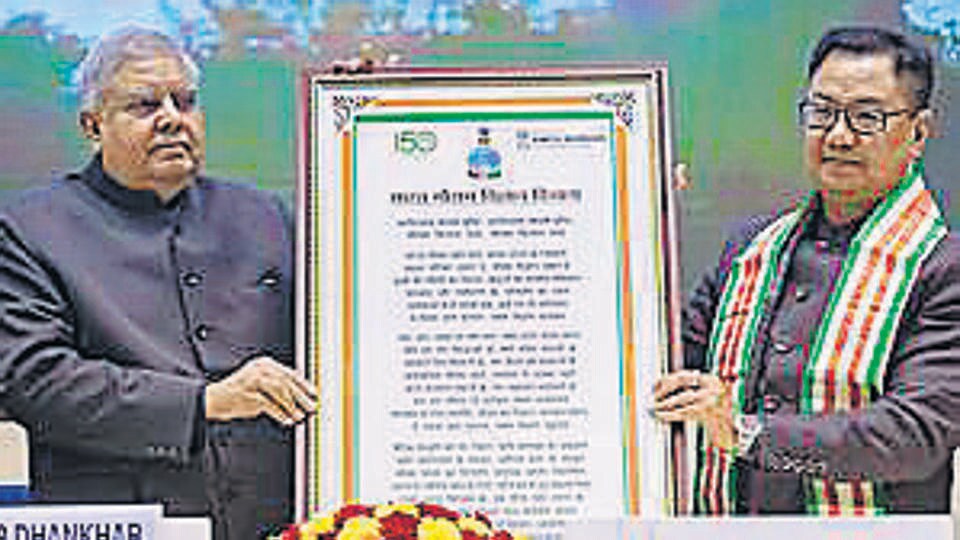
Vice President Jagdeep Dhankhar, who formally kicked off IMD’s yearlong celebrations of its 150th year at an event on Monday, also launched IMD’s mobile app, ‘Mausam’, that integrates all services offered by the weather office and unveiled new initiatives such as the Panchayat Mausam Seva and NFCS.
Dhankhar praised the weather office for a huge improvement in the quality of its predictions, saying IMD’s impact transcended mere weather forecasts and that the agency has protected national interests and helped shield citizens from the wrath of nature.
IMD has been through several phases of evolution since January 15, 1875, M Mohapatra, director general, IMD said on Monday. From providing forecast services for ports in 1865, it started providing ocean forecasts in 1898, and flood warnings in 1966. “IMD however continues to face challenges in forecasting cloudbursts, lightning events and localised extreme weather events,” he added.
The climate crisis poses a huge risk for India, said Kiren Rijiju, the minister for earth sciences. “It is visible in the form of melting of ice and glaciers in the polar region as well as the great hill ranges like the Himalayas. There is sea level rise and increase in frequency and severity of extreme weather events. Climate change is impacting the socio-economic and political life. India faces great risk from climate change. The poor and developing countries are suffering more. We have to become more resilient.”
Rijiju pointed out that IMD has significantly improved its weather monitoring infrastructure. The number of doppler radars have increased from 15 in 2014 to 39 last year, with 25 more to be added in the next two to three years; and the number of rainfall monitoring stations has increased from 3945 in 2014 to 6095.
“The accuracy of our forecasts for different severe weather events also increased by 40% in the past five years,” Rijiju added.
India has some of the oldest meteorological observatories of the world. The instrumental era of science and meteorology in India commenced with the establishment of the first Meteorological and Astronomical Observatory in Madras in 1793. While the first war of independence was being fought by the Indians , a group of Scientists in Asiatic Society of Bengal was working to establish a national meteorological committee for standardising instruments, exchanging data and utilising data for cyclone and flood disaster management and finding out the relationship between the diseases and weather in India. This was followed by the formation of a sanitation committee in 1860 and finally, the meteorological committee at the provincial level . But the Asiatic society of Bengal again reiterated the need of National Meteorological Committee , pointing to the limitations of provincial committees. Finally, Governor General Council agreed to form a national committee, which eventually became IMD.
The India Meteorological Department was born in 1875 with HF Blanford as Meteorological Reporter.