E-Paper



Bihar SIR: Key takeaways from draft electoral roll after ECI’s revision
The ECI attributes 2.2 million deletions to deaths, 3.6 million deletions to permanently shifted/absent and another 0.7 million voters to already enrolled.

 Prefer HTon Google


New Delhi : The Election Commission of India (ECI) released the draft electoral roll for Bihar after its Special Intensive Revision (SIR) on Friday. The draft electoral roll, according to HT’s calculations on data sourced from ECI, has 72.4 million electors. This number is the same as what was released by ECI on July 27 (no detailed break-up was given then) and 4.9 million or 6.3% less than the number of electors in the 2024 Lok Sabha elections, the latest period for which we have elector count for the state.
To be sure, an ECI press release issued on Friday says that there can still be additions and deletions to this draft roll and the final count before the assembly elections could vary. Moreover, ECI’s own status report on the exercise published on August 1 made these comparisons with respect to the draft roll published on June 24, when there were 78.9 million electors in the state. However, since this number was not disaggregated beyond district level, HT has used the 2024 Lok Sabha numbers for the analysis of the numbers released on Friday to do an assembly constituency (AC) level analysis. Here is what the numbers suggest.
There is a wide variation in AC-wise change in number of electors
Bihar has 243 ACs across 38 districts. The AC with the highest deletion between the 2024 elector count and the SIR draft roll is Gopalganj which has seen 62,269 or 18% of its electors deleted. The AC with the lowest deletion is Dhaka in Purvi Champaran district, which has seen just 2,083 or 0.63% of its electors deleted. At the district-level, Gopalganj has seen the highest deletion while Sheikhpura has seen the lowest deletion in percentage terms. In absolute terms, it is Patna and Sheikhpura which have seen the highest and lowest number of deletions. Absolute changes in the number of electors is misleading because it can be higher for a district with more electors. Patna district has the highest number of electors in the state. To be sure, a lot of districts show a large variation in change in voter count across ACs. (See map)
If one were to classify Bihar’s 243 ACs into 203 General, 38 Scheduled Caste (SC) reserved and two Scheduled Tribe (ST) reserve ACs, the aggregate deletion in these groups is 6.4%, 5.9% and 5%.
Is the change in voter count a result of deletion of migrant voters?

The ECI press release attributes 2.2 million deletions to deaths, 3.6 million deletions to permanently shifted/absent and another 0.7 million voters to already enrolled (elsewhere). One proxy which can be used to answer whether migration out of the state is the largest driver of change in elector counts across ACs is to check for a correlation between 2024 voter turnout and deletion in number of voters at the AC level. This is based on the premise that ACs with a larger share of migrant but absentee voters would have had lower turnouts in the past. A basic correlation check does not support this theory as the correlation between share of voters deleted and AC-wise turnout is very weak.
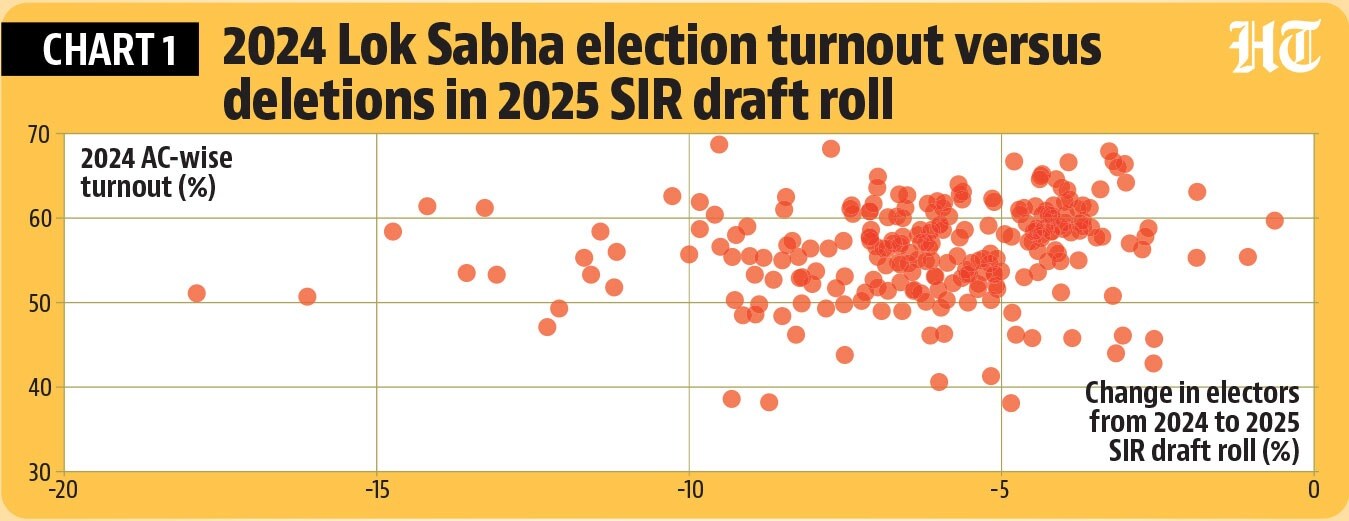
(See Chart 1)
Are deletions a function of alliance-wise performance in 2020 elections?
One of the theories doing the rounds has been that the SIR could lead to large scale deletion of Opposition voters in the state. A comparison of AC-wise deletions with alliance-wise victories in 2020 elections shows that this is unlikely to be true. The National Democratic Alliance (NDA) won 125 out of the 243 ACs in the state. The total voter deletion in these ACs is 6.4% which is somewhat more than the overall deletion of 6.1% in the 115 ACs won by the Mahagathbandhan (MGB) in 2020. One could use the 2024 results for this analysis too but the MGB or INDIA alliance won only 68 ACs in 2024. The NDA had also won a larger number of ACs in the ACs with the top 25% and top 50% of deletions, while the MGB had won a greater share of ACs in the ACs with the bottom 50% of deletions between 2024 and the SIR draft roll. To be sure, these comparisons should be read with caution, because it is impossible to connect the voters who have been deleted from the rolls to which party they would have voted for, if they voted at all (more on this later).
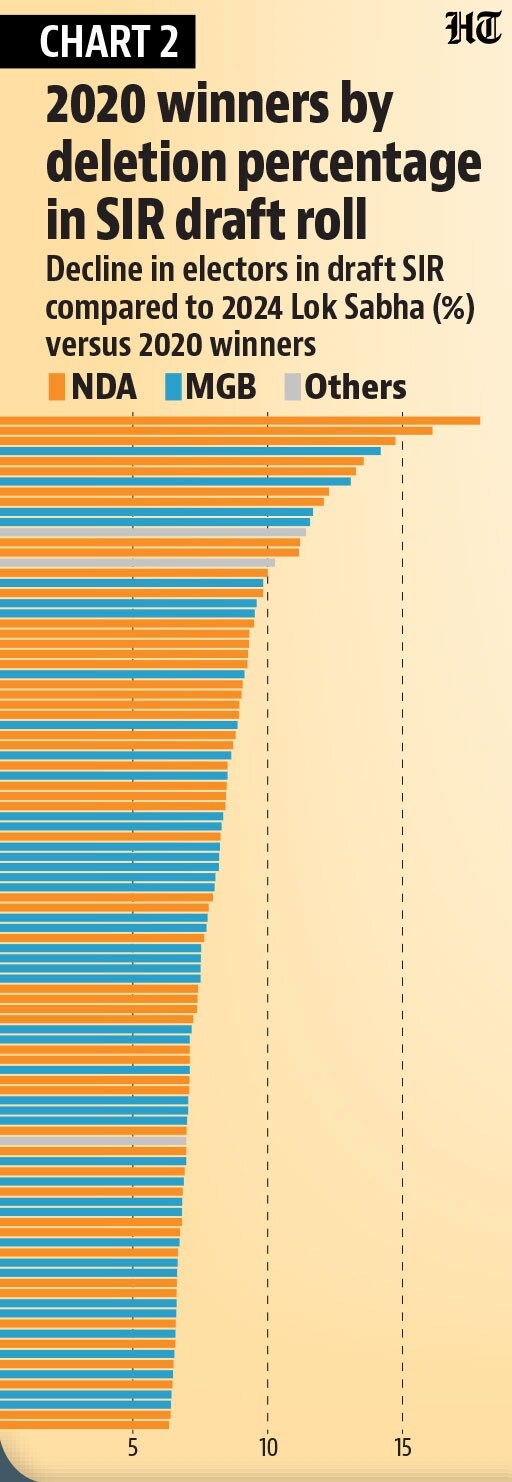
(See Chart 2)
What about deletions in Muslim dominated ACs?
This is a more difficult question to answer because electoral rolls do not mention religion of voters and we do not even have religious break-ups of electors at the AC level. If one were to rank district-wise Muslim population from the 2011 census, then Kishanganj, which has the highest share of Muslim population in Bihar has seen the second highest deletion of voters between 2024 and the SIR draft roll. However, other districts with a large share of Muslim population do not figure in the list of districts with highest deletions. For example, Katihar and Araria, which have the second and third highest share of Muslims, have the sixth and tenth lowest deletions as a share of their respective 2024 Lok Sabha elector count.

Another way to check whether deletions are higher in Muslim dominated ACs is to check the deletion in ACs which either had a Muslim winner or runner-up candidate. Of the 19 ACs won by Muslim candidates in 2020 assembly elections, 7 figure in the top 25% districts with voter deletions while 4 figure in the bottom 25% by number of deletions. The break-up is 11 and 8 in the top and bottom 50% by share of voters deleted. For 22 ACs where Muslim candidates were runners-up (and a Muslim did not win), the average share of voters deleted is 6.3% and varies from 13.6% to 0.63%.

(See Chart 3A and 3B)
Have seats with close contests seen more deletions?
One could argue that these are the ACs which could be most sensitive to changes in electoral rolls. Once again, there is no correlation between victory margin in 2020 and the share of voters deleted between 2024 and SIR draft roll.
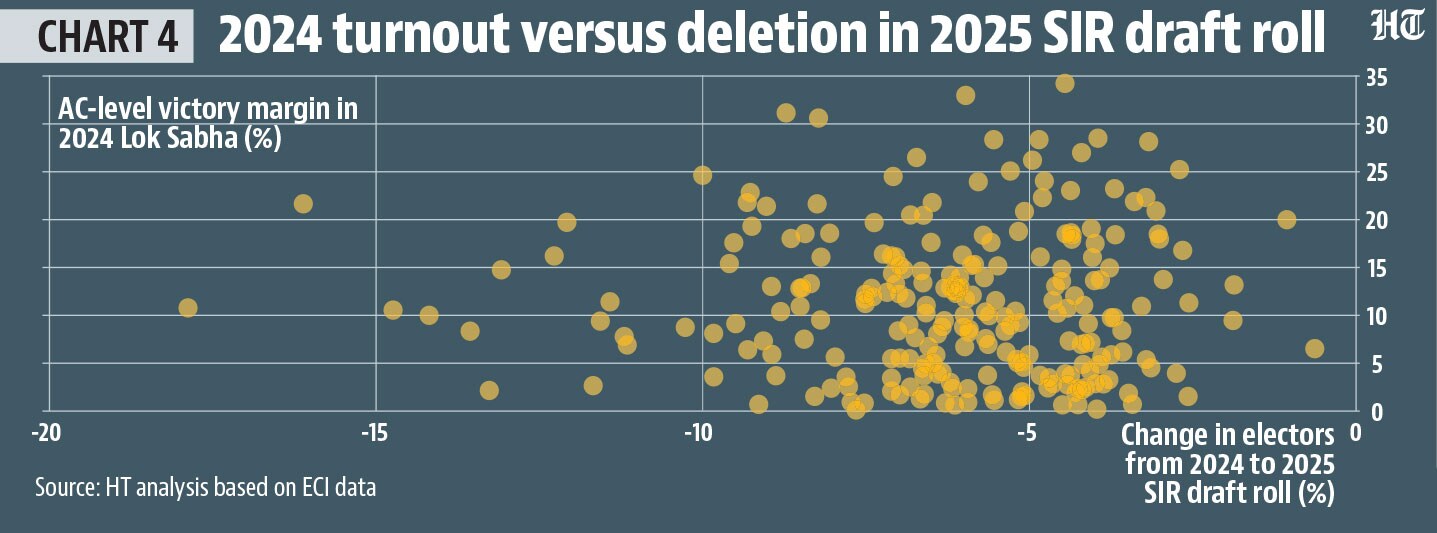
(See Chart 4)
Theoretically, the SIR could have no impact on actual polling in Bihar
This is an extremely counter-intuitive but eminently plausible scenario. In the 2024 Lok Sabha elections, voter turnout across ACs in Bihar ranged from 38.1% to 68.7%. In all of these ACs, the electors in the draft SIR roll are more than the number of people who cast their vote in 2024. If, and we do not know this for sure, the only voters who have been deleted are either deceased or not present in the state (and therefore did not vote in the last election) then one could very well have a situation where the absolute voter turnout is still close or even higher than the 2024 number and what we get is an increase in voter turnout; this number will be have to increase from 56% in 2024 (Bihar had the lowest voter turnout among all states and UTs in the country in the election) to 59.8% in 2025 for the absolute voter count to remain the same.