
 E-Paper



Citizens don’t need to prove their ancestry, explains MHA
Assam’s NRC, ordered by the Supreme Court and completed earlier this year, left out 1.9 million people, including lakhs of Hindus.


The Union government on Friday blamed those who have filed petitions against the Citizenship (Amendment) Act, or CAA, in the Supreme Court for instigating violent protests across India even as it tried to allay concerns around the relationship between CAA and a proposed countrywide National Register of Citizens (NRC) exercise.
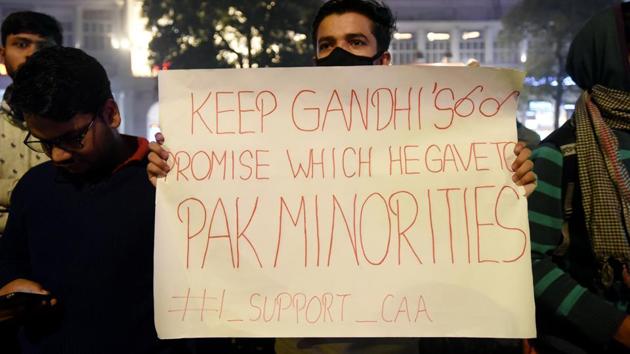
Assam’s NRC, ordered by the Supreme Court and completed earlier this year, left out 1.9 million people, including lakhs of Hindus. Subsequently, several Bharatiya Janata Party (BJP) leaders, including home minister Amit Shah have said that an NRC will be carried out across India, but only after passage of the amended citizenship law. The understanding was that this would protect the interests of non-Muslims excluded from NRC.
The CAA fast-tracks Indian citizenship to “persecuted minorities” from three Muslim-majority neighbours of the country, Bangladesh, Pakistan, and Afghanistan.
On Friday, the ministry of home affairs made it clear that the documentation required to establish citizenship in a national NRC wouldn’t be as stringent as it was for in the Assam exericse.
“It would be sufficient for you to provide the details of your birth such as date of birth, month, year and place,” the Home Ministry said in a 13-point FAQs, or Frequently Asked Questions, issued late on Friday evening. Those who do not have details about their birth will have to share information about their parents although they are not required to submit any documents related to the parents, it added.
This is the first time that the home ministry has officially answered questions around NRC. To be sure, even plans for a nationwide one are yet to be announced (leave alone the methodology), although it is widely believed that the basis for this will be the ongoing National Population Register or NPR, launched when the Congress-led United Progressive Alliance was in power.
The FAQs said the documents that are “likely” to be accepted are “voter ID cards, passports, Aadhaar numbers, licenses, insurance papers, birth certificates, school leaving certificates, documents relating to land or home (ownership) or other similar documents”.
But this list is illustrative, it added. “A decision is yet to be taken on such acceptable documents,” it said. The final list of acceptable documents could be longer “so that no Indian citizen has to suffer unnecessarily”.
A home ministry official who spoke on condition of anonymity said that NRC, mandated under the citizenship (registration of citizens and issue of national identity cards) rules of 2003, will come after the government prepares the National Population of Register (NPR).
NRC, the ministry said, is merely a normal process to register your name in the Citizens’ Register.
“Just like we present our identity cards or any other document for registering our names in the voter list or getting an Aadhaar number, similar documents shall need to be provided for NRC, as and when it is carried out,” the document said.
Indian citizenship is automatically granted to any person born in the country until 1987. Those born between 1987 and 2003 in the country are citizens if either of their parents are Indian citizens. Those born after 2003 are citizens only if both parents are Indian citizens.
India’s only experience with a citizens’ register has been in Assam. The FAQs said Assam was a different case in light of the NRC’s peculiar circumstances in this state.
“Infiltration is an old problem in Assam. To curb it, there was a movement and in 1985, the then Rajiv Gandhi government, to identify the intruders, had to enter into an agreement to prepare NRC, assuming the cut-off date of 25 March 1971,” it said.
A key concern expressed by activists and opposition leaders including Congress president Sonia Gandhi has been that the NRC documentation would be so stringent that it would leave out the poor and disadvantaged.
Even if a person is “ illiterate and does not have relevant documents’, the ministry said, “the authorities will allow that person to bring a witness. Also, other evidence and community verification etc. will also be allowed. A proper procedure will be followed. No Indian Citizen will be put in undue trouble.”
The government questioned the assumption that the poor do not have any means of identification. It said they too are beneficiaries of one central scheme or the other and the government would use this information to establish citizenship. “If you are living here, you will have something,” a home ministry official said.
Responding to a question on the need for a nationwide NRC, this person added: “We felt the need to identify illegal migrants which should have been done long time ago. No country across the world would allow illegal persons on its soil”.
The ministry also stated that anyone, including students, intellectuals and political parties, are welcome to give any suggestions on CAA as the rules for its implementation, including details of documents required and deadline for applying, are yet to be framed.
Commenting on the violence that has erupted around the country following the passage of CAA, the home ministry official said 59 parties who have gone to the Supreme Court against CAA are also responsible for it.
“We had anticipated violence but largely in Assam.”
A second home ministry official defended the internet shutdowns ordered across different states and said these were done to ensure mobs do not gather and damage property.


