
 E-Paper



Employee reps call financial benefits Union govt announced ahead of Diwali inadequate
They said the government should have merged 50% DA with basic pay when the allowance reached that level

 Prefer HTon Google


Ahead of the Diwali festivities, the Union government announced a 30-day ad hoc bonus for 2025-26 and a 3-percentage-point increase in dearness allowance (DA), taking it from 60% to 63% of basic pay, for its employees, even as their representatives say the bonus remains inadequate. The government retained a calculation ceiling of ₹7,000 a month for the 11th consecutive year.
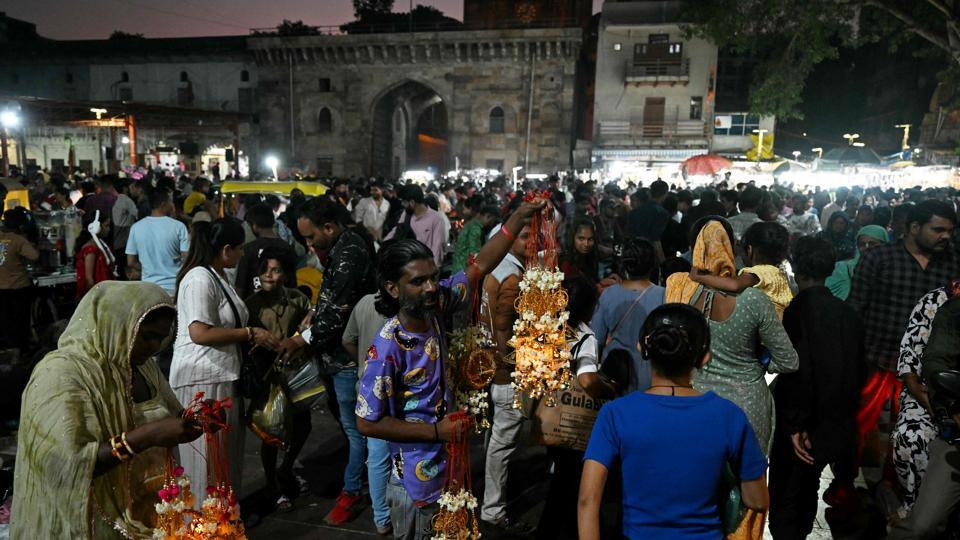
On October 15, the finance ministry’s expenditure department sanctioned a non-productivity-linked bonus equivalent to 30 days’ emoluments for eligible central government employees for the accounting year 2025-26. The maximum payout works out to ₹6,908, based on the monthly calculation ceiling of ₹7,000.
The bonus applies to Group C employees and non-gazetted Group B employees not covered by any productivity-linked bonus scheme. It is applicable to eligible personnel of the Central Armed Police Forces and armed forces, employees of Union Territory administrations that follow the Union government’s pay structure and are not covered by another bonus scheme.
Employees must have been in service on March 31, 2026, and completed at least six months of continuous service during 2025-26 to qualify. Those with shorter qualifying service will receive the amount on a pro-rata basis.
On October 28, the Union Cabinet approved the increase in DA for central government employees and dearness relief (DR) for pensioners. The increase will be effective retrospectively from July 1, 2026, entitling employees and pensioners to arrears.
The DA and DR revision is expected to benefit around 4.85 million central government employees and 6.87 million pensioners. It will have an annual financial implication of ₹10,016.10 crore for the exchequer, according to the finance ministry.
DA is revised twice a year to compensate employees for rising prices. The allowance is calculated using the All-India Consumer Price Index for Industrial Workers, which tracks changes in retail prices faced by industrial workers.
Employee representatives say the announcements fall short of their demands. All India NPS Employees Federation president Manjeet Singh Patel said the government has maintained the 11-year-old record by releasing the same ₹6,908 as a 30-day bonus. “Similarly, just before Diwali, it has given only a 3% increase in dearness allowance, expecting that this will make employees’ Diwali better,” he said.
Patel said the government should have merged 50% DA with basic pay when the allowance reached that level, instead of allowing it to continue as a separate component. He said employees were already facing a loss of around 6-7% because of the government’s decision not to merge the allowance with basic pay.
Patel urged the government to merge 50% of the existing DA with basic salary and calculate the remaining 13% as DA on the revised basic pay.
Madras School of Economics director NR Bhanumurthy said the two announcements were part of the government’s regular practice and came when employees typically face higher spending during the festive season. He added that it is also very timely. “Certainly, it is very useful for government staff during the festival season,” he said.
Bhanumurthy said demands for a higher bonus ceiling and the merger of DA with basic pay could be taken up by the Eighth Central Pay Commission, which is currently functioning. “My feeling is that all these things would be transferred to the Eighth Pay Commission to address when they recommend their report. All these issues may be deliberated by the commission. It cannot be a case-by-case basis,” he said. He added that the government would need to examine the rationale and the basis for revising the bonus before increasing the ceiling.
The Eighth Pay Commission is expected to examine broader issues relating to salaries, allowances and other service conditions of central government employees. The bonus ceiling and the demand for merging DA with basic pay are among the issues employee representatives want addressed through the pay commission process.


