E-Paper



In Hemant Soren’s successful Jharkhand campaign, tribal connect was key
JMM chief Hemant Soren’s successful campaign for the Jharkhand assembly elections rested on three prongs

 Prefer HTon Google


The campaign for this round of assembly elections officially began on October 15, when the Election Commission of India announced polls in Maharashtra and Jharkhand. But in India’s tribal heartland, the campaign began far earlier – on June 28, when chief minister Hemant Soren was released from jail after being imprisoned for five months over corruption charges. The 49-year-old was already buoyed by the Indian National Developmental Inclusive Alliance’s (INDIA) performance in the Lok Sabha polls – the Jharkhand Mukti Morcha (JMM) won three seats and its ally, the Congress, won two, up from one and one in 2019 – and he set out to craft a campaign premised on his persona, pushing his wife Kalpana Soren into a prominent spot, and playing up his family’s links to the state’s formation.
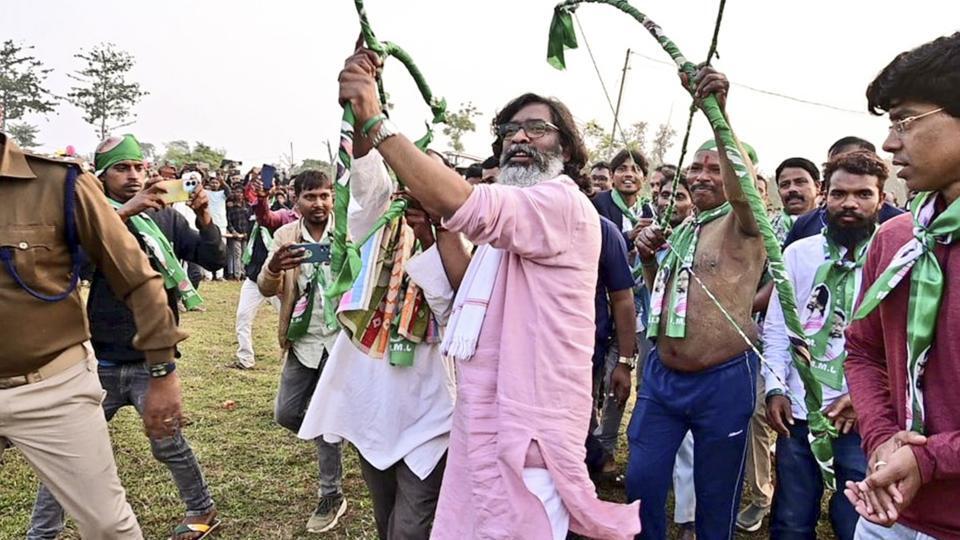
Soren’s successful campaign rested on three prongs.
One, emerge as the undisputed leader of the tribals. Soren had already embarked on this project in 2019 when he crafted the first pre-poll pact in the JMM’s history. He now linked his controversial jail term to the question of tribal asmita (pride). In every election speech, he reminded ordinary people how the Bharatiya Janata Party (BJP) had detained a tribal son and conspired against the adivasis. Whenever possible, he brought up controversies around the Chhota Nagpur Tenancy Act and the implementation of a domicile policy based on land records from 1932 – two issues that had kicked up a huge political storm during the last BJP government in the state between 2014 and 2019, and were responsible for the defeat of the National Democratic Alliance (NDA) in 2019. Soren’s lieutenants also reminded people how the BJP nominated a non-tribal person (Raghubar Das) as chief minister, a first for a state whose formation was catalysed by a long and bloody adivasi movement.
Also Read: Three key takeaways from the results in Maharashtra and Jharkhand
Though he didn’t campaign due to ill health, the figure of Soren’s father and JMM founder Shibu Soren was used strategically to fan his emotive connection with a generation of people who had seen the senior adivasi leader emerge as a flag-bearer of a separate state for tribespeople in the 1970s. This approach also helped the JMM control the more polarising aspects of senior Soren’s legacy and built a more inclusive campaign.
Of course, it is unlikely that Soren would have emerged as a pan-state leader had it not been for his jail stint. In rally after rally, he played up his imprisonment, called it unjust, and attacked the BJP for having imprisoned a son of the soil. He alleged that he was locked up because he was serving poor tribespeople and was standing against big business interests, and promised the electorate an expansion in reservations if he was voted back to power. This was the second prong of his strategy, one that also hinged on pushing his wife, Kalpana Soren, into prominence. This was a risky strategy at first – after all, her rising prominence at the time of his arrest had led to rumblings in the party and it was also among the issues responsible for the exit of senior leader Champai Soren months before the elections (he joined the BJP). But together, the Soren couple put the chief minister’s persona and his jail stint the emotive core of their campaign.
This helped Soren emerge as the biggest leader, not only of his own tribal group, the Santhals – the biggest scheduled tribe (ST) in the state, comprising roughly a third of the province’s adivasi population – but also blank out other competing tribal leaders from the BJP among groups such as Oraon, Munda and Ho. In a field crowded with other former chief ministers, it helped one stand out. The JMM ended up winning 27 out of 28 seats reserved for Scheduled Tribes.
And three, the JMM was buoyed by the response among rural women to its Mukhyamantri Maiya Samman Yojana, which gave ₹1,000 to poor women. By making the cash transfer scheme the centrepiece of its welfare outreach, the JMM was able to build a new catchment of voters in every constituency whose identities lay beyond the traditional buckets of community or region. It helped arrest the development narrative that the BJP has successfully used elsewhere, and blunt allegations of corruption – especially in those 68 seats where more women voted than men.
The culmination of this strategy was a victory unprecedented in scale in Jharkhand, helping JMM retain power for the first time in its existence. The ease of the win, though, hid just how bruising the campaign trail had been these last few months. As Soren told HT in an interview, no other elections were as tough.