
Sign in

India’s population will be 25% more than that of China by 2050, says study

Population Reference Bureau figures show that, at the moment, the Indian and Chinese populations are estimated to be 1.37 and 1.39 billion respectively.

Updated on: Aug 23, 2018, 16:33:53 IST
New Delhi, Hindustan Times | By
Share
Share via
  • facebook
  • twitter
  • linkedin
  • whatsapp
Copy link
  • copy link

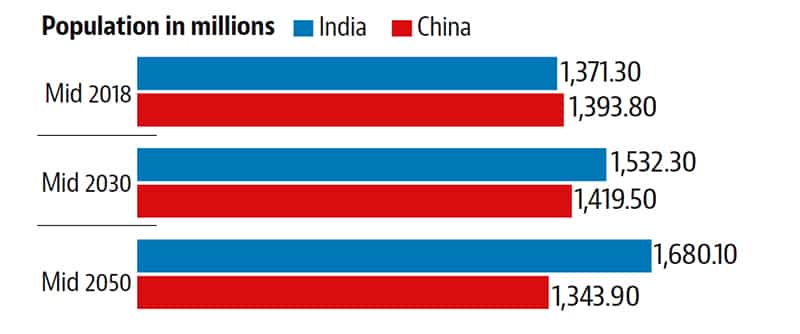
By mid-2030, India’s population will likely be 8% more than that of China, and by mid-2050, this ‘lead’ will become 25%, according to the 2018 World Population Data Sheet released by the Population Reference Bureau (PRB), a Washington-based non-profit organisation.

According to Population Reference Bureau estimates, the compound annual growth rate of India’s population between mid-2018 to mid-2030 is likely to be 0.93%, and come down to 0.46% between 2030 and 2050. (AP file photo)

The PRB figures show that, at the moment, the Indian and Chinese populations are estimated to be 1.37 and 1.39 billion respectively. While India’s population is expected to reach 1.53 and 1.68 billion by mid-2030 and mid-2050, China’s is likely to reach 1.42 billion by mid-2030 and then fall to 1.34 billion by mid-2050.

That India will replace China as the world’s most populous country does not mean that its demographic transition is not happening.
Article image
  • Roshan Kishore
    ABOUT THE AUTHOR
    Roshan Kishore

    Roshan Kishore is the Data and Political Economy Editor at Hindustan Times. He heads the newsroom's data journalism team, which produces Number Theory, a daily data-driven feature for the print edition and the HT app. Number Theory uses data analysis and story-telling based on it to add value to the newsroom’s daily coverage by putting stories in a larger context on a range of issues, including politics, macroeconomy, markets, global affairs and climate. Under his leadership HT’s data journalism work has established itself as a niche product in Indian journalism and pushed the boundaries of marrying academic rigour with news sense and speed. Along with writing and editing data stories, he has also been writing a weekly political economy column called Terms of Trade for HT Premium. A trained economist with an MPhil degree from Jawaharlal Nehru University, Kishore has also been a visiting fellow at the Centre for Advanced Studies of India (CASI) at the University of Pennsylvania. Along with his journalistic work, his writings have also appeared in journals such as the Economic and Political Weekly and working papers for CASI and UNESCAP.Read More