
 E-Paper



Modi govt puts construction of 3 more Kalvari class submarines on front-burner
Three more Kalvari class submarines will be constructed at MDL with French Naval Group support to arrest declining force levels end-2030.

 Prefer HTon Google


In order to maintain the force levels of diesel-attack submarines, Prime Minister Narendra Modi has put the proposal to build three additional Kalvari class (evolved Scorpene class) submarines at Mazagon Dockyards Limited with support of French Naval Group on the front-burner.
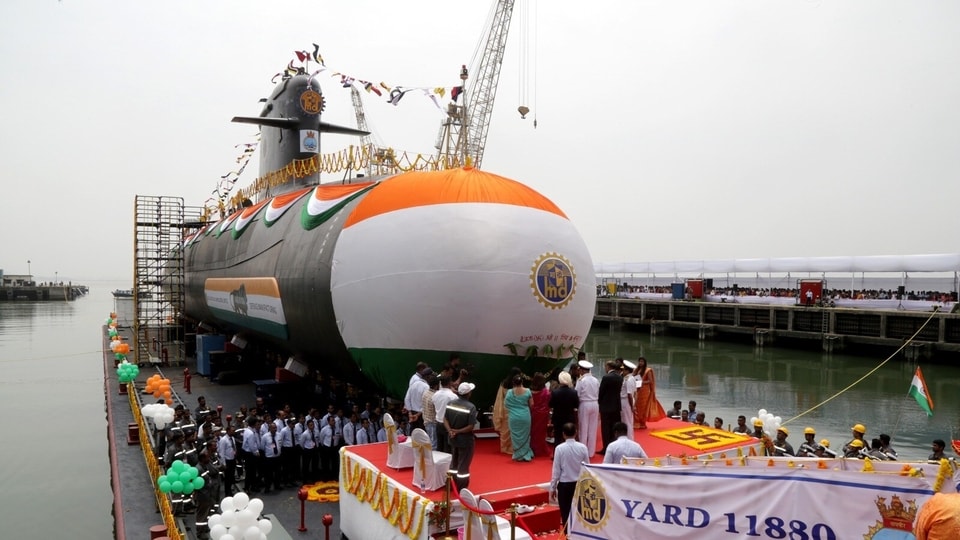
The estimated cost for construction will be around ₹33000 crore and a modified proposal is being put up before Cabinet Committee on Security (CCS).
With Pakistan expected to acquire eight Type 039 Yuan class submarines, equipped with air independent propulsion (AIP), by 2028-2030, the Indian Navy domination of the Indian Ocean Region will be challenged by both its western neighbor and its backer China. This is because the Indian Navy’s Shishukumar (HDW) and Sindhughosh (Kilo class) are heading towards the end of their shelf life and the submarine force levels will decline by the end of this decade.
Also Read | Boating, light shows, marine life: Nod to naval museum expansion
While India already has six Kalvari class submarines in its arsenal, the decision to construct three more of its class was put on backburner as national security planners were putting Project 75 (I) or submarines with AIP on a priority as part of their long term vision.
Even though the Kalvari class was approved in 2004, the newly evolved Kalvari or Scorpene class will have NATO standard torpedoes, incorporate heavy weight torpedoes developed by DRDO and will have 800 km range SCALP submarine launched missiles. Not only will the new order revive submarine building in MDL but also upgrade the technical skills of shipyards engineers and workers. The additional three submarines at present will be powered by Lead Acid Batteries (LAB) but can be replaced by Lithium Ion Batteries (LIB) during upgrade. The LIB are far more efficient than LAB and will pose a serious threat to AIP submarines of Pakistan in terms of speed and stealth.
What is more significant is that after building the upgraded Kalveri class, India will be able to lease out submarines to friendly countries like Indonesia or even construct for them under 100 per cent TOT transfer from Naval Group. Another reason for the revival of the Project 75 proposal is the fact that the Project 75 (I) has been delayed due to validation of AIP developed by the DRDO even though Germany’s TKMS is ready to provide the AIP for the Project 75 (I) class submarines.
Also Read | Indian Navy to commission third anti-submarine warfare craft, Mangrol
With the Indo-Pacific threatened by expansionist PLA Navy and instability of Middle-East, it is important that India maintains a minimum conventional submarine force deterrent while its nuclear submarine with nuclear ballistic missile (SSBN) project is going at full speed with four such deterrent to enter the Indian Navy next year. While the Modi government has given clearance to the Indian Navy to construct two conventionally armed nuclear powered submarines (SSN), the Indian Navy is expected to acquire one SSN from Russia on lease by 2028.


