E-Paper



Iran thanks India for rescuing 20 crew members from vessel hijacked by Somali pirates
Azini was hijacked between the coastal towns of Bandar Bayla and Hafun on the northeastern coast of Somalia

 Prefer HTon Google


Iran on Tuesday thanked the Indian government and armed forces for rescuing all 20 crew members of an Iranian vessel seized by Somali pirates in the Arabian Sea and said the operation reflects the spirit of solidarity and cooperation between the two countries.
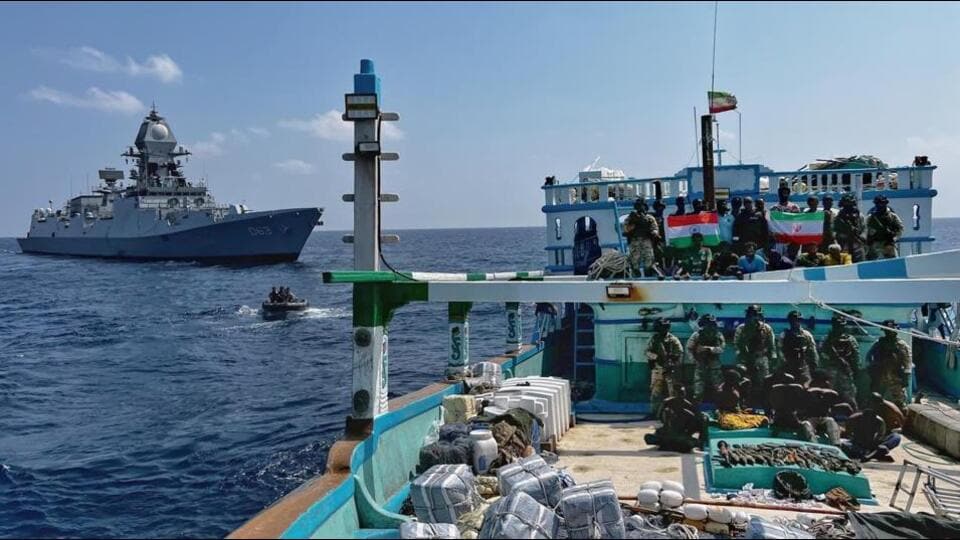
The Indian Navy coordinated the operation conducted 3,000 km from Mumbai to rescue the crew of the fishing vessel Azini, which was taken over by the pirates on October 29. There were no casualties or injuries during the operation, which defence minister Rajnath Singh described as “meticulously coordinated”.
The Iranian embassy in New Delhi expressed its “sincere gratitude” to the Indian government, Indian Navy and Indian Air Force (IAF) for the successful operation to rescue the crew of Azini. “This humanitarian operation stands as a testament to the spirit of friendship, solidarity and cooperation between Iran and India,” the embassy said in a statement.
“We highly commend the professionalism, courage and effective coordination demonstrated by the Indian Armed Forces, reflecting India’s strong commitment to Humanitarian Assistance and Disaster Relief (HADR) and its role in saving lives beyond borders,” the statement added.
Also Read:Indian Navy rescues 20 crew members from hijacked Iranian vessel after 48-hour operation
Azini was hijacked between the coastal towns of Bandar Bayla and Hafun on the northeastern coast of Somalia, a region that has witnessed renewed pirate activity in recent years.
The hijacking represented a significant maritime security threat, with the possibility of Azini being used as a “mother ship” for launching further pirate attacks against merchant shipping in the region, the Indian Navy said on Tuesday.
“Responding to the situation, the Indian Navy tasked a mission-deployed warship to intervene, supported by a maritime reconnaissance aircraft,” the navy said in a statement. “Working in close coordination, these platforms located the vessel after persistent surveillance, tracked its movements and employed calibrated non-kinetic measures to contain its movement and prevent its escape.”
Marine commandos involved in the operation on Monday were “augmented through a precision airdrop” by a C-17 aircraft of the IAF. Photos released by the defence ministry showed INS Kolkata, a stealth destroyer, was involved in the operation.
The navy said the operation reflected its “high operational preparedness and ability to undertake complex maritime security operations through seamless inter-service coordination”, and underscored India’s commitment to remain the first responder and preferred security partner in the Indian Ocean.
While lauding the armed forces, the defence minister said in a social media post: “The swift localisation, interception and safe release of the crew and vessel from significantly-armed pirates, with timely support from the Indian Air Force, speak well of the Indian Navy’s high operational readiness and ability to respond decisively to maritime threats across the region.”
Singh added, “Our brave personnel have once again demonstrated India’s ability, intent and resolve to safeguard lives, uphold maritime security and ensure stability across the Indian Ocean Region.”
At any given time, India has had at least one warship carrying out round-the-clock anti-piracy patrols in the Gulf of Aden since October 23, 2008, to protect Indian sea-borne trade, instill confidence in the seafaring community and act as a deterrent to pirates.
The operation was conducted against the backdrop of continuing concerns over the resurgence of Somali pirates in the Gulf of Aden and parts of the western Indian Ocean, where commercial vessels remain vulnerable to attack.