
 E-Paper



Narendra Modi podcast with Nikhil Kamath: PM touches upon Godhra riots, says 'I felt everything'
Nikhil Kamath podcast: PM Modi also recalled the United States' denial of visa to him when he was the CM of Gujarat.

 Prefer HTon Google


Prime Minister Narendra Modi appeared on his first-ever podcast on Friday, where he touched upon many controversial topics, including the 2002 Godhra riots and the visa denial by the United States in 2005.
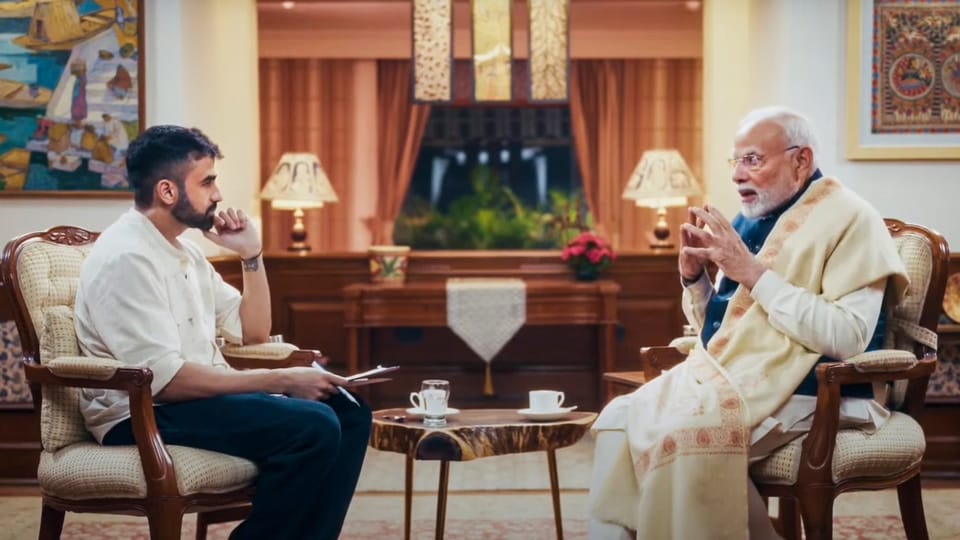
PM Modi told entrepreneur Nikhil Kamath that after he witnessed "that painful scene", he "felt everything" but did everything to control his emotions because he was the chief minister of Gujarat.
"On February 24, 2002, I became MLA for the first time, and on February 27, I went to the assembly. I was a three-day-old MLA when such an incident happened in Godhra. We first received reports of fire in a train, then gradually we received reports of casualties. I was in the House, and I was concerned. As soon as I came out, I said I wanted to visit Godhra... There was only one helicopter...I guess it was ONGC's, but they said that since it is a single-engine chopper, they cannot allow a VIP on it. We argued, and I said that I would be responsible for whatever happened," PM Modi said.
He said he saw painful scenes of dead bodies when he reached Godhra.
"I reached Godhra, and I witnessed that painful scene, those dead bodies... I felt everything, but I knew that I was sitting in a position where I would have to stay out of my emotions and natural tendencies. I did whatever I could to control myself," he told Kamath.
What PM Modi said on US visa denial?
PMModi also recalled the United States' denial of visa to him when he was the CM of Gujarat.
"I was the MLA when the American government refused to give me a visa. As an individual, going to America was not a big thing, I had visited before also, but I felt the disrespect of an elected government and the country, and there was a dilemma in my mind as to what was happening... That day, I held a press conference, where I said that the American government had rejected my visa. I also said that I see India, where the world will stand in the queue for visas. This is my statement in 2005 and today we are standing in 2025. So, I can see that now, the time belongs to India," he added.
PM Modi said the world trusts India because the country doesn't adhere to duplicity in global affairs.
"The world trusts us, because there is no duplicity in us, whatever we say we say clearly. Even in these times of crisis, we have repeatedly said that we are not neutral. I am in favour of peace, and I will support whatever efforts are made towards it. I tell this to Russia, Ukraine, Iran, Palestine and Israel. They have faith in me, that what I am saying is right," he added.
PM Modi also narrated the story of Chinese President Xi Jinping's visit to Gujarat.
"When I became the PM in 2014, leaders from across the world made courtesy calls... Chinese President Xi also made a courtesy call in which he said that he wants to come to India. I said: 'You are welcome, you must visit'. He said 'I want to visit Gujarat, your village Vadnagar... you know why? You and I share a special bond'... He said Chinese philosopher Hiuen Tsang resided the longest in your village and when he returned to China, he resided in 'my village," he told the Zerodha founder.
With inputs from PTI


