E-Paper



Number Theory: Ten years of Modi government and the Indian economy - I
This two-part data journalism series seeks to evaluate the economic performance of the Narendra Modi government which has been in office for 10 years


The current government will present its last budget, technically a vote-on-account, on February 1. Because this is an election year, this budget’s announcements will not be binding for the fiscal year 2024-25 and the final budget will be presented in July by the new government which is elected in the 2024 general elections. To be sure, the interim budget is likely to make announcements with the elections in mind and one will have to see how they affect the budgetary math. Having said this, the run-up to the 2024-25 interim budget is a good opportunity to evaluate the economic performance of the Narendra Modi government which has been in office for 10 years. This two-part data journalism series will seek to do exactly that. The first part will look at this government’s performance on the crucial fronts of growth, employment and inflation and the second part will look at the questions of taxes and subsidies, the health of the financial sector and confidence levels in the Indian economy.
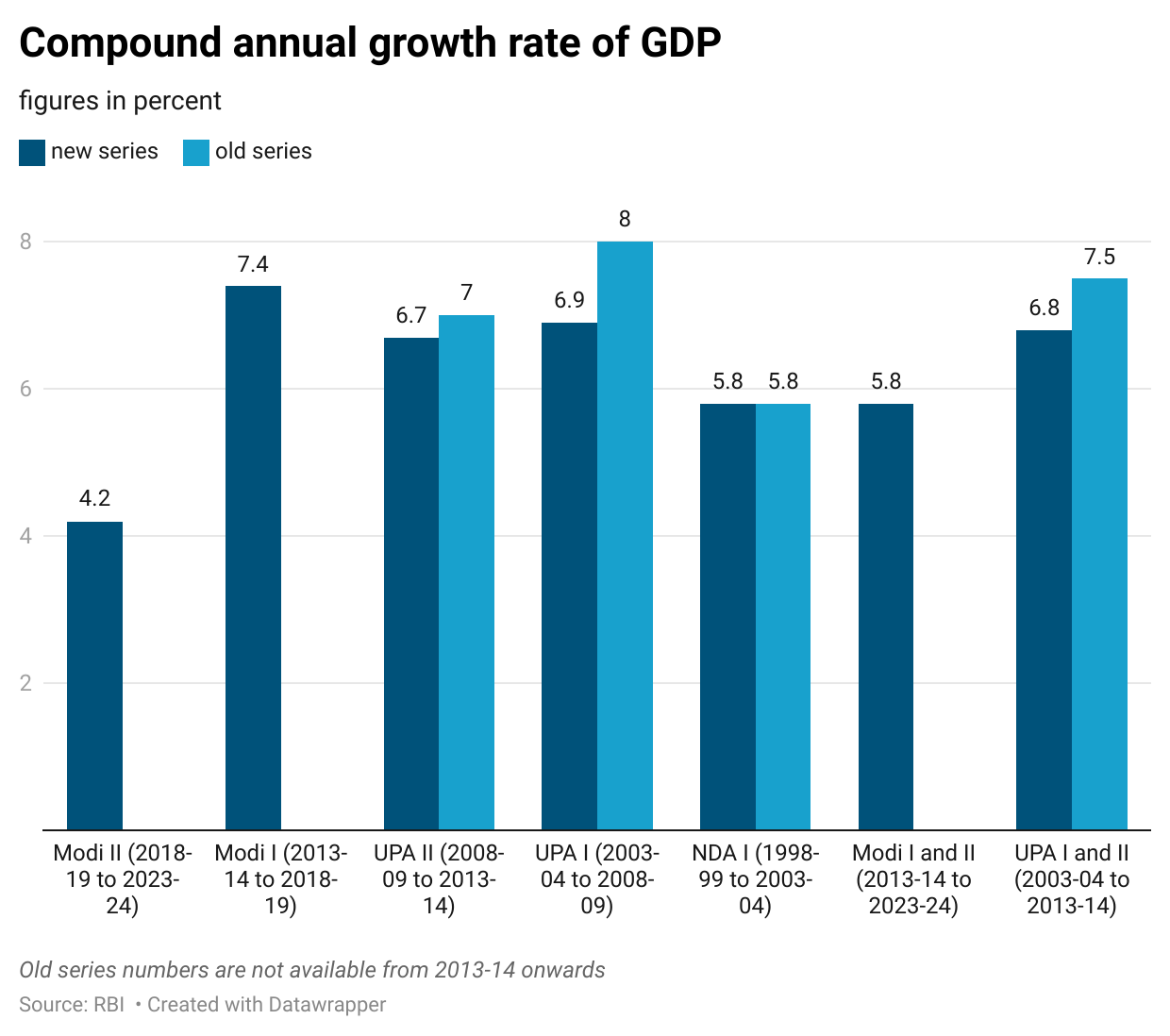
 The pandemic’s contraction has suppressed growth performance under the Modi governmentThe best way to compare a government’s growth performance is to compare the compound annual growth rate (CAGR) of GDP during its period with previous governments. Unfortunately, this method cannot be applied uncritically to evaluate the current government’s track record on growth. This is because the pandemic forced a contraction in the Indian economy in 2020-21 and this is bound to lead to a lower CAGR for GDP under the second Modi government. This is exactly how one should read the 4.2% CAGR of GDP under the second Modi government. This number would have been significantly higher had the pandemic not happened and it would be unfair to use the 4.2% CAGR number to argue that the current government’s track record on growth has been significantly worse than the decade under its predecessor United Progressive Alliance (UPA). Having said this, some basic comparisons of GDP growth under the Modi government and its predecessor are given in the chart.
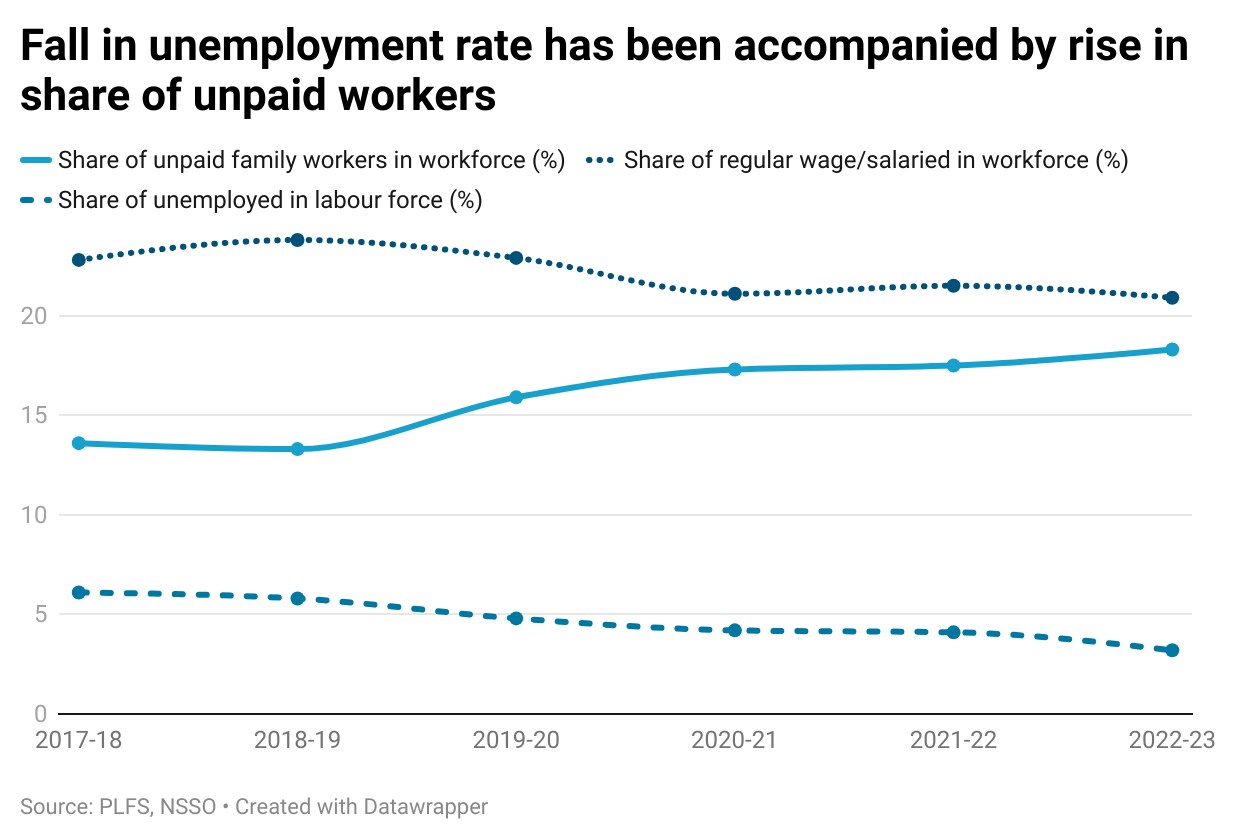
- And headline unemployment numbers exaggerate its job-creation recordJust as headline GDP CAGR numbers paint the current government in bad light even though the biggest reason for the number being lower is an exogenous shock to the economy, unemployment rate numbers paint this government’s employment generation record in a positive light even though the situation is not as sanguine as it seems. A four-part data journalism series published in these pages explained this in detail. The sharp fall in unemployment rate – from 6.1% in the first periodic labour force survey (PLFS) conducted in 2017-18 to just 3.2% in the 2022-23 PLFS – despite a rising labour force participation rate (LFPR) is a result of more workers, especially women taking to unpaid self-employment than people finding remunerative jobs. The share of unpaid family workers (a category of self-employed workers in the PLFS) in the workforce has increased from 13.6% in 2017-18 to 18.3% in 2022-23. In the same period, the share of salaried or regular wage workers -- the best paid workers in the economy -- has decreased from 22.8% to 20.9%.
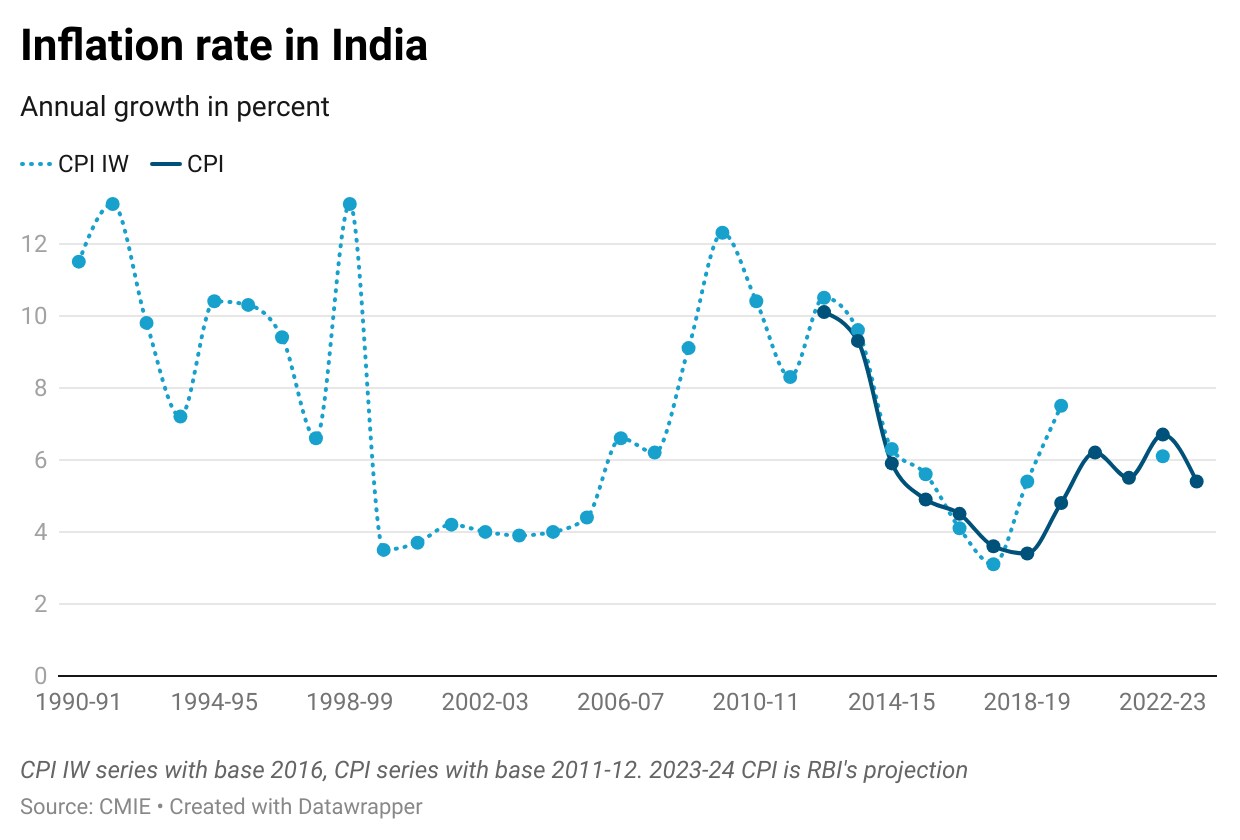
- Fortune notwithstanding, inflation control has been this government’s biggest successWhile headline numbers on both growth and employment under the Modi government are misleading in a way, and therefore prone to political misinterpretation when compared to the UPA period, there is one area where the verdict is easier to pronounce. This is when it comes to inflation in the economy. Because the current Consumer Price Index (CPI) series only gives inflation data from 2012-13 onwards, we have used the Consumer Price Index for Industrial Workers (CPI IW) data to compare inflation during the Modi government and the UPA period. CPI IW stayed above the 6% mark every year since 2006-07 under the UPA government. During the UPA II government, this number was more than 10% in three years and its lowest value was 8.3%. Inflation, as seen in the CPI series fell sharply from its UPA era high under the first Modi government and it reached a low of just 3.4% in 2018-19. While the second Modi government has seen higher inflation levels, the numbers are nowhere close to what they were during the UPA II period. To be sure, the Modi government has been lucky with global commodity prices, especially for crude oil, compared to its predecessor and this might have played a big role in inflation being lower under the current government. But this is unlikely to weaken the political traction which the government could reap in elections thanks to the absence of inflationary headwinds.