
 E-Paper





Follow the latest breaking news, major developments and agenda-setting stories from India and around the world with the newsdesk at Hindustan Times. Operating round the clock, the desk brings together experienced editors, reporters and correspondents to deliver fast, accurate and contextual reporting across subjects that influence public policy, governance, business, society and international affairs. The HT News Desk covers politics, elections, government policies, the economy, business and markets, science and technology, the environment, law and order, infrastructure, education, climate issues and geopolitics, while closely tracking developments across states, institutions and global capitals. The team also leads coverage of major breaking news events, policy announcements, court proceedings, natural disasters, public emergencies and significant international developments. Reports published by the newsdesk are based on information gathered from reporters on the ground, official statements, government agencies, court records, regulatory filings, recognised institutions and other authoritative sources. Stories undergo editorial scrutiny and verification processes to ensure accuracy, fairness and relevance, and are updated as events evolve and additional information becomes available. Whether covering a key political decision in New Delhi, an economic policy shift affecting millions, a landmark court ruling or a major global event, the HT News Desk aims to provide readers with reliable, fact-based journalism that delivers not only the latest developments but also the context and analysis needed to understand their wider implications.
BJP relives Vajpayee days in domain of tribal ally
The BJP harked back to the days of former Prime Minister Atal Bihari Vajpayee in a bid to deepen ties with regional ally Bodoland People’s Front (BPF), which mostly comprises of former rebels.


The BJP harked back to the days of former Prime Minister Atal Bihari Vajpayee in a bid to deepen ties with regional ally Bodoland People’s Front (BPF), which mostly comprises of former rebels.
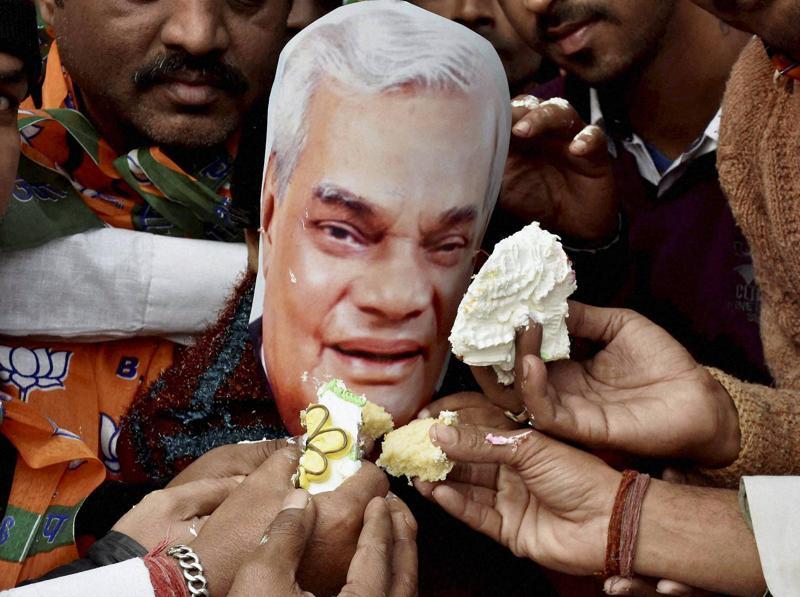
Vajpayee had first brought the BPF onboard the BJP-led NDA in 2003, the year when the Bodoland Territorial Council (BTC) was formed. But financial considerations made the BPF drift towards the Congress after the NDA lost the Lok Sabha polls in 2004.
Letting bygones be bygones, the BJP and the BPF once again are coming together in a bid to win the assembly elections scheduled in April-May.
On Tuesday, Prime Minister Narendra Modi pinned his hopes on the alliance while addressing a BPF rally at Bodofa Nwgwr near Kokrajhar town in western Assam.
Kokrajhar, 236 km west of Guwahati, is the headquarters of the BTC and is the BPF’s domain. Bodofa Nwgwr is named after popular Bodo leader Upendra Nath Brahma who was given the moniker Bodofa, which means ‘Father of Bodos’.
But while Modi shared his vision of a better future, local leaders and commoners recalled the time when Vajpayee’s intervention saw the BTC upgraded to a Sixth Schedule area.
“People cannot forget Vajpayeeji, who gave the people of Bodoland the respect they deserved,” said former minister and BJP’s campaign head Himanta Biswa Sarma.
The throwback to the Vajpayee days engaged the crowd at Bodofa Nwgwr as Modi’s arrival from Gangtok was delayed by almost an hour.
Modi, who donned a Gorkha cap in Gangtok, was seen sporting a traditional white-and-red Assamese gamosa around his neck as he alighted from an IAF chopper at Bodofa Nwgwr.
BTC chief Hagrama Mohilary, who has been heading the council for 12 years now, greeted him with a yellow ‘arnai’ — a traditional Bodo scarf — at the helipad. On stage, the yellow ‘arnai’ was replaced with a lilac one.
Mohilary briefly recalled the support the BTC had received from the BJP during its fledgling days, while underscoring the lack of development during the UPA reign.
“We hope Modiji will help us solve many problems — these include the issue of militancy (United Liberation Front of Asom and National Democratic Front of Bodoland), granting of ST status for Adivasi and Koch-Rajbongshi communities, and adequate relief for the victims of riots between 2008 and 2014,” he said.
The BTC chief also assured Modi that the BJP-BPF alliance would deliver results in Assam. “We will teach the Congress a lesson this time. We will win 100%,” he said.
The BPF has 12 seats that it is expected to retain. The BTC and adjoining areas have another half a dozen seats which could see the BJP through.
Under the circumstances, the BPF’s support is of paramount importance for the BJP, which has conceded that its hopes of winning 84 of the 126 assembly seats in Assam were unrealistic. A party or coalition needs at least 64 seats to form a government.
In 2006, the Congress had won 53 seats, and an alliance with the BPF that year had helped it reach the magic number.


