
Sign in

Pathankot terror attack: Pakistan goes slow, yet to file a case

Pakistan has neither shared any part of its ongoing investigation nor has it named the persons behind the attack whose identities were shared by New Delhi.

Updated on: Jan 29, 2016, 23:15:28 IST
Hindustan Times | By , New Delhi
Share
Share via
  • facebook
  • twitter
  • linkedin
  • whatsapp
Copy link
  • copy link

India wants Pakistan to at least register a police report and name the persons and group involved in the Pathankot airbase attack almost a month ago. New Delhi has used back channels to supply Islamabad with evidence and the identities of attackers and conspirators but the pace and urgency of the response on the Pakistan side is growing into a major stumbling block for resumption of the bilateral dialogue.
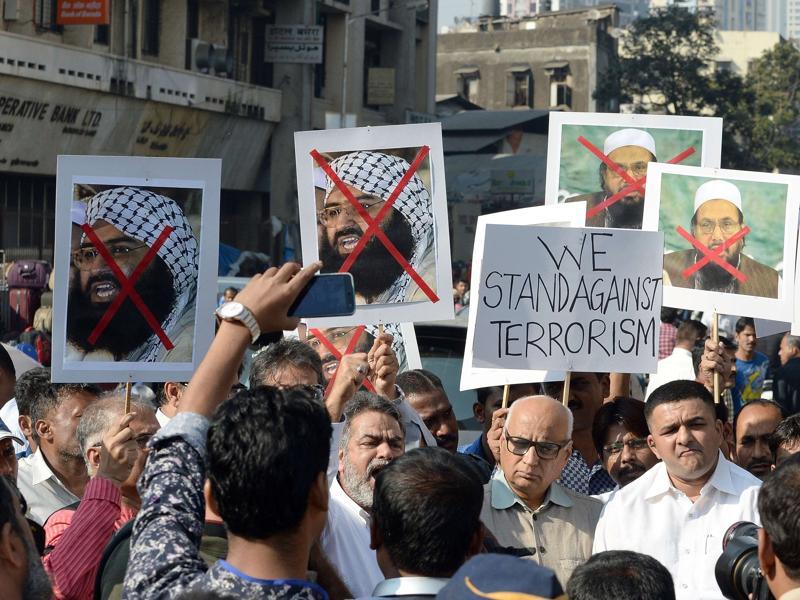
Indian activists carry photographs of the chief of Jaish-e-Mohammad, Maulana Masood Azhar (L) and chief of Pakistan's outlawed Islamic hardline Jamaat ud Dawa (JD), Hafiz Mohammad Saeed (R) during a protest against the attack on the air force base in Pathankot, in Mumbai on January 4, 2016. (AFP)

Top government sources said that there is evidence to indicate that Pakistan enforcement agencies questioned Jaish-e-Mohhamad chief Maulana Masood Azhar for a couple of hours on the Pathankot attack and are still keeping a watch over the radical Islamist. Intelligence reports also indicate that some religious seminaries in southern Punjab and Sialkot have been ostensibly sealed with another 20 persons rounded up and questioned by the police for investigation.

Pakistan has neither shared any part of its ongoing investigation nor has it named the persons behind the attack whose identities were shared by New Delhi.

“ Even though the front doors of the seminaries have been sealed, intelligence reports show visual proof of these radical Islamic institutions functioning behind the doors with impunity. We do not know what has come out from interrogation of the 20 detained persons. Not even a zero FIR (which can be registered at any police station on the attack for preliminary investigation) has been registered. How will the Pakistan team come to investigate in India without even registering the case”, said a senior government official.

Read | Pakistan seeks ‘concrete evidence’: Pathankot going way of 26/11 probe?

Communication intercepts and Pakistan phone numbers shared by India with Islamabad indicate that Pathankot terror group was launched by a senior Jaish operative from Sialkot. The intercepts have also revealed the names of Usman Sarwar of Lahore, Saad Mughal and senior Jaish commander Kashif Jan, both from Karachi and part of the attack.

There is a strong foreboding in the Indian national security establishment that Pakistan will soon ask for a smoking gun from India to start its basic investigations. While New Delhi wants to resume bilateral dialogue after seeing tangible and sincere action by the Nawaz Sharif government against the JeM, there is also recognition of the that these same terrorist groups contribute to the coercive power of the Pakistan state.

Read | ISI’s slow probe on Pathankot means Jaish men may be freed

  • Shishir Gupta
    ABOUT THE AUTHOR
    Shishir Gupta

    Shishir Gupta is Executive Editor at Hindustan Times and one of India's top journalists covering national security, strategic affairs, foreign policy and geopolitics. Over the past three decades, he has extensively reported on India's military, diplomatic and security landscape, covering every major conflict and national security challenge, from the 1999 Kargil War and the 2020 East Ladakh standoff to Operation Sindoor in 2025. He has also covered major terror attacks, including the IC-814 hijacking, the 26/11 Mumbai attacks and the 2025 Pahalgam terror strike, along with numerous Pakistan-backed terrorist incidents in the Kashmir Valley and across India. He has reported on national and state elections for more than three decades. A recognised authority on strategic affairs, Gupta has covered India's nuclear programme since the Pokhran-II (Shakti series) tests in May 1998 and has written extensively on global nuclear issues, Indian diplomacy and the country's expanding global outreach. He has also reported widely on international conflicts and terrorism, with a special focus on the Indian subcontinent. Gupta has interviewed Prime Minister Narendra Modi more than four times, including Modi's first interview with the print media after becoming Prime Minister in May 2014. His other interviews include three with the Dalai Lama, as well as conversations with Benjamin Netanyahu, Amit Shah, Yogi Adityanath, S. Jaishankar, Nirmala Sitharaman and Piyush Goyal. He is the author of Indian Mujahideen: The Enemy Within (Hachette, 2011) and Himalayan Face-off: Chinese Assertion and Indian Riposte (Hachette, 2014). He was awarded the Chevening-Wolfson Joint Scholarship at Wolfson College, University of Cambridge, UK, in 1998 and participated in the International Visitor Leadership Program (IVLP) of the US State Department in 2006. He received the Ben Gurion Prize from Israel in 2011 and the K. Subrahmanyam Prize for Strategic Studies in 2015 from the Manohar Parrikar Institute for Defence Studies and Analyses (MP-IDSA). Since 2024, he has hosted Point Blank, Hindustan Times' weekly YouTube show on global geopolitics.Read More