
 E-Paper



Crocs attack: A tour of some of the strangest micro-nations in the world

 Prefer HTon Google


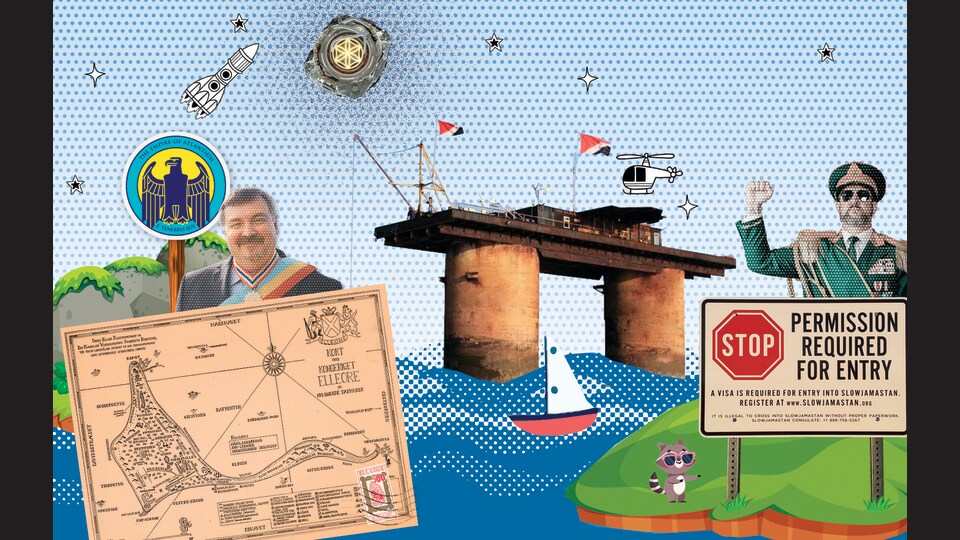
Some have built their own monuments; others have banned Crocs. One micro-nation had a battle fought over it, though it’s just a World War 2 platform in the sea.
What makes a country a country, and why are so many micro-nations popping up around the world, fighting to be seen?
The United States of Kailasa has probably caused the most chaos, with representatives showing up at UN meetings in Geneva; signing a sister-city agreement (that was soon rescinded) with the mayor of Newark. And, just this month, getting an official from Paraguay’s department of agriculture replaced after it emerged that he had signed on to explore diplomatic relations with the fictional state.
At the other end of the scale is the Kingdom of Elleore in Denmark, one of the oldest continuous micro-nations. It was founded on the 3.7-acre island of Elleore in 1944 by a group of school teachers, to parody the royal traditions and government structure of Denmark. The kingdom has its own lore, according to which Irish monks first settled the island in 944 CE. For one week a year, its “citizens” (which include students of the founding teachers) return to the private island from their “51-week holiday abroad”, to get things in order before they take off again.
During this time, some cook, young ones go to “university” (it’s mostly games), and the rest get down to tasks such as expanding on the lore. The island is off-limits to “foreigners”, and one must be 12 years old to apply for citizenship.
Now, according to the Montevideo Convention on the Rights and Duties of States — recognised as the rulebook in these matters since 1933 — a nation must have a permanent population, a defined territory, a government and a capacity to enter into relations with other states, in order to qualify as a country.
A micro-nation is typically an unrecognised state-like entity, whose founders have declared dominion over a piece of land (often privately owned; most are isolated islands). They are typically set up to parody a real country, make a political statement, serve as a means of expression, or underline a unique way of life.
There are currently over 100 micro-nations in the world, with about a third of these in Australia, according to a 2021 study titled Micronations: A Lacuna in the Law by Australian legal academics Harry Hobbs and George Williams, published in the International Journal of Constitutional Law.
Most design their own notional currencies, flags, constitutions and passports, and appoint unrecognised diplomatic representatives. They usually have a king, princess, sultan, supreme pontiff or “elected head”.
They are invariably bound by the laws of the recognised countries within which they sit.
“A primary driver for the foundation of many micro-nations is frustration with state authority, whether manifested in resistance to taxation, or regulation of any sort,” Hobbs and Williams write.
The micro-nations serve as an interesting social experiment — akin to the hippie communes of the 1970s — reflecting unusual definitions and ideals. They also serve as a reminder of how much it takes to keep a real country in working order. In 2020, for instance, the Principality of Hutt River in Western Australia, one of the longest-running micro-nations in the world, dating to 1970, “surrendered” to Australia after Covid-19 dried up tourism, a major source of income.
“Micronations are frequently dismissed as trivial or an oddity. Nonetheless, in dressing in the language of statehood… [they] provoke important public law challenges,” Hobbs and Williams write. Here’s more on some of the strangest.
A water world
The Principality of Sealand is located on an abandoned World War 2 base that’s essentially a concrete platform in international waters, off the coast of England. It was commandeered in the 1960s by the late Paddy Roy Bates, a World War 2 veteran, who declared it a micro-nation in 1967.
There was even a tiny battle on Sealand, in 1978. Mercenaries stormed the platform while Paddy Roy and his wife Joan Bates were in Austria, trying to negotiate the sale of the space. The invaders held their son Prince Michael hostage for three days. Bates helicoptered in, in the middle of the night and fought them off, and kept one German citizen prisoner until Germany sent a diplomat in to negotiate.
That was in a time when Sealand enjoyed a certain independence, because it sat outside British jurisdiction in the North Sea. In 1987, the UK extended its territorial waters and enfolded it. The 4,000-sq-metre platform is now private property maintained by the Bates family, with Prince Michael overseeing maintenance, funded by the selling of official Sealandic titles and citizenships.
A space kingdom
With over 250,000 citizens, Asgardia has a larger population than many small countries.
The experimental digital space nation was set up by Igor Ashurbeyli, a Russian-Azerbaijani scientist, engineer and self-appointed head of the nation (later ratified by online vote). His mission, as he sees it, is to create a starting point from which to “build a new home for humanity in space”.
Physically, Asgardia is represented by a satellite about the size of a loaf of bread, floating in orbital space. The satellite, containing digital copies of the Asgardia constitution and flag and data on the micro-nation’s “citizens”, was launched into space in 2017.
Its national digital currency, the Solar, sells at parity with the Euro, among collectors, and is reportedly backed by funds deposited in an international bank.
Ashurbeyli, incidentally, is an accomplished scientist, who won a 2023 Unesco medal for his contributions to the development of nanoscience and nanotechnologies. How his micro-nation helps with the mission for a new home in space, is not clear.
A teen empire
The Empire of Atlantium was founded by three teenagers in New South Wales, Australia, on 3rd Decimus, 10500 (that’s Atlantium for November 27, 1981). George Cruickshank, has served since as Imperial Majesty and Emperor.
Atlantium sits on 80 hectares of bushland, about 350 km from Sydney, bought by Cruickshank in 2008. It has a rapidly growing population of over 3,000 “citizens”, though most have never visited. They instead lie scattered around the world, some having paid additionally for the status of unaccredited diplomatic representative / ambassador.
Atlantium has open borders through which people and kangaroos can hop. It isn’t striving for real-world recognition. Cruickshank sees it as a sustained performance-art project meant to make its “citizens” think about ideas such as borders, sovereignty, citizenship and nation-building.
A cabin functions as the seat of government; stamps and souvenirs are available at an adjoining post office. Selfies can be taken at the country’s “monuments”, which include a 4-metre-high concrete pyramid and the Capitaline Column.
A sultan in the desert
A former DJ, Sultan Randy R Dub Williams, rules the United Territories of The Sovereign Nation of the People’s Republic of Slowjamastan, an 11-acre micro-nation in the California desert.
His 5,000 “citizens” signed up online but are unlikely to visit, given his despotic nature. Crocs, for instance, are “banned” here. So is biting string cheese or playing mumble rap.
There’s a passport, a national anthem titled Slowjamastan (I Think It’s Gonna Be an Awesome Place), and a “national animal”, the raccoon.
Williams, a travel enthusiast, founded Slowjamastan in 2021. His plans for his people’s republic include solar facilities, an armadillo farm and a restaurant. So far, he has installed a mailbox, and conducts “Porder Batrol” in a van with a number of appropriate-looking decals.
To be fair, he does seem to have spent a lot of time on his website, which is dramatic in its detail. “Be on high alert for smuggled Crocs this upcoming weekend (Source: Slowjamastani Intelligence),” is its most recent advisory. Other updates from Porder Batrol include “Stopped 79 drivers who had their feet on the dashboard” and “Destroyed 17 tunnels (later discovered to be just gophers, but still…)”. One can see why people pay for citizenship.
Kailasa, meanwhile, is a micro-nation that really checks very few boxes. For all its erroneous recognition, it has no confirmed location. Its founder Nithyananda, a self-styled godman and rape-accused fugitive, reportedly bought an island off the coast of Ecuador on which to house it, but no one knows which one. He, meanwhile, has been untraceable since 2019.


