
 E-Paper



Meet Assamese artist Santanu Hazarika who quit engineering to become a doodle artist and now designs your favourite gaming jerseys, cola campaigns

 Prefer HTon Google


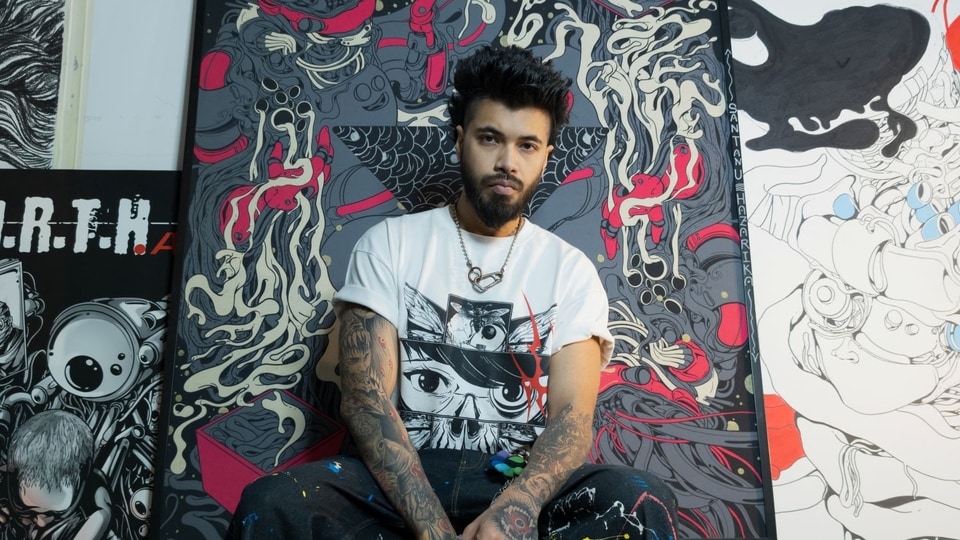
Multidisciplinary visual artist Santanu Hazarika's client list in music is a who's who of Indian counterculture: Divine to Seedhe Maut. Here's his untold story.
In India in 2014, if you told your parents you wanted to quit engineering to become a doodle artist, you were basically asking for a family intervention. Santanu Hazarika did it anyway. Also read | Abhay Sehgal interview: What's it like being an artist in the age of social media and should you go to art school?
The self-taught artist from Assam had just won the inaugural Red Bull World Doodle Art Championship. Overnight, he went from the guy sketching for fun to the one representing India on a global stage. It was validation. It was freedom. But it also came with a tag that would follow him for the next decade.
For years, everyone introduced him the same way: 'Santanu Hazarika, doodle artist'. Today, if you call him that, he’ll politely correct you. “I don’t kind of use the title anymore because I have kind of grown beyond it,” Santanu told HT Lifestyle in an interview.
“The title was sort of like a means to an end; it really helped me get my footing, change my track, and winning the world championship gave me that confidence. It also helped me break many stereotypes back home so I could pursue art or design as a career. But that was just a side of me. Now I work as a creative director on multiple projects and visual arts initiatives. It’s actually more three-dimensional than just being labelled as an artist at this point," he added.
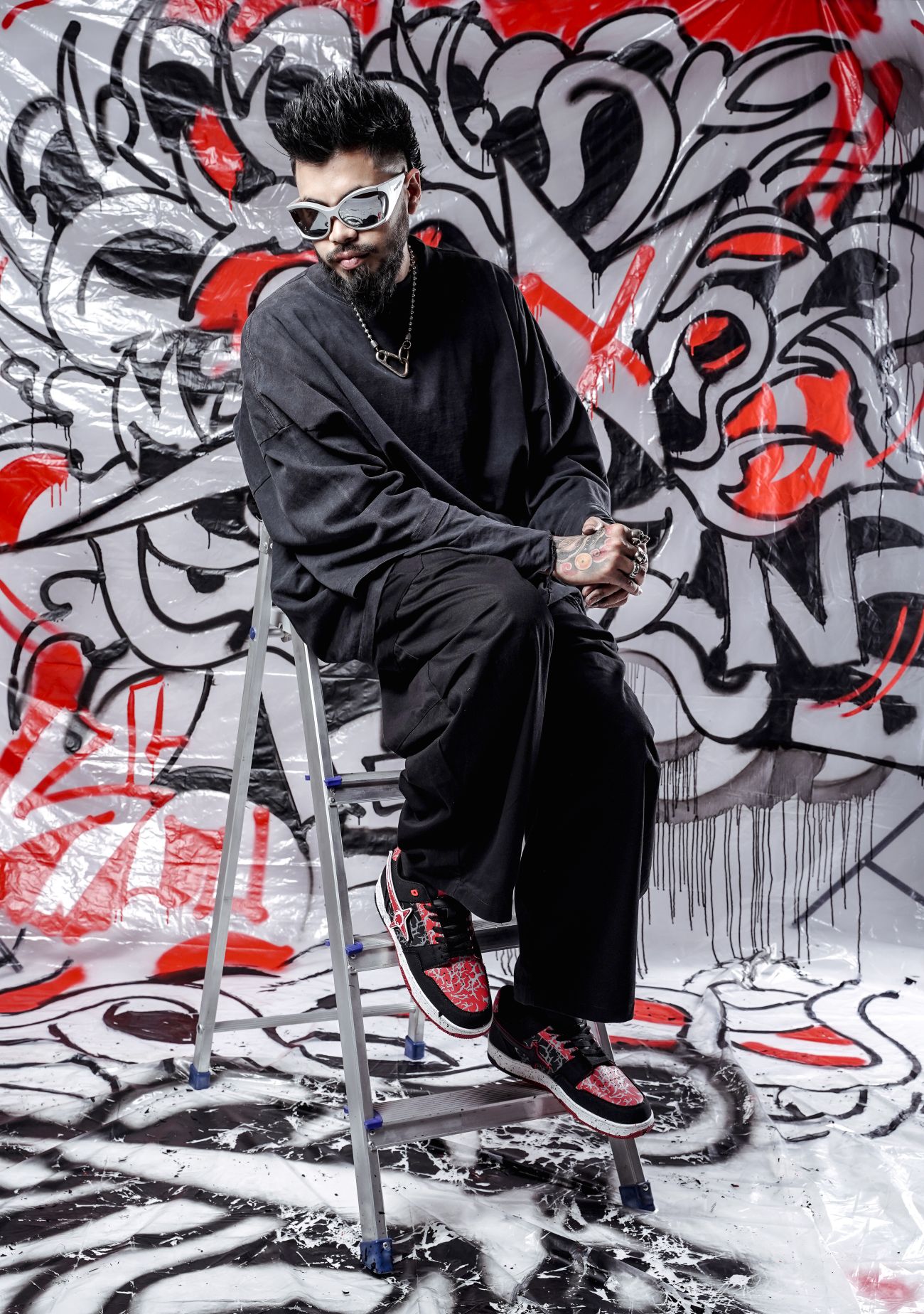
Three-dimensional is an understatement
If you look at Santanu’s portfolio today, it doesn’t look like it belongs to one person. It looks like it belongs to an entire creative agency. One day he’s painting a huge mural. The next day he’s doing a custom paint job on a motorcycle. Then he’s directing visuals for Divine, Seedhe Maut, Raftaar, and Nucleya or designing digital assets for Nothing. Then he’s collaborating with Adobe.
How does a man with no formal art school training pull that off? Pure, obsessive, self-education. Santanu didn’t go to art school, but he made his own curriculum. Japanese manga. Renaissance art. Heavy metal album covers. Graffiti on the streets of Guwahati. Everything was a textbook.
“The learning period has always been there,” he said, adding, “Even now, at this point, I’m learning every day. Everything: new skills, new media, be it AI or new technologies coming around. The first stepping stone was quite exciting for me because everything felt new. Every opportunity felt like a potential track or a potential lesson. The words I would use are 'intriguing excitement.'
And here’s the secret sauce: he doesn’t change his process. He changes his tools. Translation: give him a wall, a sneaker, a car, or a gaming jersey — the soul will still look like Santanu Hazarika. He explained: “I have a distinctive art style and a distinctive process. Essentially, it’s the process which defines the outcome, and I feel like I’ve stuck to that single process almost my whole life. It’s only the technicalities of work that change with different mediums, but the core of it, the essence, and the process more or less remain the same. You need a good anchor point to fall back on, sequence by sequence, irrespective of the medium.”
His rule? 60 percent global aesthetics, 40 percent roots
When Konami — yes, makers of eFootball — asked Santanu to design custom sportswear for their global video game franchise, most artists would have gone full cyber-futuristic. Santanu brought Assam to the pitch. Literally. He took the gamusa — the traditional red-and-white woven cotton towel that is basically Assamese identity in fabric form — and deconstructed it. He didn’t just paste it. He studied its geometry, its colours, its soul.
“How I stay rooted is the fact that I am rooted. It has never been the case that I try to force my cultural identity into everything, rather than keeping it in a nice balance. For a project like the eFootball jersey, I moulded Assamese identity. I stripped it down to the basic colours of the very thing that gives us an identity — which is the gamusa," he shared.
His formula? 60-40. “The ratio was more or less 60-40, with 60 percent being the idea of the jersey, how the aesthetics were going to look, the sportswear, and 40 percent being inspired by everything that is gamusa and my roots. So that’s how I play with the game of ratios," she explained.
It’s not tokenism. It’s not exoticism. It’s why his work never feels like a forced 'Indian touch' that brands add for diversity points. He’s now taking that philosophy further — building an artist and music residency in Assam to create a two-way creative highway between the northeast and the rest of India.
When Thums Up and Jasprit Bumrah came knocking
If you’ve seen Thums Up’s ThunderWheels 3.0 campaign with Jasprit Bumrah, you’ve seen Santanu’s brain at work. On paper, it’s a commercial brief: make a cricket superstar look thunderous. In Santanu’s head, it’s a Venn diagram where Bumrah’s lethal pace, Thums Up’s high-octane energy, and his own love for motorcycles, metal, and speed all overlap.
He shared, “Jasprit was really amazing and open to all the ideas, and he liked my designs in the first iteration itself. This comes with experience. I’ve been in this industry for more than 10 years, and I’ve worked with almost 150 brands and artists. So I kind of know what the design language is going to be like.”
“Jasprit being Jasprit, he’s the face of the brand. So all I had to do was sort of mix them up so that my art represents their combination. Biking and motorcycling are important factors. Speed, alternative design, thrill, excitement, adventure—these are also the kind of things reflected in the music I listen to, like rock and metal. Everything sort of belongs in the same ecosystem, and all I had to do was give it a form," Santanu added.
And for everyone wondering — how do you stay 'street' when you’re working with cola giants? His answer is: “Because I’ve always done this, brands come to me for that reason. It’s not the other way around. I’m not even trying hard to keep my work original or true to its roots because that’s what my roots are, and that’s my appeal.”
His other clients
Both hip-hop and metal — and Santanu’s art — are unfiltered. Just raw, loud, bold expression. No wonder his client list in music is a who’s who of Indian counterculture. Divine, Seedhe Maut, Raftaar, Nucleya – even sitar prodigy Rishab Rikhiram Sharma, and now a super-immersive experience with Sid Sriram.
It makes sense when you hear his logic: “Artists like Seedhe Maut, Divine, and heavy metal musicians have a very similar language in terms of how vocal we are about our things and how bold we are with our art forms. The music automatically resonates with the kind of things I do, and that’s why it just works out.”
AI, authenticity and why he’ll never quit sketching on paper
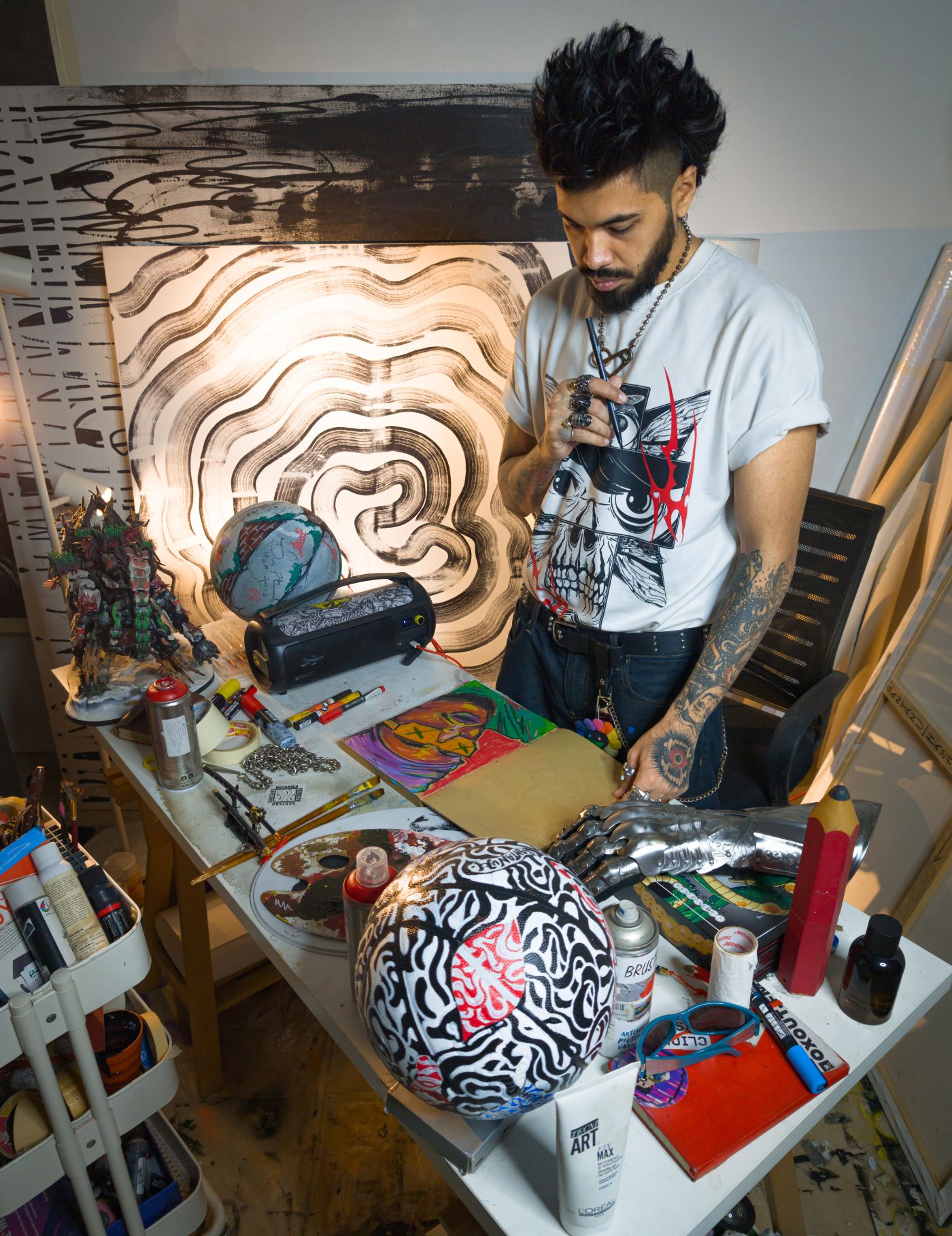
We had to ask him. In 2026, everyone is using AI. But there is one non-negotiable for him: “One thing that I’ll never let AI or technology replace is my drawing and sketching process." He added: “That’s my favourite, and to this day, I sit down, doodle, make notes, sketch, and draw in my diaries, on paper, or in my art books, and I’ll never let that go. That’s what keeps me excited. That’s what declutters my brain and brings me peace in ways that even I can’t comprehend.”
The man who was labelled a doodle artist a decade ago, who outgrew the label, still goes back to doodling every single day to stay sane. It’s his meditation. His sanctuary. His analogue ritual in a hyper-digital world.


