
 E-Paper



Weekend Drive by Hormazd Sorabjee: Falcon in the desert

 Prefer HTon Google


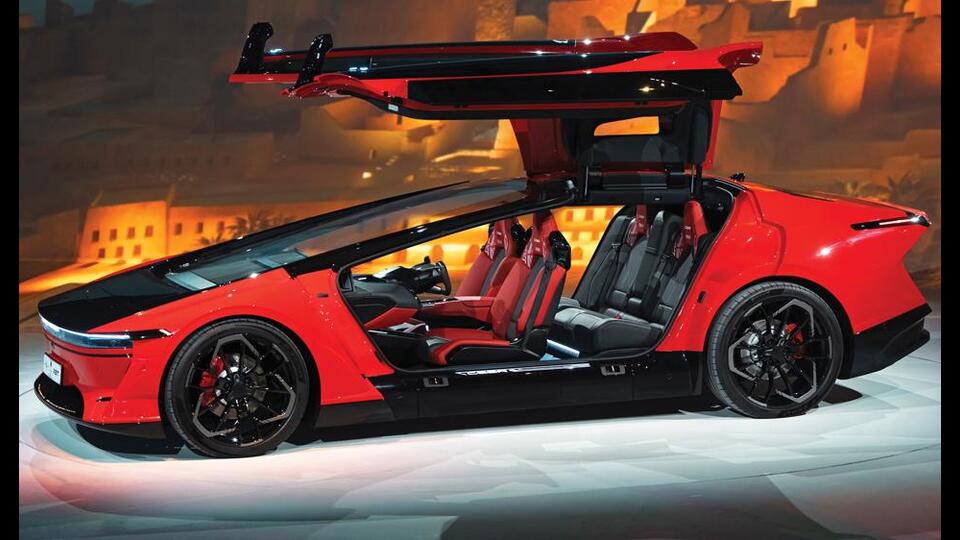
With their sharp edges, falcon wing-like doors and halo cooling systems, Saudi Arabia’s new Exobot cars might kickstart a new auto industry in the Middle East
Saudi Arabia’s first home-grown car brand has arrived, with two wildly futuristic electric flagships and a plan to build a car industry from the ground up.
It’s hard to miss the irony. The world’s biggest oil exporter has launched its first cars, and neither burns a drop of petrol. But for Saudi Arabia, that’s exactly the message. Ceer, a name that loosely means “to drive forward” in Arabic, is a pet project of Crown Prince Mohammed bin Salman. Its Exobot sedan and SUV, unveiled near Jeddah, are meant to show a nation built on oil that it can build a green future too.
Few car start-ups have had pockets this deep. Ceer is backed by the Public Investment Fund, Saudi Arabia’s sovereign wealth fund, and was set up as a joint venture with Foxconn, the company better known for assembling iPhones. The factory, in King Abdullah Economic City near Jeddah, cost around $1.3 billion and can build roughly 2,40,000 cars a year. And Ceer has lined up partners including BMW, Hyundai and Rimac.
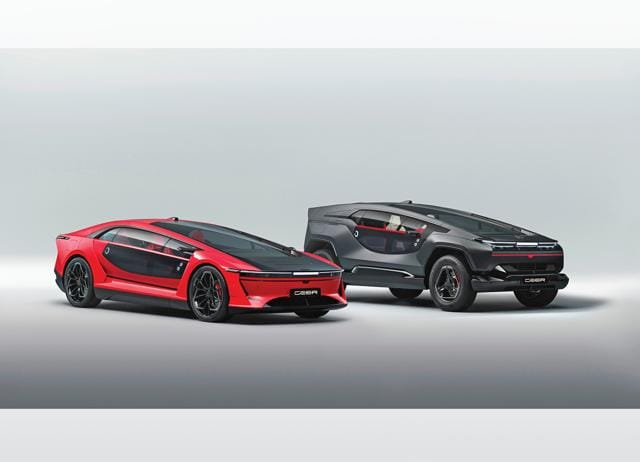
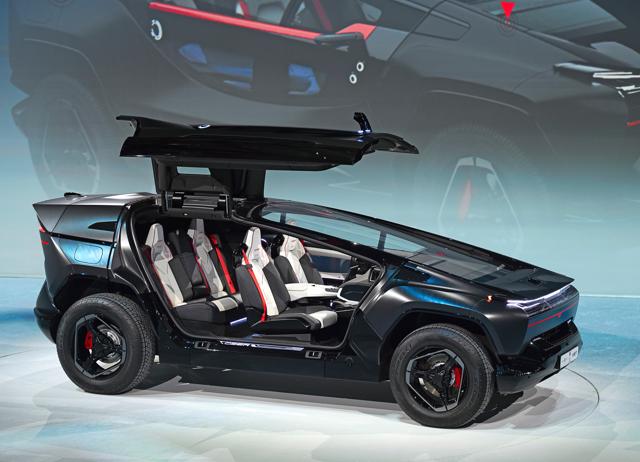
Ceer Automotive CEO James DeLuca’s ambitions are not modest. He wants to ignite an industry, inspire a nation and “amaze the world”. That starts with the design. The Exobots are huge, sharp-edged wedges, with the sedan more than 5.2 metres long and over two metres wide. Each has what Ceer calls the biggest windscreen ever fitted to a passenger car, and nearly three-metre-long rear-hinged doors inspired by the wings of the Shaheen falcon. Chief designer Rob Melville says the wedge shape borrows from the triangles of traditional Najdi architecture. Love it or loathe it, you won’t mistake it for anything else.
All that glass in a desert climate sounds like the makings of a pizza oven, but Ceer has a clever “halo cooling” system that blows cold air across the roof, and the company claims it can bring a 65°C cabin down to 22°C in 10 minutes.
Launch versions make 850hp, and the top-spec model delivers a staggering 1,111hp, enough to hit 100kph in a claimed 2.1 seconds. That’s supercar territory in a car that seats four adults. A range of up to 670km and a 30-minute fast charge make it practical too. Inside, a 48-inch screen stretches across the dashboard, yet Ceer has kept physical buttons for the things you use most.
For now, “Made in Saudi”; doesn’t quite mean “Made of Saudi”. Only about 18% percent of the car is sourced locally, with the rest coming from China, South Korea and around 18 Indian suppliers. Ceer hopes to push local content to 45% by 2034.
Production begins in January 2027, with deliveries from March. Don’t hold your breath for an India launch; the cars are built for left-hand drive. Five more affordable hybrid models are due by 2030, and they’ll matter more than these headline-grabbing flagships.
The real test begins next year, when the first Exobots leave the factory and Ceer has to convince buyers to sign on the dotted line.
From HT Brunch, October 10, 2026
Follow us on www.instagram.com/htbrunch


