
 E-Paper



Lok Sabha elections 2019: AAP promises end to sealing, home for all
While releasing the manifesto, AAP convener and Delhi chief minister Arvind Kejriwal said the party will be able to attain full statehood for the city only if it wins all seven seats in the national capital.

 Prefer HTon Google


Relying completely on the national capital becoming a full state, the Aam Aadmi Party (AAP) in its manifesto, released Thursday, promised to set up Delhi’s own Public Service Commission within a year, apart from an immediate crackdown on corruption by reviving the anti-corruption branch (ACB).
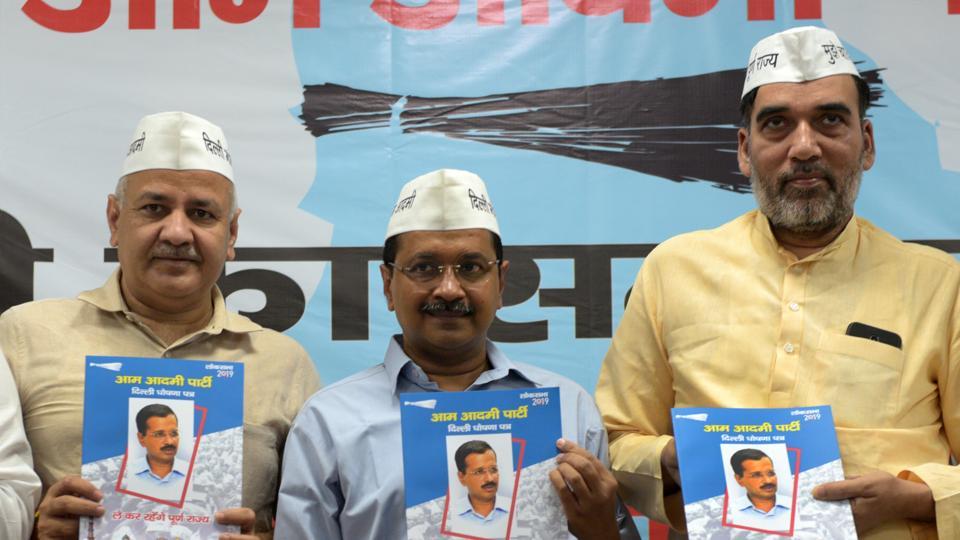
While releasing the manifesto, AAP convener and Delhi chief minister Arvind Kejriwal said the party will be able to attain full statehood for the city only if it wins all seven seats in the national capital in the ongoing Lok Sabha elections.
Delhi goes to polls on May 12 and the results will be declared on May 23.
Bringing the issue of corruption back into the political discourse, the party said it would revive the ACB like it did during the 49-day AAP government and “break the spine of corruption” in Delhi. The ACB went under the direct control of the Centre through the lieutenant-governor on the basis of a notification issued by the Union ministry of home affairs in May 2015.
If the AAP wins, the party also plans to address the problem of transfers and postings of officers in the Delhi government by setting up its own commission within a year.
The issue has resulted in multiple flashpoints between the AAP government, the L-G and the Centre as currently, the subject of ‘services’ is under the Union government’s control. The AAP government claims that not having control over transfers, postings, performance reviews and accountability of bureaucrats obstructs governance. Top officers of the Delhi government belong to the Indian Administrative Services’ AGMUT (Arunachal Pradesh, Goa, Mizoram and Union Territories) cadre because of which they also get transferred out of Delhi.
The AAP manifesto also states that owing to “zero accountability” of the Delhi Police towards the people, Delhi has the highest crime rate in India, whereas the conviction rate is only 52%.
It talked of carrying out “extensive reforms” on the basis of a Supreme Court judgment in the case of Prakash Singh versus Union of India, 2006, to modernise Delhi Police.
“Delhi Police is highly understaffed and two-thirds of positions are lying vacant. AAP will ensure that all posts are filled, along with a 33% reservation for women. Response time of PCR vans to will be brought down to five minutes,” it said.
Reacting to the proposed police reforms, retired Indian Police Service (IPS) officer Prakash Singh, who served as the chief of Uttar Pradesh and Assam police forces, and whose public interest litigation led to the SC passing landmark police reforms in 2006, said, “These are all cosmetic changes. Gradually, all state police forces are upgrading themselves. What is needed are institutional reforms. No party talks about that.”
Singh said reforms should be such that the police are separated from extraneous pressure. “That is the real reform. The Congress has said they will discuss reforms as noted in the case. But they were in power when the Supreme Court had passed the judgment in my case,” he said.
The manifesto also a had a chart comparing Delhi with London, Berlin, Moscow, Mexico City, Ottawa and Washington City. It attempted to show how these cities have power over the local police, appointments and transfers, land and city planning, housing, traffic and transport planning and local bodies while Delhi has none.
In a personalised message to voters, Kejriwal listed the things he would get done — women safety will improve; law and order will improve; youth will get jobs; every child who has scored over 60% marks in class 12 will get a college admission; sealing will be stopped; every Delhi resident will have an own house; unauthorised colonies will be regularised; and Delhi will be made a clean and beautiful city.
Addressing the issue of the sealing drive, the AAP manifesto said it would completely stop the action and redraft building by-laws. On having control over land, which currently vests with the Centre, the party promised houses on cheap loans to every voter family. It said it will also formulate a new rental housing strategy for Delhi and create new rental housing stock for migrants, professionals and students.
Apart from filling the existing vacancies of over two lakh government jobs in the Delhi Police, education, health department with 85% reservation for city residents, the AAP also said it would implement 14 bills passed by the state assembly as soon as Delhi becomes a full state. These Bills, which include the Jan Lokpal Bill and a model Mohalla Sabha Bill are currently with the Central government.
Deputy CM Manish Sisodia said all of these would come true only if Delhi becomes a full state. That will be possible only if Delhiites vote for AAP and make the win all seven seats, he said.


