
 E-Paper



Terms of Trade | Karnataka polls, a laboratory for Congress and BJP
Rahul Gandhi's OBC reservation remarks and exodus of party leaders from the saffron party indicate something larger is going in the southern state. An analysis


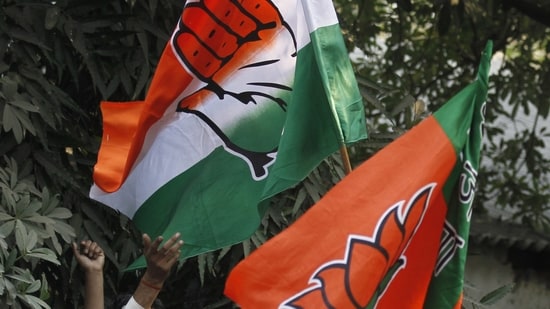
It is always hazardous to predict electoral outcomes in India. Karnataka’s fragmented politics, especially given the suspense on the fate of the third force i.e., Janata Dal (Secular), makes it an even more hazardous exercise this time around. Whatever the results of May 13 may be, the political strategies (and not tactics) deployed by the two major players in the state and the country, namely, the Bharatiya Janata Party (BJP) and the Congress are best understood as aspirations to recraft the political-organisational basis of how the two parties have functioned historically. What makes it even more interesting is the fact that while the Congress is trying to correct its past mistakes in the hope of a better future, the BJP is actually trying to recraft its organisation like the Congress was in the past in its hegemonic days.
Let us look at them one by one.
Speaking at a campaign rally in Karnataka, Congress leader Rahul Gandhi became the first person from the Gandhi family to ask for a caste census and explicitly link it to the demand for proportionate reservation — this will increase it to (at least) more than 40% from the extant 27% — for Other Backward Classes (OBCs). Gandhi’s endorsing this demand is directed at more than the Karnataka elections and the Congress is clearly hoping to align itself to the larger strategy of forging a pan-OBC solidarity with other regional parties to eat into the BJP’s support base in the 2024 elections.
The BJP’s Karnataka campaign, at least as of now, has been mired in the news of senior regional leaders leaving the party. While Karnataka BJP has always been a faction ridden party, the central leadership’s reaction this time seems like it is not exactly perturbed about defections from its ranks, even if they provide a fillip to the Congress’s fortunes in these elections. This almost sounds like a passive purge of the veterans in the ranks.
While campaigning will go on till May 8, it is unlikely that these two issues will lose their importance in this round of Karnataka elections.
Importance of Rahul Gandhi demanding proportionate OBC reservations
Let us take the Congress first. If there is one political party which has suffered the most due to the rise of OBC politics in India, it is the Congress. It first lost to the Dravidian OBC assertion in Tamil Nadu. Then came the OBC challenge from what would eventually become Mandal based political formations in Bihar and Uttar Pradesh. Once it lost power the Congress has never been able to resurrect itself in these states, which, before the partition of Bihar and Uttar Pradesh, accounted for 178 out of 543 Lok Sabha seats.
At the risk of making a provocative argument, it can be said that Congress’s historical antagonism with OBC politics is more a result of its historical evolution than a programmatic aversion to OBC aspirations. The Congress party’s leadership developed in an environment of truncated democratic representation which the British offered as a bargaining chip to the anti-colonial movement. Because the elections held during British rule initially offered limited franchise to propertied classes, large parts of the Congress leadership ended up excluding those who did not own property in India.
This led to an automatic exclusion of OBCs and dominance of landed upper caste people in the Congress leadership. Once the die was cast, it was very difficult for the Congress party to purge its upper caste vested interests in order to accommodate the aspirational surge in OBC politics after independence. With OBCs becoming the most dominant group once universal suffrage kicked in, it was only a matter of time before they unseated the Congress from a position of power in key Indian states.
The deployment of reservations as a political promise to achieve the objective of OBC dominance in politics was, in the words of James Manor, driven by a realisation “that the main result of such programmes is not the transformation of the lot of the ‘backward classes’ but rather a temporary surge in their political consciousness” which is useful in winning elections. Ironic as it is, Manor wrote these lines to describe the success of a Congress politician from Karnataka (Devraj Urs) in mobilising OBC support.
While the Congress did patch up with OBC parties in the aftermath of Babri demolition to protect the cause of secularism, and the first UPA government rolled out the second phase of Mandal Commission recommendations giving reservations in central educational institutions (Mandal I only reserved jobs), it has never really invested itself completely in the cause of OBC politics. By making such a commitment for the first time, Rahul Gandhi is clearly hoping to undo the Congress’s historical unravelling at the hands of OBC assertion.
What could possibly explain BJP’s cold shoulder to its regional leaders in Karnataka?
There can be only two explanations for this. The easiest answer is that the BJP is extremely confident about winning Karnataka. If this were to happen it would require a trend break in Karnataka’s political history. The state has not reelected a government with majority in many years. The BJP, despite being a more united force than what it was in 2013 and enjoying anti-incumbency tailwinds, could not win a majority in the 2018 elections. One can argue that a majority in 2023 is an unlikely if not impossible scenario at the moment.
The other answer, and it is slightly in the realm of conspiracy theory, is that the BJP’s central leadership is reconciled to a loss, but is using the opportunity to purge its organisation of elements which it has never been very comfortable with in the first place. While the party has been pragmatic enough to placate its biggest troubled asset B S Yeddyurappa in these elections — it has perhaps drawn a lesson from its 2013 defeat — it is clearly not interested in extending a similar long rope to other leaders. What explains this kind of attitude?
The answer to this is to be found in the qualitative transformation in the nature of the BJP in the post-2014 era. The BJP organisation, under the leadership of Narendra Modi in the period after 2014, can only be compared to what the Congress had become under Indira Gandhi which was best articulated by Dev Kant Barooah’s infamous line “India is Indira. Indira is India”.
At a more serious level, there is now an extreme centralization of both political and financial capital in the BJP. This translates itself in terms of praxis to Modi being the chief campaigner and vote mobiliser and the high-command being the overwhelming collector and provider of political funding. As is obvious, such an arrangement requires a dilution of the political economy clout of regional leadership of the party, both in terms or not allowing anybody to emerge as a challenger to the authority (and popularity) of the high-command as well as reducing local level corruption which is a necessary by-product of raising political finance. It is on the latter front that the BJP government is battling a huge anti-incumbency in Karnataka. By denying tickets (which is what has triggered the exodus) to what could be non-pliant leaders in Karnataka, the BJP is hoping to make its rebellious Karnataka unit fall in line with the new normal.
Will these gambles pay off for the Congress and the BJP?
As has been argued above, Karnataka is only (a low-risk) test case for these gambles by the Congress and the BJP. The real question is whether the Congress can resurrect itself by firmly aligning itself to the Mandal bandwagon and will the BJP’s long-term prospects be helped by making its state leadership completely pliant to the high-command?
Let us first look at the reasons why the strategy could work.
When OBC assertion first started in the 1960s and ’70s, an overwhelmingly upper caste leadership made it impossible for the Congress to align itself to the Mandal wave. It would have faced either a rebellion or a sabotage from within. The situation is as different as it could be today, as the Congress does not even have what can be described as organic state-level leaders in most Indian states. Also, the Hindu upper caste vote bank has already left the Congress and it is more than happy to support the BJP, which notwithstanding its pragmatic social engineering, is still invested in Hindu conservatism as far its larger worldview is concerned. BJP’s social inclusion has legitimised a politics of Sanskritization unlike what Dravidian or Left variety of politics sought to do. If one were to put it crudely, Rahul Gandhi’s decision to align the Congress’s rhetoric to social justice will, if nothing else, deliver a progressive political death to the Congress rather than it carrying the stigma of a Brahminical political force which eventually atrophied.
For the BJP, there have never been better times than what the political strategy of Brand Modi and its ‘double-engine’ franchises has delivered for it since 2014. It has won India’s largest state Uttar Pradesh, established a hegemonic presence in the north-east, done a coup on its senior partner Shiv Sena in Maharashtra and managed to become the main opposition party in West Bengal. While communal polarisation including dog-whistling from the highest levels, especially during campaigns, has played a role, one will be missing the point if the importance of execution and delivery of large-scale welfare and infrastructure projects and othering of dominant caste politicians at the state level (Yogi Adityanath in Uttar Pradesh is a quasi-exception to this) is not taken into account. Karnataka so far has been a troubled state on all these counts.
Having discussed the pros, let us now come to the cons.
Unlike in the 1960s and 1970s, when OBC assertion was driven by a genuine passion against political dominance by upper caste leaders and feudal dominance by (largely) upper caste landowners in Indian villages, India’s socio-economic landscape is very different today. While OBCs do not have proportionate representation in education and jobs, especially the better ones, their political representation is much higher than what it was when the first Mandal rebellion began.
That upward mobility of OBCs in politics has not led to a concomitant improvement in the realm of education and jobs is bound to have created a cynical attitude towards the potential of politics as an engine of equality even within the ranks of OBC voters. What will add to this cynicism is the fact that a lot of constituents of the new Mandal coalition are the same organisations which are seen as responsible for having betrayed the Mandal revolution by pandering to nepotism and sectarian preferences for sub-castes rather than OBCs as a whole.
In fact, one can argue that by choosing to invest its energies in the Mandal basket, the Congress might have let go of an opportunity to precipitate a genuine class polarisation in India, which is another issue which has seen a lot of polemics from Rahul Gandhi. While a small subset of upper castes is indeed disproportionately privileged in India, it will not be wrong to argue that an overwhelming share of them are also feeling the heat from India’s growth trajectory which has created a viability crisis in agriculture and not generated enough well-paying jobs. A Mandal 3.0 campaign is bound to alienate this lot.
For the BJP, the problem is best captured by paraphrasing its often-used jibe against the opposition which is “If not Modi, then who”. As a party which is emaciating its state-level organisation of mass leaders (notwithstanding their vices), its biggest challenge will come in the form of “After Modi, who”. This is not just a question of BJP going the House of Cards way in the future where it is only dealing with palace coups.
While most analysts, especially those critical to the BJP, like to focus on Modi’s past as a dedicated volunteer of the RSS, it was his organic evolution as a chief minister of Gujarat which allowed him to develop his own political economy vision which is the cornerstone of the BJP’s political strategy today. As much as the BJP would like to believe that this strategy will work forever, creative destruction of this political economy approach will eventually catch up with the Modi line, especially as the party runs out of first-generation problems which it has exploited to the hilt via its welfare schemes so far.
To be sure, none of the issues discussed in this column could manifest themselves in the immediate future. But politics is never about tomorrow. In the words of Lenin, in politics, “there are decades where nothing happens; and there are weeks where decades happen”.
Every Friday, HT’s data and political economy editor, Roshan Kishore, combines his commitment to data and passion for qualitative analysis in a column for HT Premium, Terms of Trade. With a focus on one big number and one big issue, he will go behind the headlines to ask a question and address political economy issues and social puzzles facing contemporary India.
The views expressed are personal
 ABOUT THE AUTHORRoshan Kishore
Roshan Kishore is the Data and Political Economy Editor at Hindustan Times. His weekly column for HT Premium Terms of Trade appears every Friday.


