A strange contradiction is being seen in the streets of Delhi these days. While posters announced that the “Mother of Democracy” welcomed G20 delegates, the Bhartiya Janata Party (BJP) filled political corridors with arguments against having a democratically-elected, representative state government for Delhi. When these arguments are dissected along administrative, legal and historical lines, they are just another device in the BJP’s toolkit for capturing power when denied so by the people electorally.
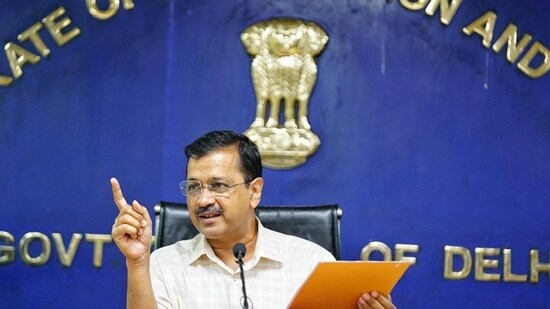
Delhi chief minister Arvind Kejriwal at the Delhi Secretariat. He has opposed the ordinance passed by the Centre, according certain powers to the Lieutenant Governor, calling it "unconstitutional". (HT photo)
To begin with, one must distinguish the New Delhi Municipal Council (NDMC) area – which houses the Central Government offices, the Supreme Court, and the diplomatic avenue – from the rest of Delhi. NDMC comprises only about 1.8% of the population and 3% of the land in Delhi. The present question is about the remaining 97% of the 20 million people of Delhi, who rightly deserve to be governed by a state government that was elected by them and is, thus mindful of the needs of the constituents and can be held accountable.
As two landmark Supreme Court (SC) judgements from 2018 and 2023 have held, the elected government in Delhi has the sole authority to administer Delhi on all matters falling in the State and Concurrent Lists except three – police, law and public order. The 2023 Constitution Bench judgment of the Supreme Court further noted, “The principles of democracy and federalism are essential features of our Constitution and form a part of the basic structure. Federalism in a multi-cultural, multi-religious, multi-ethnic and multi-linguistic country like India ensures the representation of diverse interests.”
The Constitution’s vision of a federal set up has stood the test of time, enfranchising people through state governments that are closer to them, represent their needs, and are responsible to the electorate. Over the decades, several erstwhile Union Territories have been converted into full-fledged states. This is testimony to the value of a representative form of government as well as the wisdom of our parliamentarians.
Constitutional mandate
It is this promise of representation made by democracy that was sought to be fulfilled when the 69th Amendment to the Constitution was passed in 1991, granting a legislature and a popularly-elected state government to the people of Delhi. In an era when decentralisation of power has been a plank for empowering people at the grassroots level the world over, it is perverse that the BJP is now seeking to turn back the clock by engaging in a political discourse on the abolition of state government altogether.
The pitch against an empowered state government for Delhi also betrays ignorance of a comparative perspective. When we study the governance structures of national capitals in countries across the world, it becomes clear that India has the most regressive form of governance for its national capital. For example, it is the local city government in London (UK), Berlin (Germany), Mexico City (Mexico), Ottawa (Canada) and Washington DC (USA) that exercises control over police, land and city planning, housing, traffic and transport planning, and appointment and transfer of officials; the Delhi government doesn't.
In comparison, Delhi, with far fewer powers, stands out as an anomaly. Not only does the current governance setup create everyday hurdles in the delivery of basic public services to the people of Delhi, it is also a blot on the core ideals of democracy that India prides itself on. The undeniable conclusion is that cities thrive when their people find a voice, through an elected legislature and a popular government, and when the legislature and the government are adequately empowered.
A long history of this demand
Indeed, all major political parties, including the BJP and Congress, have consistently demanded full statehood for Delhi since 1951. We may do well to remember BJP leaders Atal Bihari Vajpayee’s and Lal Krishna Advani’s protests in the streets demanding full statehood for Delhi way back in the 1980s; or the words of former Chief Minister Madan Lal Khurana of BJP, who after winning the first Vidhan Sabha elections said that the House appeared like a body without a soul; or BJP’s Sahib Singh Verma’s remark in the late '90s that he was a powerless Chief Minister. We must also recall the bill introduced in the Parliament by Advani, when he was Union home minister in 2003, seeking full statehood for Delhi.
The BJP has now made a U-turn, resigned to the fact that the popularity of CM Arvind Kejriwal and the transformational work of the AAP government in education, health, and the water and power sectors will ensure that the BJP stays out of power in the national capital for the foreseeable future. The attack on the powers of the Delhi government, therefore, only reflects the ideological bankruptcy, lack of pragmatic long-term vision, repress-the-Constitution policy, and opportunistic politics of the Centre and the BJP.
The Delhi Ordinance is only the most recent attempt in BJP’s political ploy to wrest power away from a popularly elected government to avenge an electoral defeat. In 2021, the Central government amended the GNCTD Act to undo the effect of the 2018 Supreme Court verdict, and last month, it brought out the Delhi Services Ordinance to nullify another five-judge SC verdict. In the midst of this, it also amended the Delhi Municipal Corporation Act last year to disproportionately give powers to the Central Government over Delhi’s municipal body. It has become clear that the unrest in BJP is only because it cannot control Delhi by constitutional means.
Democracy rests on the pillars of constitutionalism, representation, inclusivity, empowerment, and equitable development. To question the need for a state government for Delhi is to question the very value of representative democracy. The “mother of democracy” should lead the path – it should indeed be a ‘Vishwaguru’ for cooperative federalism, decentralization and democratic form of government in letter and spirit. Not a polity going backwards, undoing the hard-fought gains of the people of India.
Jasmine Shah is an AAP leader. Views expressed are personal.

 E-Paper