

 E-Paper


Crocodile survey
1 / 11

 View Photos in a new improved layout
Updated on Dec 06, 2011 03:17 pm IST
Wildlife biologists Michael Cherkiss (L) with the US Geological Survey and Joseph Wasilewski weigh a small crocodile that they captured in a cooling canal adjacent to the Turkey Point Nuclear Power Plant, during a nighttime survey of the crocodiles in the area in Homestead. The crocodile monitoring program began in 1978, a year after employees stumbled upon a crocodile nest in the plant’s cooling canal system. AP Photo/Wilfredo Lee
2 / 11
 View Photos in a new improved layout
Updated on Dec 06, 2011 03:17 pm IST
A wildlife biologist holds a small crocodile that will be released into one of the cooling canals adjacent to the Turkey Point Nuclear Power Plant during a nighttime crocodile survey in Homestead. The initial goal was to ensure that the plant did no harm to the species but over the last three decades it has helped raise the number of crocodiles to more than 1,500 today. It is now classified as threatened, a small step toward the species' survival. AP Photo/Wilfredo Lee
3 / 11
 View Photos in a new improved layout
Updated on Dec 06, 2011 03:17 pm IST
Wildlife biologist Rafael Crespo, with the University of Florida, measures a small crocodile captured in a cooling canal adjacent to the Turkey Point Nuclear Power Plant, during a nighttime survey of the crocodiles in the area in Homestead. AP Photo/Wilfredo Lee
4 / 11
 View Photos in a new improved layout
Updated on Dec 06, 2011 03:17 pm IST
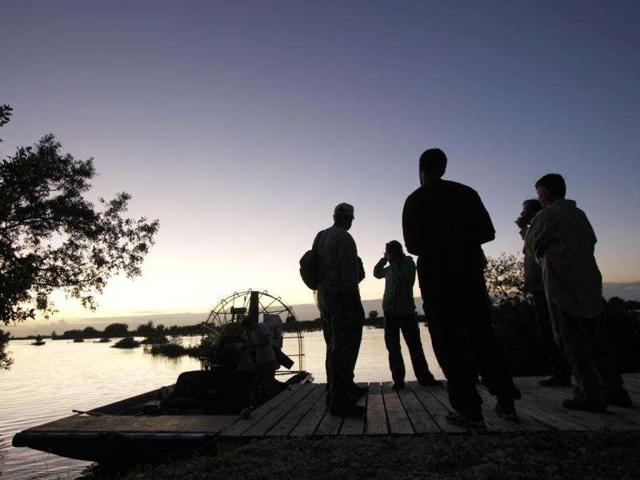
Wildlife biologists gather waiting for nightfall at a dock on a cooling canal adjacent to the Turkey Point Nuclear Power Plant during a nighttime crocodile survey in Homestead. AP Photo/Wilfredo Lee
5 / 11
 View Photos in a new improved layout
Updated on Dec 06, 2011 03:17 pm IST
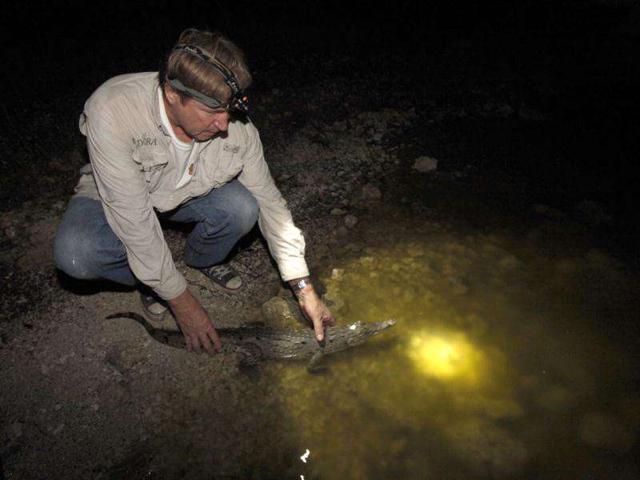
Wildlife biologist Joseph Wasilewski prepares to release a small crocodile back into one of the cooling canals adjacent to the Turkey Point Nuclear Power Plant, during a nighttime survey of the corocodiles in the area in Homestead. AP Photo/Wilfredo Lee
6 / 11
 View Photos in a new improved layout
Updated on Dec 06, 2011 03:17 pm IST
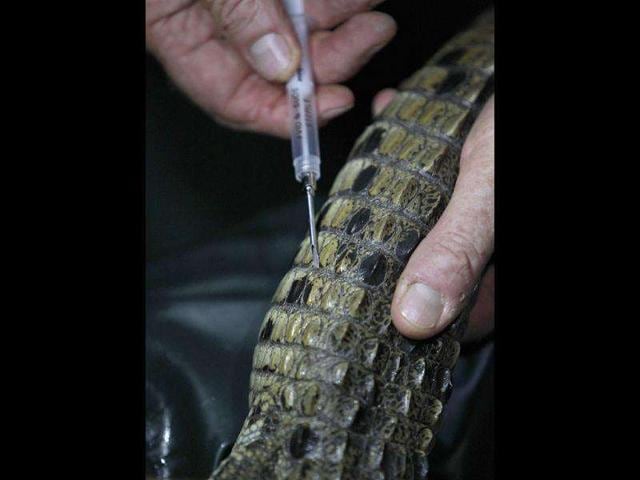
A wildlife biologist prepares to inject a microchip into a newly captured crocodile during a nighttime survey of the crocodiles in one of the cooling canals adjacent to the Turkey Point Nuclear Power Plant in Homestead. AP Photo/Wilfredo Lee
7 / 11
 View Photos in a new improved layout
Updated on Dec 06, 2011 03:17 pm IST
Wildlife biologist Joseph Wasilewski cuts off some of the bony plates or scales on crocodiles, called scutes, from a newly captured crocodile in a pattern to represent the animal's number and location of capture during a nighttime survey of the crocodiles in one of the cooling canals adjacent to the Turkey Point Nuclear Power Plant in Homestead. AP Photo/Wilfredo Lee
8 / 11
 View Photos in a new improved layout
Updated on Dec 06, 2011 03:17 pm IST
Wildlife biologist Joseph Wasilewski releases a small crocodile back into one of the cooling canals adjacent to the Turkey Point Nuclear Power Plant, during a nighttime survey of the corocodiles in the area in Homestead. AP Photo/Wilfredo Lee
9 / 11
 View Photos in a new improved layout
Updated on Dec 06, 2011 03:17 pm IST
Wildlife biologist Michael Cherkiss with the US Geological Survey holds a small crocodile captured in a cooling canal adjacent to the Turkey Point Nuclear Power Plant, during a nighttime survey of the corocodiles in the area in Homestead, Florida. AP Photo/Wilfredo Lee
10 / 11
 View Photos in a new improved layout
Updated on Dec 06, 2011 03:17 pm IST
Wildlife biologists use an avid microchip scanner to scan the stomach of a small crocodile captured in a cooling canal adjacent to the Turkey Point Nuclear Power Plant, during a nighttime survey of the crocodiles in the area in Homestead, Florida. AP Photo/Wilfredo Lee
11 / 11
 View Photos in a new improved layout
Updated on Dec 06, 2011 03:17 pm IST