
 E-Paper



An ordinary drive turned into a nightmare for this Delhi-NCR family. Their dashcam became a crucial witness
No camera can undo an injury. No footage can erase the memory of a collision. But it can help prevent the truth from becoming another casualty of the accident.

 Prefer HTon Google


You may be interested in

45% OFF
70mai A510 HDR 3K Dual Channel Dash Cam, BITA 2026 Best Dashcam Award Winner, STARVIS 2 IMX675 Sensor, ADAS, GPS Logger, MaiColor Vivid+ Night Owl Vision, App Playback, Parking Monitoring
 70mai A510 HDR 3K Dual Channel Dash Cam
- BITA 2026 Best Dashcam Award Winner
- STARVIS 2 IMX675 Sensor

₹11,999
₹21,999Check Details
38% OFF

70mai A410 Dual Dash Cam [2026 New Launch], Made in India, 2.5K HDR Front & 1080P Rear, in-Built WiFi & GPS Logger, Super Capacitor, G-Sensor, Optional Parking Mode, Upto 256GB Support
- 70mai A410 Dual Dash Cam [2026 New Launch]
- Made in India
- 2.5K HDR Front & 1080P Rear
₹7,999
₹12,999Check Details
55% OFF

boAt Hive Dashcam E1, 1296P Full HD Recording, G-Sensor Emergency Recording, Loop Recording, Low Light Vision, Wide Angle FOV, Built-in Wi-Fi, Mic, Speaker, App Support (Space Black)
- boAt Hive Dashcam E1
- 1296P Full HD Recording
- G-Sensor Emergency Recording
₹2,899
₹6,499Check Details
45% OFF
Qubo Dashcam Pro X (2026 Edition) | 2K Resolution | Doubles up as in-Cabin Camera | NightPulse Vision | Wide FOV | Supercapacitor | Built in Wi-Fi, Mic | Up to 1TB Storage | Built for Indian Roads
- Qubo Dashcam Pro X (2026 Edition) | 2K Resolution | Doubles up as in-Cabin Camera | NightPulse Vision | Wide FOV | Supercapacitor | Built in Wi-Fi
- Mic | Up to 1TB Storage | Built for Indian Roads
₹3,290
₹5,990Check Details
45% OFF

TUSA 4K Front & 1080 Rear Dash Camera | WiFi Car Dash Cam | Super Night Vision | 6-Layer Lens | Loop Recording | Emergency Recording | Parking Monitor & Type-C Connectivity
- TUSA 4K Front & 1080 Rear Dash Camera | WiFi Car Dash Cam | Super Night Vision | 6-Layer Lens | Loop Recording | Emergency Recording | Parking Monitor & Type-C Connectivity
₹5,500
₹9,999Check Details
An ordinary evening drive turned into a nightmare for a colleague and her family when an SUV allegedly coming from the wrong direction rammed into their car. What followed is a disturbing reminder of how vulnerable we are on Indian roads, and why a dashcam is no longer a luxury.

There is something particularly unsettling about road accidents. One moment, you are going about your life, perhaps thinking about dinner or simply getting home. The next, everything changes. Sometimes permanently.
A few days ago, a colleague of mine experienced something nobody should have to. An accident that could have left her with lifelong injuries. Thankfully, it didn’t. But it left her and her family with something that isn’t quite as easy to recover from: trauma.
The fear. The helplessness. And perhaps the most frustrating question of all: Why me? The thing is, she wasn’t doing anything wrong.
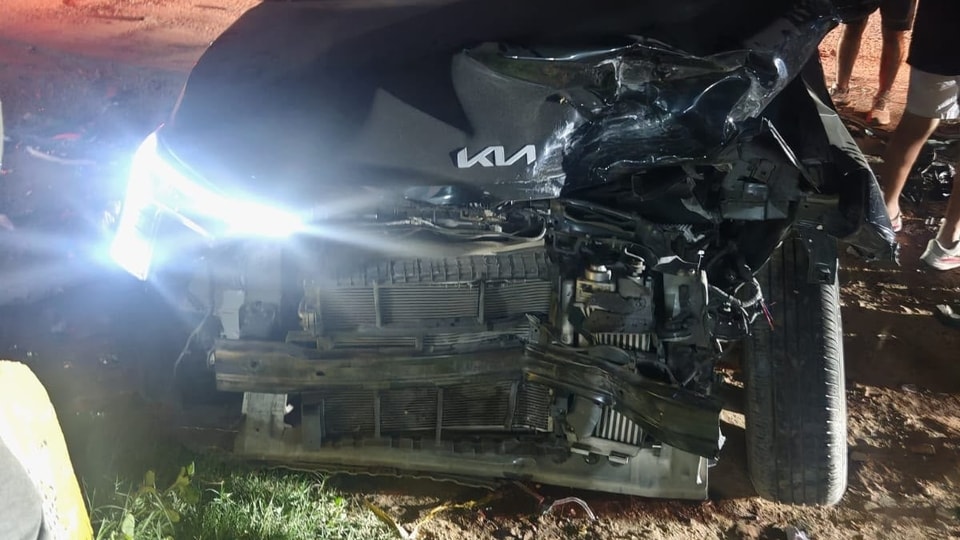
On October 14, around 9 pm, she was travelling with her husband and mother-in-law in their Kia Sonet. Just another evening in Delhi-NCR, where driving is increasingly becoming an exercise in self-preservation.
Then, seemingly out of nowhere, a black Mahindra Scorpio appeared from the wrong side of the road and rammed into their car. I know this because I have seen the dashcam footage myself. She sent it to me moments after her crash, alerting me about her situation considering the next day, an important meeting was scheduled.
At precisely 9:11 pm, with the Sonet travelling at approximately 15 kmph, the SUV came into view and collided with it. Everything unfolded within seconds, leaving the occupants with little apparent opportunity to react.
Think about that. You could be driving slowly, following the rules, doing everything expected of a responsible motorist, and still find yourself at the receiving end of someone else’s recklessness.
The Sonet suffered extensive damage and was reportedly left undriveable. My colleague sustained injuries to her hand, lips, ears and chest. Her husband suffered a nose injury resulting in substantial bleeding, while her 67-year-old mother-in-law, who had recently undergone knee surgery, experienced pain and swelling in her knee.
And if the collision wasn’t distressing enough, what allegedly followed was worse.
According to the police complaint and her verbatim account to me, the Scorpio driver, who as per the FIR filed, goes by the name, Chandrashekhar Agrawal, abused, assaulted and threatened my colleague. She also alleged that he pulled at her clothes and claimed he wasn’t afraid of the police. An FIR has since been registered under Sections 281, 125(a), 324(4), 351(3) and 74 of the Bharatiya Nyaya Sanhita.
Allegations concerning intoxication, assault and intimidation remain matters for investigation. A dashcam cannot establish all of these. But it can document the collision itself.
And that is where this story becomes bigger than one accident.
Without the dashcam, whose word would you believe?
Imagine the same incident without a camera recording it.
A damaged car. An angry confrontation. Conflicting accounts. A crowd gathering around, everyone suddenly becoming an expert on what happened. And somewhere in the middle, an injured woman trying to explain that she wasn’t responsible.
We would like to believe facts always prevail. Unfortunately, that isn’t necessarily how things unfold on Indian roads.
There is an uncomfortable social dimension, too. Women drivers are still subjected to stereotypes about their driving abilities. The sort of prejudice that passes off as humour until someone’s credibility is questioned before the facts are examined.
Would that have happened here? We cannot know. But the dashcam removes a significant part of the ambiguity.
It doesn’t care whether the driver is a man or a woman. How expensive the other vehicle is. How influential its owner might be. Or how aggressively someone argues after an accident.
It simply records what happened. And sometimes, that is the most powerful thing you can have on your side.
Anyone who regularly drives around Delhi-NCR knows the peculiar anxiety of navigating its roads. Wrong-side driving, aggressive overtaking, signal jumping and the occasional motorist who believes owning a bigger SUV somehow grants them greater authority.
Of course, owning an SUV doesn’t make someone reckless. But the culture of intimidation that often accompanies road rage is difficult to ignore.
My colleague’s experience illustrates why being a careful driver isn’t always enough. You can control your speed and lane discipline. What you cannot control is someone coming towards you from the wrong direction.
A dashcam isn’t just another accessory
We spend extraordinary amounts protecting our cars. Paint protection films, ceramic coatings, fancy infotainment systems, alloy wheels and whatnot. Yet, a relatively inexpensive device that could help establish what happened during an accident is still treated as optional. I find that rather strange.
Because a dashcam does something most accessories cannot: it helps protect your interests when circumstances are no longer in your control. It can preserve the sequence of events leading up to a collision, support your account when someone disputes it, provide useful evidence during insurance claims and potentially capture registration numbers in hit-and-run incidents. Importantly, it can also protect innocent motorists against false accusations.
No, footage doesn’t automatically establish legal liability. It must still be examined alongside other evidence. But there is a world of difference between saying this is what happened and being able to show it. In my colleague’s case, that difference is captured in just a few seconds of footage.
Why you shouldn’t cheap out on a dashcam
I won’t name the dashcam brand installed in my colleague’s Sonet. It isn’t important, and this isn’t a sponsored piece. What matters is taking this category seriously. If you drive regularly, particularly around Delhi, Gurugram or Noida, I would strongly recommend investing in a dependable front-and-rear dashcam.
Don’t get carried away by resolution figures alone. A camera advertising 4K isn’t automatically better at recording usable evidence than a well-tuned 2K model.
Prioritise low-light performance, number-plate legibility, reliable loop recording, impact-event protection and durability in Indian heat. A high-endurance memory card is equally important.
And make sure the camera is actually recording. Check your footage periodically, verify the date and time, and preserve original files immediately after an incident. After all, a dashcam that fails when you need it is barely better than having none.
The real cost of not having one
We often judge accessories by their upfront price. A few thousand rupees here, a few thousand there. Eventually, we decide what is essential and what can wait. But the value of a dashcam isn’t measured by how often you use its footage. In fact, I hope you never need it for anything beyond recording an uneventful commute. Its value lies in that one occasion when you desperately need it.
When someone disputes your account. When an accident leaves you shaken. When the other driver disappears. Or when you simply need to establish that you weren’t responsible. That is when a few thousand rupees start looking insignificant against the potential financial, legal and emotional consequences of having no independent recording.
Of course, no camera can undo an injury. No footage can erase the memory of a frightening collision. But it can help prevent the truth from becoming another casualty of the accident.
My colleague and her family are recovering. The car can eventually be repaired or replaced. The injuries, hopefully, will heal. The legal process will take its course. But the footage will continue to show those few seconds at 9:11 pm, when an otherwise ordinary drive took a terrifying turn. And perhaps that is the strongest argument for owning a dashcam.


