E-Paper



Portable or party speaker? Here's what I'd buy for better sound at home and outdoors
Portable vs party speakers: One prioritises convenience, the other delivers bigger sound. Here's how to choose based on your space, usage and listening habits.


Our Picks
FAQs
Our Picks
| Product | Rating | Price |
|---|---|---|
boAt Stone 510 Portable Bluetooth Speaker with 25W RMS Output, Up to 8 Hours Playtime, IPX5 Resistant, Type-C Charging, TWS Mode, Built-In Mic, Voice Assistant, Ergonomic Carry Handle (Midnight Black)View Details  | ₹2,099 | |
 | ||
JBL Flip Essential 2, Wireless Portable Bluetooth Speaker with Deep Base, IPX7 Water & Dustproof (Without Mic, Black)View Details | ₹5,999 | |
| ||
Bose New SoundLink Flex Portable Bluetooth Speaker (2nd Gen), Portable Outdoor Speaker with Hi-Fi Audio, Up to 12 Hours Battery Life, Waterproof and Dustproof, BlackView Details | ₹13,490 | |
| ||
Sony ULT Field 1 Wireless 30W Bluetooth Speaker, 12hrs Playtime, Massive Bass, Hands Free Calling, IP67 Water, Dust & Rustproof, Sound Connect App-BlackView Details | ₹7,989 | |
| ||
Marshall Willen II Portable Bluetooth Speaker with 17+ Hours of Portable Playtime, Dust & Waterproof (IP67) - Black & Brass.View Details | ₹9,999 | |
| ||

Research-Backed Choices
Every product we recommend is chosen through a combination of Primary Research and Secondary Research.
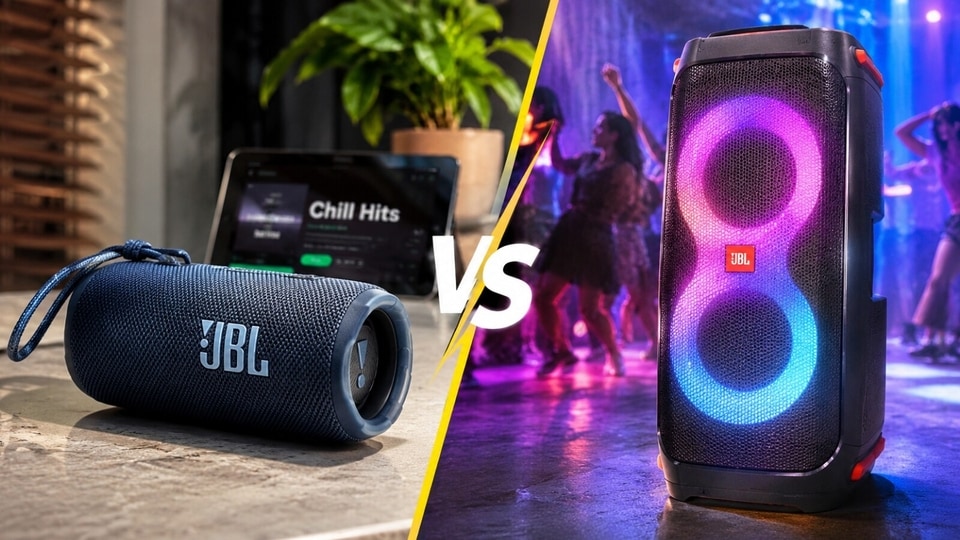

A compact portable model or a larger party speaker? The choice can be confusing, especially when both categories promise powerful sound, wireless connectivity and long battery life. However, they are built for rather different listening experiences. A portable speaker is designed to travel with you, whether that means carrying it to the balcony, packing it for a weekend trip or using it in a small room. A party speaker, on the other hand, focuses on filling larger spaces with louder sound, stronger bass and features that make group gatherings more entertaining. Before spending money, it is worth understanding where these differences matter in everyday use.
Portable vs party speakers: What is the difference?
The most obvious difference is size, but the distinction goes beyond dimensions. Portable speakers are generally compact, lightweight and easy to carry. Many feature built-in rechargeable batteries, Bluetooth connectivity and basic physical controls. Some are small enough to fit into a backpack or even a large handbag.
Party speakers are usually larger and heavier. They often feature bigger drivers, dedicated bass units, lighting effects and higher audio output. Some models include microphone or guitar inputs, making them suitable for karaoke sessions, announcements and small performances.
Neither category is automatically better. A compact speaker may be ideal for personal listening, while a party speaker can be excessive if you simply want background music while working or relaxing.
1. Sound quality and volume: How much power do you need?
If loudness is your priority, party speakers generally have the advantage. Their larger cabinets and speaker drivers can move more air, helping them deliver stronger bass and fill larger rooms. This makes them useful for house parties, family gatherings and outdoor celebrations.
Many also offer dedicated bass enhancement modes or equaliser settings. These can make dance tracks and electronic music sound more energetic, although pushing the bass too far can affect vocal clarity.
Portable speakers are usually designed for smaller listening spaces. They can sound surprisingly good for their size, with some models offering clear vocals and balanced audio. However, they may struggle to maintain the same impact as a party speaker in a large room or open outdoor area.
Do not judge performance by wattage alone. Speaker design, driver quality, tuning and cabinet construction all influence the final sound. If possible, listen to the speaker at different volume levels before buying. A model that sounds impressive at low volume may become harsh when turned up.
2. Portability and design: Will you carry it around?
This is where compact speakers make their strongest case. Their smaller dimensions, lighter construction and convenient carrying straps make them easier to take to a picnic, holiday, terrace or friend's house.
Many portable models also come with rugged designs, rubberised exteriors and water-resistance ratings. These features can be useful around swimming pools or during outdoor activities. However, check the exact IP rating rather than assuming every portable speaker is waterproof.
Party speakers are less convenient to move around. Some have built-in handles and wheels, but they still require more storage space and may need two people to carry comfortably. They are better suited to a fixed spot at home or an occasional event than daily travel.
Think about where you plan to keep the speaker when it is not playing music. A large party speaker can become inconvenient if you live in a compact apartment with limited storage.
3. Battery life and power supply
Portable speakers are generally designed for battery-powered use. This makes them convenient when there is no power outlet nearby. Battery life varies significantly depending on speaker size, volume level, lighting effects and wireless features. Manufacturer estimates are usually based on specific testing conditions, so real-world playback may be shorter.
Party speakers vary more widely. Some offer rechargeable batteries, while others are primarily designed to work through a wall outlet. Battery-powered party models can be useful for outdoor gatherings, but features such as powerful bass and lighting can drain their batteries faster.
If you plan to use a speaker for long events, check its playback time at realistic volume levels. Also look for charging time and whether the speaker can continue playing while connected to power.
4. Connectivity and extra features
Most modern portable and party speakers offer Bluetooth, but the additional connections can differ.
Portable speakers typically focus on simple wireless playback. Some support stereo pairing, allowing two compatible units to work together, while others include USB playback or auxiliary inputs. Check whether the speaker supports the Bluetooth features you actually need, including multipoint connectivity if you frequently switch between devices.
Party speakers often offer more ways to connect. Depending on the model, these can include USB ports, AUX inputs, microphone sockets and guitar inputs. Some also feature built-in karaoke modes, DJ-style effects, lighting controls and companion apps.
If you plan to host karaoke evenings or small events, these additions can be genuinely useful. For everyday music listening, however, they may add cost without offering much practical benefit.
5. Price and value: Which one gives you more for your money?
Portable speakers are available across a wide range of budgets, including affordable models for casual listening. You can spend more for better sound, stronger water resistance, longer battery life and improved connectivity.
Party speakers often cost more because of their larger hardware and additional features. Premium models may also include microphone inputs, lighting systems and more powerful amplification.
But paying extra for a party speaker does not make sense if you rarely turn the volume up. Similarly, buying a tiny portable speaker for a large living room may leave you wanting more volume and bass.
Compare speakers based on the way you intend to use them. A well-built portable model can offer better value for everyday listening, while a party speaker may justify its price if you regularly host gatherings.
6. Which speaker should you choose for your home?
For a bedroom, study or small living room, a portable speaker is often enough. It is easy to reposition, simple to operate and suitable for music, podcasts and occasional movie playback.
If you have a larger living room, host friends regularly or enjoy loud music with pronounced bass, a party speaker is worth considering. It can also work well for outdoor gatherings, provided it has sufficient battery capacity or access to power.
There is one more consideration: neighbours. A powerful speaker may sound exciting, but its bass can travel through walls and floors. If you live in an apartment, a smaller speaker with controlled bass may be a more practical choice.
Portable vs party speakers: Major differences
Which one should you buy?
If you want a speaker that can move between your bedroom, balcony, office and travel bag, choose a portable model. It offers convenience without demanding much space, and many are capable enough for everyday music listening.
A party speaker is the better choice if loud playback, stronger bass and features such as karaoke or microphone support are important to you. It makes more sense for frequent gatherings than for someone who mostly listens to music alone.
My recommendation is to think about your most common listening situation, not the occasional one. Buying a large party speaker for a gathering that happens twice a year may not be the best use of your budget. Equally, a compact portable model may disappoint if you expect it to power a crowded house party.
Similar stories for you:
ANC and ENC sound similar, but they solve different problems. Here's what you should know
A monitor can make or break your workday, so here are 7 features I'd check before buying one
If I were buying an air purifier today, these are the 5 smart models I would check
Disclaimer: At Hindustan Times, we help you stay up-to-date with the latest trends and products. Hindustan Times has an affiliate partnership, so we may get a part of the revenue when you make a purchase. We shall not be liable for any claim under applicable laws, including but not limited to the Consumer Protection Act, 2019, with respect to the products. The products listed in this article are in no particular order of priority.