
 E-Paper



Back to the wall, Nepal PM Oli goes for broke. Now wants a party convention
Nepal political crisis: There is pressure from China on politicians in Kathmandu not to split the Nepal Communist Party

 Prefer HTon Google


A four-hour-long meeting of the Nepal Communist Party secretariat ended inconclusively on Saturday evening after Prime Minister KP Sharma Oli tried to block attempts to get him to step down, demanding that NCP convene a party convention to decide the next steps for the ruling NCP.
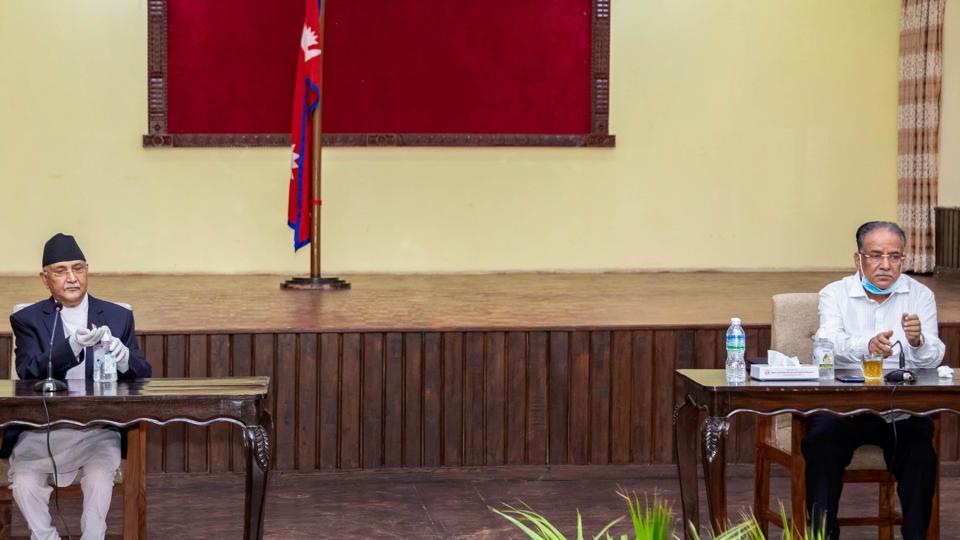
Saturday’s marathon meeting came against the backdrop of PM Oli’s rivals in the party stepping up pressure on the prime minister to quit the himalayan nation’s top executive post. The meeting was wrapped up late on Saturday evening after PM Oli abruptly called it a day and went to meet President Bidhya Devi Bhandari.
Pushpa Kumar Dahal, better known by nom de guerre Prachanda, left the meeting soon after and also headed to meet President Bhandari at her official residence Shital Niwas, people familiar with the development told Hindustan Times.
An NCP leader said PM Oli came up with a counter-offer to sabotage the push for an early decision on the prime minister’s future. PM Oli suggested that this decision should be left to a convention of party workers that could be convened later this year.
“This would be a non-starter,” the NCP leader said.
Also Read: Nepal PM Oli changes tack after pressure to quit, asks who will replace me
The ruling NCP was formally set up in February 2018 with the merger of the CPN (Unified Marxist–Leninist) and CPN (Maoist Centre) that had contested the election in an alliance and received overwhelming support from the people.
“But the assimilation of the cadre of the two parties that merged in 2018 never took place on the ground,” he said, pointing that PM Oli’s new tactic appeared to be designed to keep the leadership issue hanging in balance for months.
The only thing that the nine-member NCP secretariat appeared to have agreed on is that the next steps for the party and government’s leadership should be decided on the basis of consensus.
The senior leaders agreed to resolve the issues through consensus, party spokesperson Narayankaji Shrestha told media persons after the meeting.
A tweet by PM Oli’s press adviser Surya Thapa did not claim that there was any consensus or agreement at the meeting either.
Saturday’s NCP secretariat meeting - a smaller body than the 44-member standing committee that is scheduled to meet on Sunday - was expected to arrive at a decision on PM Oli’s future that could be put before the standing committee. This plan could have been upended by PM Oli with his push for a party convention.
There have already been demands that the party convene the meeting of a 445-member central committee, an exercise that would also take some time to organise.
PM Oli has been able to hold on to the prime minister’s chair - he is also the co-chairman of the party - with some intervention from China that made it clear that it did not want the merged communist party to split. PM Oli leveraged Beijing’s interest in a united communist party in Nepal to his advantage, putting out a word that the party would fall apart if he is forced to step down.


