
 E-Paper



Shattered jaws, lost hand, tear gas: France sees its ‘most violent’ student protests in decades; parents slam ‘disgusting’ handling by cops
The past two weeks have seen violent protests by high-school students and teachers' unions across Paris and several parts of France.

 Prefer HTon Google


Student protests in France are growing violent as riot police forces continue to use dangerous weaponry to curb the agitation while government critics and human rights campaigners condemn the use of unnecessary violence seen in police arrests and tactics so far.
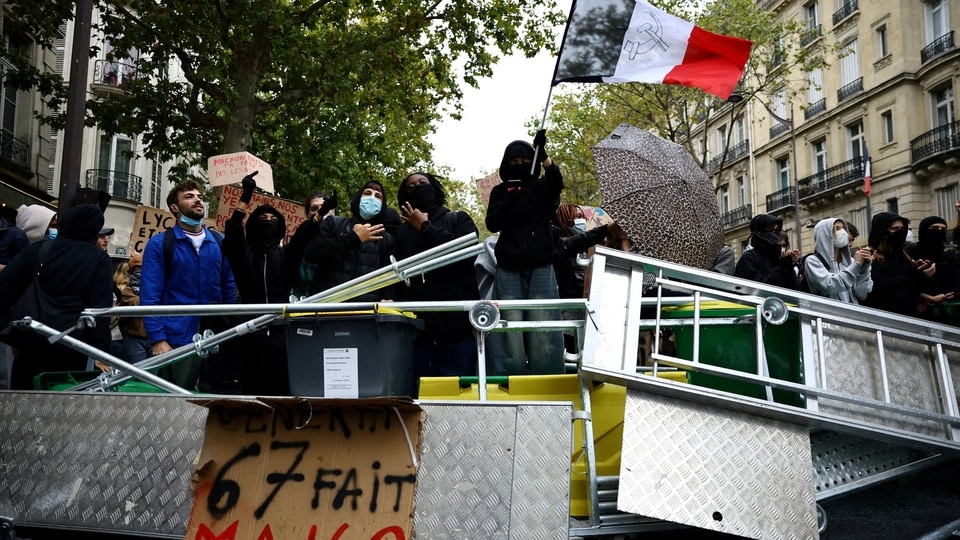
The past two weeks have seen violent protests by high-school students and teachers' unions across Paris and several parts of France as public frustration over dilapidated schools, teacher shortages and dips in education quality fuels anger on the streets.
Despite heavy police crackdowns, the agitation shows no sign of easing out anytime soon with more than 500 schools closed every day after demonstrations swept across the country, and unions representing high-school students, teachers and other workers planning more marches for Thursday.
Jaw shattered, hand blown off
Several serious injuries incurred by student protestors have been blamed on the use of excessive force by the riot police in an effort to curb the protests. A 15-year-old from the former mining town of Lens lost a hand in an incident involving a police stun grenade.
In another instance, a 14-year-old student shattered his jaw and lost many teeth after being attacked with a tear gas grenade. The boy, Eden, shared a video with his mother demonstrating protests outside his school just moments before being attacked with the grenade. Following surgery, he can no longer speak and can eat only with a straw.
“It’s shameful, it's appalling, it’s violent, it’s disgusting, it’s despicable — I could give you a whole list of words," the latter victim's mother told AP. "They are dealing with children. And children demanding what? Simply better conditions in which to study.”
The officer who fired a grenade launcher directly at the student in this case said during questioning in custody that he acted in “a fraction of a second” to protect a female colleague who'd exchanged blows with the boy, according to a statement from the prosecutor's office leading the investigation. He was taken into custody a week after the incident and charged with violent mutilation, punishable by up to 15 years in prison.
Similarly, in Tours, the prosecutor revealed that a police riot-control round is suspected in the partial blinding of a 16-year-old.
More than 6,000 arrests and dozens of injuries have been reported in the clashes so far, as per Reuters. Cops have been accused of using batons, tear gas and non-lethal flashball guns against minors while the authorities allege injuries to several riot police officers as well.
State power and detention
Several French human rights activists have spoken out in favour of the student-led agitation, claiming that the movement is giving young school children, soon to be voters, a real taste of state power and their rights as citizens.
“It politicises you at an incredible speed,” Alexis Baudelin, a Paris attorney for more than a dozen youngsters taken into custody, told AP. “For many of them — for all of them — this was one of the first times that they'd taken part in a demonstration, coming together in a public space to voice demands they considered legitimate.”
Several lawyers and researchers have also cautioned that the movement could sour younger generations against the Republic for failing to deliver on its promise of ‘Liberty, Equality and Fraternity’.
“Being locked up for hours and hours with nothing, in cells that are for the most part extremely unsanitary, in police stations that smell terrible, where you can’t sleep, with police officers telling you that if you don’t talk, if you don’t tell the truth, threatening you, telling you that your life is going to be ruined. It’s an experience that can be deeply traumatic and is completely out of proportion," Baudelin added.
Samy and Warkya, both 17, also made allegations of being picked on by cops due to their colour, as per AP's reports. " There was no apparent motive, because we weren't wearing hoodies, we had nothing on us, our faces were visible," they said. “Here in France, they don’t listen to us. They would rather send in the police than listen to us and put measures in place to improve our daily lives." Wakya, however, claimed that her first experience of detention only further increased her resolve to continue to protest.
Government's response so far
The government, so far, has had a delayed reaction to the protests with Prime Minister Sebastien Lecornu addressing the nation on Wednesday to share that the government would review the demands made by students and present proposals at the end of October on issues ranging from renovating buildings to make more teachers available. Lecornu provided no details in this matter, however.
"In the past, too many promises were not kept, quite simply because they were untenable," Lecornu said. "What I want are concrete, quick and fully funded answers." Student leaders, on the other hand, called out the lack of an immediate government response on the matter after talks at the education ministry on Wednesday failed to draw a clear conclusion.
In addition, Prime Minister Lecornu acknowledged the “legitimate” demands of the students and called the riots the most violent student movement in decades. The use of stun grenades to curb the protests was also banned as per an announcement by the Interior Minister.
Education Minister Edouard Geffray told parliament that 24 high schools had been damaged by fire or vandalism to the extent that they would remain closed for weeks, meaning some 30,000 students would receive no in-person teaching until they reopened. A cost of €20 million to €30 million has been estimated to fix the damage caused so far.
‘Could have been my kids’
Bally Bagayoko, the mayor of the French town of Saint-Denis, has caught widespread public attention in a video that has now gone viral on social media which shows him trying to shield student protestors from the riot police.
"They had decided to charge and effectively go after the students, many of whom had shown no aggressive behaviour whatsoever toward the police officers," Bagayoko, who is part of the hard-left France Unbowed party (LFI), told Reuters in an interview at his town hall office in Saint-Denis, on the northern outskirts of Paris.
A father of four, he said that "the high school children who were in the street could be my children ... it is my responsibility to be at their side." Furthermore, he pushed for heavier government investment in education and advocated higher taxes for billionaires.
The student protests have been fueled by a general anger towards France's education sector with students blaming poor learning conditions for a sharp drop in French teenagers' scores in reading and mathematics over the past decade.
French 15-year-olds scored 43 points lower in reading in 2025 than in 2015, according to the OECD's Programme for International Student Assessment, the biggest drop among the OECD countries. Their mathematics scores also dropped the most.
Bagayoko also strongly denied the government's accusations of the protests being stirred by his party, deeming it an insult to the young protestors.
The movement comes six months ahead of an election to replace French President Emmanuel Macron. Far-right presidential candidate Marine Le Pen, the frontrunner to succeed Macron as per opinion polls, has stated that those who damaged schools should pay for the repairs rather than taxpayers.
The current dispensation has adopted a similar stance and has a bill going through parliament that aims to set up such a system.


