
 E-Paper





Follow the latest breaking news, major developments and agenda-setting stories from India and around the world with the newsdesk at Hindustan Times. Operating round the clock, the desk brings together experienced editors, reporters and correspondents to deliver fast, accurate and contextual reporting across subjects that influence public policy, governance, business, society and international affairs. The HT News Desk covers politics, elections, government policies, the economy, business and markets, science and technology, the environment, law and order, infrastructure, education, climate issues and geopolitics, while closely tracking developments across states, institutions and global capitals. The team also leads coverage of major breaking news events, policy announcements, court proceedings, natural disasters, public emergencies and significant international developments. Reports published by the newsdesk are based on information gathered from reporters on the ground, official statements, government agencies, court records, regulatory filings, recognised institutions and other authoritative sources. Stories undergo editorial scrutiny and verification processes to ensure accuracy, fairness and relevance, and are updated as events evolve and additional information becomes available. Whether covering a key political decision in New Delhi, an economic policy shift affecting millions, a landmark court ruling or a major global event, the HT News Desk aims to provide readers with reliable, fact-based journalism that delivers not only the latest developments but also the context and analysis needed to understand their wider implications.
 Trending News
Bangladesh removes ‘un-Islamic’ statue after protests
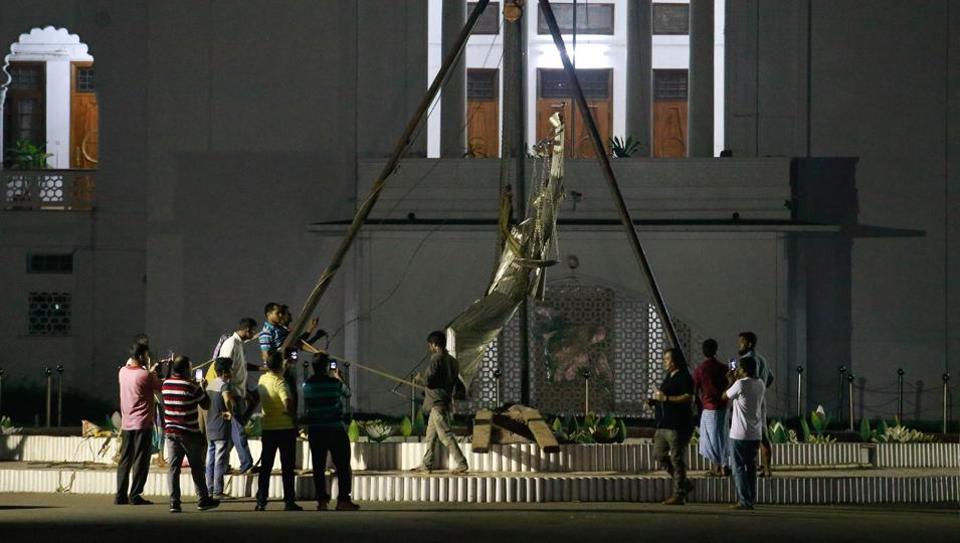
The sculpture of a blindfolded, sari-clad woman holding scales had been in place for less than six months when authorities removed it early Friday under pressure from hardliners who said it was based on the Greek goddess of justice.


Violent protests broke out Friday in Bangladesh over the removal of a controversial justice statue deemed “un-Islamic” by religious hardliners from outside the Supreme Court, a move its creator said marked a victory for Islamists.
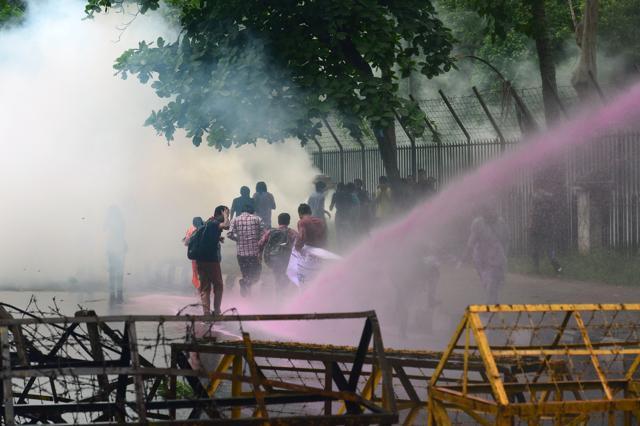
Police fired tear gas and water cannons to try to disperse hundreds of secular demonstrators who came out to protest the statue’s removal, which they see as a sign of creeping Islamisation in the officially secular country.
The sculpture of a blindfolded, sari-clad woman holding scales had been in place for less than six months when authorities removed it early Friday under pressure from hardliners who said it was based on the Greek goddess of justice.
Chief Justice Surendra Kumar Sinha ordered the removal of the sculpture from its existing location to be reinstalled in front of the Supreme Court museum on a different location inside the apex court, attorney general Mahbubey Alam said.
“He (Sinha) called me in the (Thursday) afternoon at his chamber where several senior lawyers were present... We suggested that the statue be removed from its existing location,” he said.
Sculptor Mrinal Haque, who erected the statue, said that it is being removed to maintain peace.
Haque, who along with four to five workers were overseeing the removal work said, “I don’t know where the statue was kept though the authorities told me it might be reinstalled near the apex court’s annex building”, The Daily Star reported.
“This is a slap in the face of the country’s progressive people ... they (Islamists) are demanding the statue to be removed from the apex court. They will demand dismantling of all sculptures in the country,” he told the protestors rally.
The statue was erected in December 2016, holding a sword and the scales of justice in her hands.
The statue, which is not of the Greek goddess but a Bengali woman, has ruffled feathers in the Muslim-majority nation, with hardliners staging massive protests in recent months.
According to the hardliners, the statue, a variation on the Greek goddess Themis, goes against Islam, the report said.
Police used tear gas and water cannons as protests mounted after authorities removed the statue from the Supreme Court premises.

Witnesses said scores of slogan chanting protestors rallied near the apex court complex where police hurled tear gas canisters and coloured water from water cannons to disperse them.
In April, Prime Minister Sheikh Hasina, who leads the secular Awami League party, apparently backed the Islamists by expressing her dislike for the statue and approved its removal.
In reaction to criticism over her approval, Hasina said she had asked Chief Justice Surendra Kumar Sinha why the statue of a Greek goddess had been distorted by having it clad in a saree, the report said.
“Why shouldn’t it be removed? Don’t they see that it is no more Greek. It’s half Greek, half Bengali. It’s Greek- Bengali now. Don’t they see it?” she had inquired.
Bangladesh has experienced increasing tensions between hardliners and secularists in recent years, suffering a spate of killings of atheist bloggers, religious minorities and foreign.


