
 E-Paper


Follow the latest breaking news, major developments and agenda-setting stories from India and around the world with the newsdesk at Hindustan Times. Operating round the clock, the desk brings together experienced editors, reporters and correspondents to deliver fast, accurate and contextual reporting across subjects that influence public policy, governance, business, society and international affairs. The HT News Desk covers politics, elections, government policies, the economy, business and markets, science and technology, the environment, law and order, infrastructure, education, climate issues and geopolitics, while closely tracking developments across states, institutions and global capitals. The team also leads coverage of major breaking news events, policy announcements, court proceedings, natural disasters, public emergencies and significant international developments. Reports published by the newsdesk are based on information gathered from reporters on the ground, official statements, government agencies, court records, regulatory filings, recognised institutions and other authoritative sources. Stories undergo editorial scrutiny and verification processes to ensure accuracy, fairness and relevance, and are updated as events evolve and additional information becomes available. Whether covering a key political decision in New Delhi, an economic policy shift affecting millions, a landmark court ruling or a major global event, the HT News Desk aims to provide readers with reliable, fact-based journalism that delivers not only the latest developments but also the context and analysis needed to understand their wider implications.
 Trending News
China, ASEAN nations agree on draft of South China Sea code of conduct
The text of the framework agreement would remain secret for now. No date was given for the adoption of a full code of conduct.


China and the 10 countries in the Association of Southeast Asia Nations (ASEAN) have agreed on the rough outline of a legally binding code of conduct designed to prevent clashes in the strategic South China Sea, officials said.

Chinese vice foreign minister Liu Zhenmin was quoted in state media on Friday as saying that the agreement laid a “solid foundation” for further negotiations.
“All parties have vowed to continue to constructively advance the negotiations” toward the early conclusion of the code of conduct, Liu was quoted as telling Xinhua news agency following Thursday’s meeting in the southern Chinese city of Guiyang.
The Philippines welcomed the finalisation of the draft of the framework. It contains elements that the parties agreed upon and will be presented to Chinese and ASEAN foreign ministers in August for consideration, the statement from the Philippine Department of Foreign Affairs said.
No details were given and Liu said the text of the framework agreement would remain secret for now. No date was given for the adoption of a full code of conduct.
Also on Friday, China and the Philippines were to meet separately to discuss an agenda for future talks on their dispute over islands and waters in the eastern portion of the South China Sea.
China was enraged by a ruling last year from a Hague tribunal invalidating most of its South China Sea claims in a case brought by the Philippines. Philippine President Rodrigo Duterte has downplayed that ruling as part of his push for a broad improvement in relations between the sides since taking office in June that has cast a shadow over Manila’s ties to its longtime ally, the United States.
Despite the thaw in relations, China protested a visit last month by Manila’s defense and military chiefs to a disputed island in the South China Sea. The Philippine government maintained that it owns the territory where Filipino troops and villagers have lived for decades.
China and the members of ASEAN committed 15 years ago to signing a code of conduct, but progress has been slow amid disputes over the body of water that China claims virtually in its entirety.
In the absence of such an agreement, they have followed a separate document called the Declaration on the Conduct of Parties in the South China Sea, or DOC, which among other provisions, commits the parties to “exploring ways for building trust and confidence ... on the basis of equality and mutual respect.”
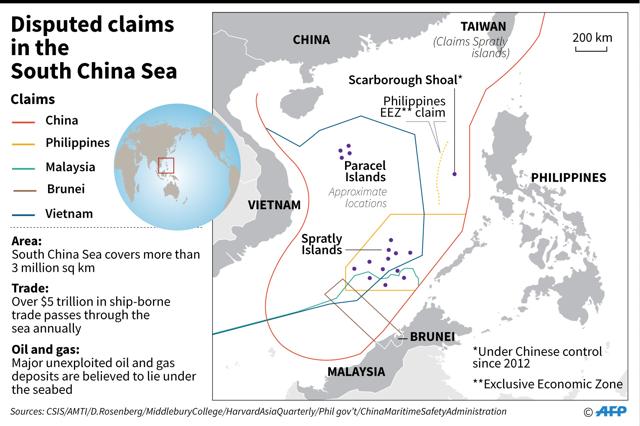
Along with the Philippines, ASEAN members Malaysia, Vietnam and Brunei also maintain claims in the South China Sea that overlap with those of China and Taiwan.
An estimated $5 trillion in global trade annually passes through the South China Sea, which is also home to rich fishing grounds and a potential wealth of oil, gas and other natural resources.


