
 E-Paper


Follow the latest breaking news, major developments and agenda-setting stories from India and around the world with the newsdesk at Hindustan Times. Operating round the clock, the desk brings together experienced editors, reporters and correspondents to deliver fast, accurate and contextual reporting across subjects that influence public policy, governance, business, society and international affairs. The HT News Desk covers politics, elections, government policies, the economy, business and markets, science and technology, the environment, law and order, infrastructure, education, climate issues and geopolitics, while closely tracking developments across states, institutions and global capitals. The team also leads coverage of major breaking news events, policy announcements, court proceedings, natural disasters, public emergencies and significant international developments. Reports published by the newsdesk are based on information gathered from reporters on the ground, official statements, government agencies, court records, regulatory filings, recognised institutions and other authoritative sources. Stories undergo editorial scrutiny and verification processes to ensure accuracy, fairness and relevance, and are updated as events evolve and additional information becomes available. Whether covering a key political decision in New Delhi, an economic policy shift affecting millions, a landmark court ruling or a major global event, the HT News Desk aims to provide readers with reliable, fact-based journalism that delivers not only the latest developments but also the context and analysis needed to understand their wider implications.
 Trending News
Russia, Iran, Turkey agree to push for Syria ceasefire after Astana talks
Russia, Iran and Turkey on Tuesday agreed to shore up a shaky truce in war-torn Syria, but rebels and Damascus made no breakthrough towards a political settlement of the conflict after indirect talks.


Russia, Iran and Turkey on Tuesday agreed to shore up a shaky truce in war-torn Syria, but rebels and Damascus made no breakthrough towards a political settlement of the conflict after indirect talks.
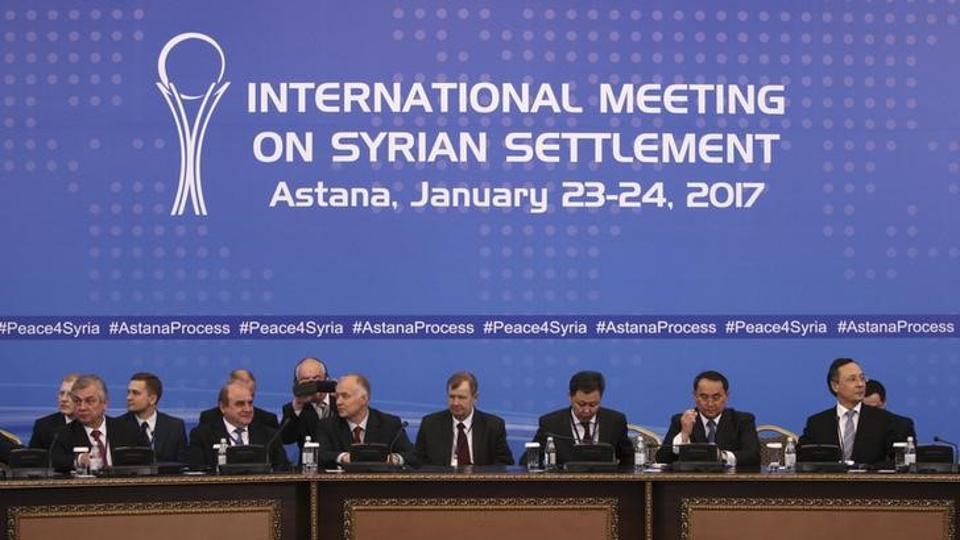
Moscow, Tehran and Ankara, the sponsors of the negotiations in the capital of Kazakhstan, announced they would “establish a trilateral mechanism to observe and ensure full compliance with the ceasefire” in place since late December.
The three powers also backed the participation of the armed rebel groups at a new round of peace talks set to be hosted by the United Nations in Geneva next month.
“There is no military solution to the Syrian conflict and... it can only be solved through a political process,” the final statement by Russia, Iran and Turkey, read out by Kazakh foreign minister Kairat Abdrakhmanov, said.
The two days of meetings in Astana -- which have left the West sidelined -- were mainly a Kremlin initiative and come as Russia has made itself the main power-broker in Syria with its game changing military support for leader Bashar al Assad.
The meeting was expected to see the first face-to-face negotiations between the regime and the armed opposition since Syria’s conflict erupted in 2011, but the rebels backed out and mediators were forced to shuttle between the two sides.
The latest diplomatic initiative to end the bloodshed in Syria that has cost 310,000 lives comes one month after regime forces, aided by Russia and Iran, dealt a crushing blow to the rebels by retaking full control of the country’s second city Aleppo.
A ceasefire brokered by Russia and rebel-backer Turkey has been in place since late December but both rebels and Damascus have complained of repeated violations.
The rebels -- who insisted they would use the Astana talks to push Damascus to respect the truce -- refused direct talks with the regime on Monday because of its continued bombardment and attacks on a flashpoint outside the Syrian capital Damascus.
‘One goal’
Regime negotiator Bashar al Jafaari said after the end of the talks that the meeting “succeeded in achieving the goal of consolidating the cessation of hostilities for a fixed period paving the way for dialogue between Syrians”.
“Astana has only one goal: consolidating the regime of the cessation of hostilities,” he said.
There were, however, no concrete details given immediately on the three-way mechanism agreed by Russia, Iran and Turkey to strengthen the ceasefire and how it would resolve the thorniest hotspots.
The rebels have called for a halt to regime attacks on Wadi Barada, an area 15 kilometres (10 miles) northwest of Damascus, but Jafaari insisted operations would continue there.
There was profound rancour and mud-slinging between the delegations from Damascus and the rebels.
It also remained to be seen how the sides could patch up differences on the role of the talks’ three organisers, Russia, Turkey and Iran.
A member of the rebel delegation told AFP on Monday that the group would agree to have Russia serve as a guarantor of the current ceasefire but not Iran, which controls troops on the ground fighting for Assad.
The Syrian regime, meanwhile, said it would refuse to hold government-level talks with Turkey and sign any document bearing the signature of a Turkish official.


