
 E-Paper



Washington jet-chopper crash: Contrasting altitude data leaves investigators confused
Preliminary data reveals conflicting altitude readings for an airliner and Army helicopter that collided near Reagan National Airport, killing all aboard.

 Prefer HTon Google


Preliminary data from the deadliest US aviation accident in nearly 25 years showed conflicting readings about the altitudes of an airliner and Army helicopter when they collided near Reagan National Airport in Washington, killing everyone aboard both aircraft, investigators said Saturday.
Investigators also said that about a second before impact, the jet’s flight recorder showed a change in its pitch. But they did not say whether that change in angle meant that pilots were trying to perform an evasive maneuver to avoid the crash.
Data from the jet’s flight recorder showed its altitude as 325 feet (99 meters), plus or minus 25 feet (7.6 meters), when the crash happened Wednesday night, National Transportation Safety Board officials told reporters. Data in the control tower, though, showed the Black Hawk helicopter at 200 feet (61 meters) at the time.
The roughly 100-foot (30-meter) discrepancy has yet to be explained.
Investigators hope to reconcile the altitude differences with data from the helicopter's black box, which is taking more time to retrieve because it became waterlogged after it plunged into the Potomac River. They also said they plan to refine the tower data, which can be less reliable.
“That’s what our job is, to figure that out,” said NTSB member Todd Inman, who grew increasingly agitated with reporters' questions seeking more information and clarity about the readings during a Saturday evening news conference.
He acknowledged that there was dissension within the investigative team about whether to release the information or wait until they had more data.
Officials say the helicopter’s maximum allowed altitude at the time was 200 feet (61 meters).
No one survived the collision, which occurred as an American Airlines flight from Wichita, Kansas, with 64 people on board was preparing to land at Ronald Reagan National Airport, just across the Potomac from the capital. The Army Black Hawk helicopter, which apparently flew into the jet’s path, had three soldiers on board.
“This is a complex investigation,” said Brice Banning, NTSB investigator in charge. “There are a lot of pieces here. Our team is working hard to gather this data.”
Banning also discussed the last moments from the jet's two black boxes, which captured sound in the cockpit and flight data.
“The crew had a verbal reaction,” Banning said, with the data recorder showing “the airplane beginning to increase its pitch. Sounds of impact were audible about one second later, followed by the end of the recording.”
Inman expressed frustration, too, that accidents like these occur, noting that the board has made “several hundred” recommendations to improve aviation that have not been acted upon.
“From tragedy we draw knowledge to improve the safety for us all. That’s what we’re doing right now, we’re dealing with tragedy, but we need to improve safety,” he said.
“You want to do something about it? Adopt the recommendation of the NTSB. You’ll save lives,” he said, adding that he has spent hours with victims' families since the crash. “I don’t want to have to meet with those parents like that again.”
The families, he said, are struggling.
“Some wanted to give us hugs. Some are just mad and angry,” Inman said. “They are just all hurt. And they still want answers, and we want to give them answers.”
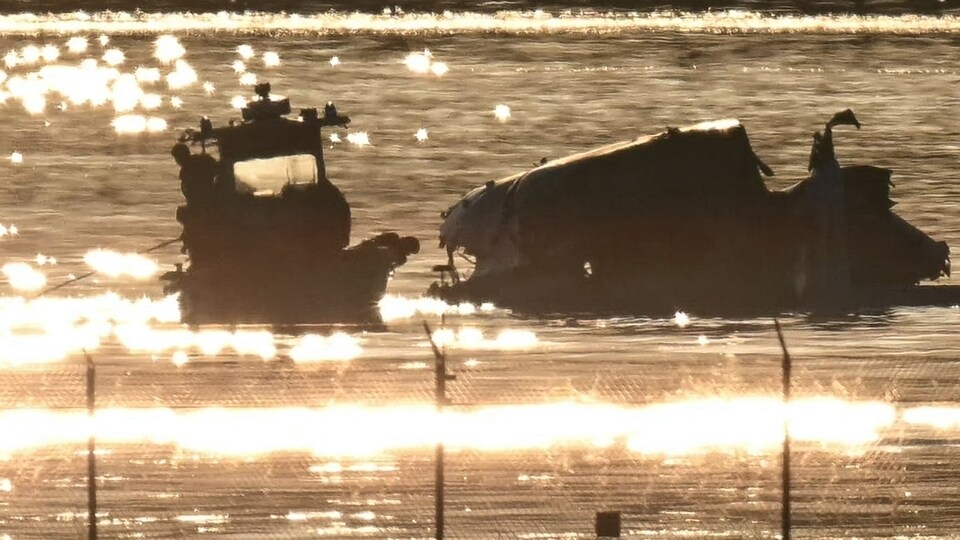
Earlier Saturday, recovery crews and divers searched the river and cleared wreckage. A Coast Guard cutter outfitted with a crane waited nearby, as occasional recovery team members slipped into the water amid a group of smaller emergency boats.
The remains of 42 people had been pulled from the river as of the afternoon, including 38 that have been positively identified, Washington emergency officials said. They expect to recover all of the remains, though the plane’s fuselage will probably have to be pulled from the water to get the rest.
Also Saturday, the Army identified Cpt. Rebecca M. Lobach, of Durham, North Carolina, as the third soldier who died in the crash. The names of the other two were released Friday, but Lobach’s name was withheld at the time at the request of her family.
Army officials have said the helicopter crew was highly experienced and familiar with the congested skies around the city. Military aircraft frequently make such flights to practice routes they would use if key government officials need to be evacuated during an attack or major catastrophe.
Investigators are examining the actions of the military pilot and air traffic control. The Federal Aviation Administration has long struggled with a shortage of controllers.
Full NTSB investigations typically take at least a year, though investigators hope to have a preliminary report within 30 days.
More than 300 responders were taking part in the recovery effort at a given time, officials said. After a rainy Friday, clear skies and warmer temperatures made for better conditions Saturday for workers in the field. Two Navy salvage barges were also deployed to lift heavy wreckage.
“ This is heartbreaking work,” Washington Fire Chief John Donnelly Sr. told reporters told reporters Friday. “It’s been a tough response for a lot of our people.”
With the nation already grieving the collision, an air ambulance slammed into a busy intersection in Philadelphia on Friday night, killing all six people on board, including a child who had just undergone treatment at a hospital, and at least one person on the ground. At least three people remained hospitalized Saturday with injuries, and officials said it could be days until the full toll of the dead and injured is clear.
In Washington, the FAA heavily restricted helicopter traffic around Reagan National on Friday, hours after President Donald Trump claimed in a social media post that the helicopter had been flying higher than allowed.
But a day after he questioned the helicopter pilot’s actions and alleged, without offering any evidence, that diversity initiatives have undermined air safety, Trump said the helicopter was “flying too high.”
“It was far above the 200-foot limit. That’s not really too complicated to understand, is it???” Trump wrote in a Truth Social post.
Wednesday's crash was the deadliest in the U.S. since Nov. 12, 2001, when a jet slammed into a residential neighborhood in the New York City borough of Queens, just after takeoff from Kennedy Airport. The crash killed all 260 people on board and five people on the ground.
Experts regularly highlight that plane travel is overwhelmingly safe, but the crowded airspace around Reagan National can challenge even the most experienced pilots.


