
 E-Paper


Follow the latest breaking news, major developments and agenda-setting stories from India and around the world with the newsdesk at Hindustan Times. Operating round the clock, the desk brings together experienced editors, reporters and correspondents to deliver fast, accurate and contextual reporting across subjects that influence public policy, governance, business, society and international affairs. The HT News Desk covers politics, elections, government policies, the economy, business and markets, science and technology, the environment, law and order, infrastructure, education, climate issues and geopolitics, while closely tracking developments across states, institutions and global capitals. The team also leads coverage of major breaking news events, policy announcements, court proceedings, natural disasters, public emergencies and significant international developments. Reports published by the newsdesk are based on information gathered from reporters on the ground, official statements, government agencies, court records, regulatory filings, recognised institutions and other authoritative sources. Stories undergo editorial scrutiny and verification processes to ensure accuracy, fairness and relevance, and are updated as events evolve and additional information becomes available. Whether covering a key political decision in New Delhi, an economic policy shift affecting millions, a landmark court ruling or a major global event, the HT News Desk aims to provide readers with reliable, fact-based journalism that delivers not only the latest developments but also the context and analysis needed to understand their wider implications.
 Trending News
Russia raises spectre of ‘new world war’ if Syria talks fail
Russian Prime Minister Dmitry Medvedev raised the spectre of an interminable or a world war if powers failed to negotiate an end to the conflict in Syria and warned against any ground operations by US and Arab forces.


Russian Prime Minister Dmitry Medvedev raised the spectre of an interminable or a world war if powers failed to negotiate an end to the conflict in Syria and warned against any ground operations by US and Arab forces.
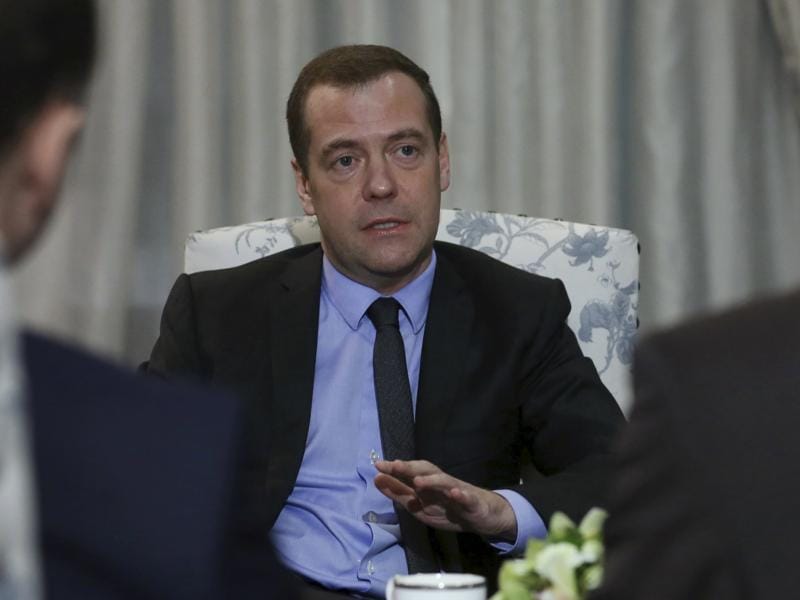
Medvedev, speaking to Germany’s Handelsblatt newspaper on the eve of talks between major powers on Syria in Munich, said the United States and Russia must exert pressure on all sides in the conflict to secure a ceasefire.
Asked about Saudi Arabia’s offer last week to supply ground troops if a US-led operation were mounted against Islamic State, he said:
“This is bad as a ground offensive usually turns the war into a permanent one. Just look at what happened in Afghanistan and many other countries.”
“The Americans and our Arab partners must think well: do they want a permanent war?” It would be impossible to win such a war quickly, he said according to a German translation of his words, “especially in the Arab world, where everybody is fighting against everybody”.
“All sides must be compelled to sit at the negotiating table instead of unleashing a new world war.”
Russia is carrying out bombing sorties around the key city of Aleppo, in support of advances by troops loyal to President Bashar al-Assad. U.S. and other Western air forces are also involved in air strikes in northern Syria.
‘Prize’ of Aleppo
Capturing Aleppo, Syria’s biggest city before the war but now divided between rebel- and government-held sectors, would represent a major military victory for Assad and a symbolic prize for Russia.
Hilighting the rift in perceptions between Russia and the West, French President Francois Hollande Assad to leave power - something Russia has always rejected.
The Munich talks appeared to hold out little promise of progress. “This meeting risks being endless and I fear the results will be extremely small,” one diplomat said.
Russian Foreign Minister Sergei Lavrov said that Moscow had submitted proposals for implementing a ceasefire in Syria and was waiting for a reaction from international powers.
Lavrov was speaking ahead of a meeting in Munich with US secretary of state John Kerry.
Members of the United Nations Security Council pressed Russia on Wednesday to stop bombing Aleppo in support of the Syrian military offensive and allow humanitarian access ahead of the Munich meeting.
“You have no one power that can act alone,” Medvedev said. “You have Assad and his troops on one side and some grouping, which is fighting against the government on the other side. It is all very complicated. It could last years or even decades. What’s the point of this?”


