E-Paper



‘Rock’ star of archaeology in central India
Meet 66-year-old Dr Narayan Vyas, who retired as superintendent archaeologist in 2009 in Madhya Pradesh after serving in over half-a-dozen states across India in a career spanning four decades. Post retirement, for someone who has spent a lifetime in the field, he didn’t look forward to enjoying life in the comforts of an armchair.

 Prefer HTon Google


In archaeology, you never really grow old; you just become more valuable. And it’s this philosophy which has kept the fire burning in the grand old man of archaeology in central India, a man credited with dusting the cobwebs and dust off thousands of year old history in Madhya Pradesh.
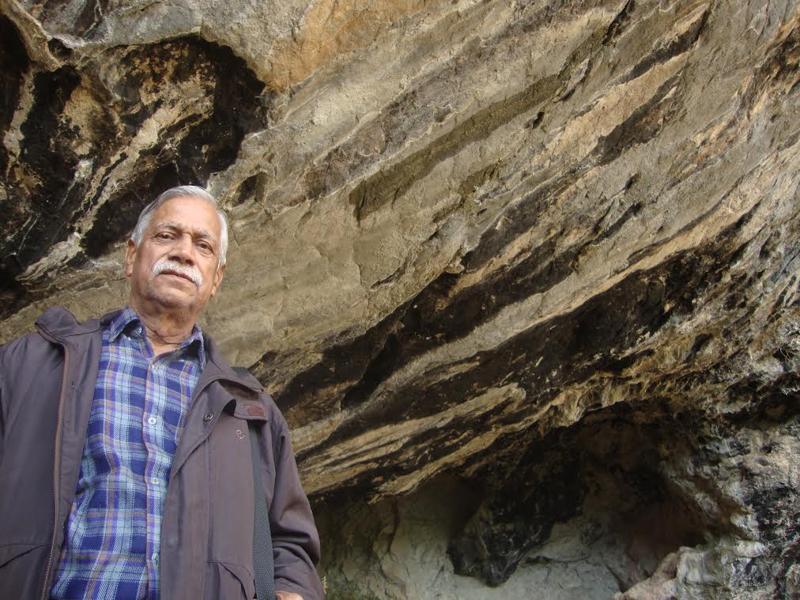
Meet 66-year-old Dr Narayan Vyas, who retired as superintendent archaeologist in 2009 after serving in over half-a-dozen states across India in a career spanning four decades. Post retirement, for someone who has spent a lifetime in the field, he didn’t look forward to enjoying life in the comforts of an armchair.
For the last two years or so, Vyas has been helping Spanish rock art experts who have visited archaeological sites in the state with him, to study and date them. In October, he spent two weeks in Spain, discussing rock art of Madhya Pradesh and comparing it the with some of the rock art sites in the European country.
‘Spanish study of rock art near Bhopal can turn out to be a milestone in archaeological research’
Seated in his study in Bhopal, with shelves filled with books, stone age tools, self-made replicas of rock arts and dozens of awards, Vyas talks about how Spanish study of rock art especially at Kathotiya on the outskirts of Bhopal, can turn out to be a milestone in archaeological research in India.
“Bhimbetaka and the nearby areas in Bhopal have one of the highest concentrations of the rock art paintings in the world. I am helping the Spanish experts from Centre De Estudis to study the rock art at Kathotiya where paintings have been found in over 65 rock shelters,” he said.
He added that in the next few months or so, the Spanish experts will seek permission from the government of India to date the rock art at Kathotiya and also make excavations at the site.
On the significance of his collaboration with Spanish experts, Vyas says the exact dating of the rock art will dispel the long-held notion especially by Western experts that Indian rock art was not that old compared to rock art of France, Italy, Spain, Siberia, parts of America and South Africa.
He said that many rock art paintings in MP, especially the ones painted with green pigment, are at least 25,000 years old. “I had earlier suggested, after my in-depth study of the style and the superimposition patterns in the paintings at Bhimbetka complex, that the age of some of the rock art paintings there is as old as 20-25,000 years. This generated much controversy among the experts as most Western experts have never accepted that Indian paintings could be that old. They always put the age of Indian rock paintings at maximum 10-11,000 years,” he added.
Vyas continues his prehistoric romance
Apart from coordinating with Spanish experts, Vyas continues his prehistoric romance.
He still takes to the field and enjoys his search for antiquities, especially stone-age tools, fossils and ancient coins.
Over the last six years, his field searches have enriched his personal collection with over 2000 prehistoric artifacts, a part of which he showcases in exhibitions. He has some very interesting artifacts in his collection that include small fossils of millions of years old trees from Rajasthan’s Jaisalmer and Bhanpur in Mandsaur, Madhya Pradesh, 2nd century pottery from Bhojpur Kolar, 3rd century blackware from Uttar Pradesh, stone axes and cleavers from Palampur Ghati in Raisen, 1600 BC copper cage pottery from the banks of Narmada in Harda district, 3rd century BC copper coins from Maurya age from Vidisha and a 3rd century BC brick with a foot impression.
The Ujjain-born Vyas studied fine arts at his hometown, but later shifted towards archaeology and did a post-doctorate degree (D Lit) on the rock paintings in Bhopal and Raisen area with focus on world heritage site Bhimbetka.
“My mother used to take me with her to the temples, some of them very old. Looking at those sculptures and the amazing architecture would make me curious about who made them. I think the seeds were sown then. Later, one of our teachers, the famous Dr VS Wakankar (the discoverer of Bhimbetka rock shelters), encouraged me to study archaeology. And thus a love affair started which still keeps me restless and fires my passion,” he says.
ARCHAEOLOGICAL TREASURE: KATHOTIYA
Cut into Vindyachal hill ranges, located in Sehore district around 25 km from Bhopal, Kathotiya houses 70 rock shelters with rock art
Believed to be 5,000 to 11,000 years old, the site has prehistoric paintings primarily in red-coloured natural dye. Some have also been painted with white and green pigments
The paintings comprise hunting scenes – men killing animals with spears – horned animals, people dancing in groups, body decoration, animal fights and other such scenes of daily life of hunter-gatherers
These paintings were discovered in 1975 by Dr Shankar Tiwari of Hamidia College in Bhopal.