
 E-Paper



Excerpt: First Bite by Priyadarshini Chatterjee
This edited extract from a book of breakfast stories from urban India looks at the varieties of rice cakes that are relished in Shillong

 Prefer HTon Google


…in the Khasi universe, rice yields unending gifts — among them a vast variety of jingbam dih sha, or kpu — traditional snacks made with a number of indigenous rice varieties like khawmynri, khaw Manipur, khawpnah, and local red rice, often paired with morning tea. Rice cakes are popular across the Northeast and eastern India as a breakfast item — from Assam’s bowl-shaped tekeli pitha, a layered treat of rice, jaggery, and coconut scrapings, steamed, tied in damp muslin or cheesecloth, and set in the mouth of tea kettles, sold out of roadside stalls, or the pancake like kholasapori pitha, also called hazarmukhi, perhaps after the innumerable air holes that pop up on its surface like a thousand mouths opening, to the Mizo chhangban, a fluffy steamed rice cake made with a thick paste of glutinous rice, which is steamed in banana-leaf parcels and served with a drizzle of honey or molten jaggery — or even crunchy granulated sugar — and a cup of tea. The Garos too have their share of rice cakes. ‘On Sunday mornings, my mother would always make rice cakes with pounded joha rice layered with pounded sesame seeds,’ Chef Marak tells me.
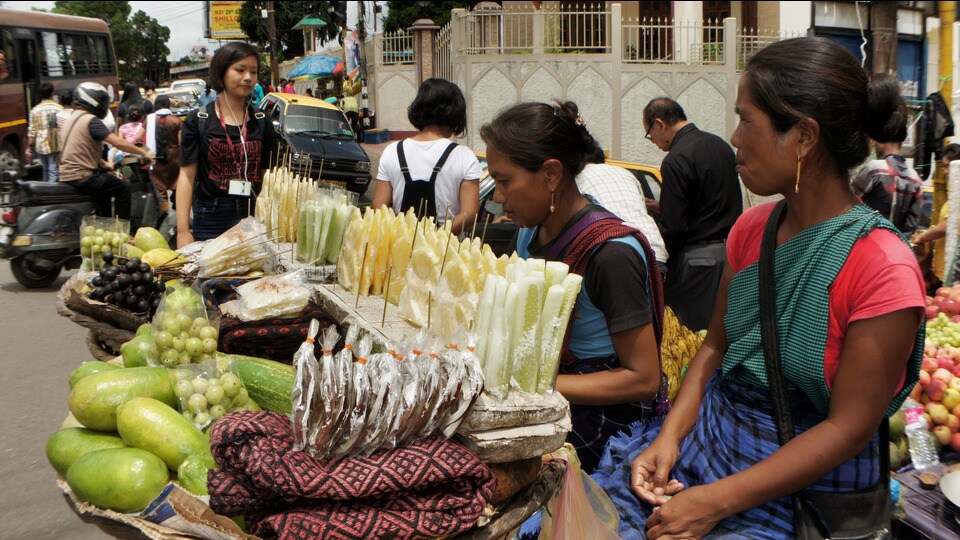
In Shillong, jingbam dih sha is an integral part of the urbanscape — sold at stalls on street corners and tea shops, and in its busy markets where women sit at tables with wobbly legs groaning with an array of these rice-baked treats, or roving hawkers carry them around in conical cane baskets. Many deliver their snacks to offices across the city, too, both in the mornings and afternoons. Near the entrance of Ïewduh, a young woman sets up shop at around 9:30 every morning. On a low table fashioned out of bricks and a wooden plank, she neatly arranges an array of steamed, baked, and fried kpu, wrapped in leaves or translucent polythene bags, in stacks and piles.
There are stout wheels of pusaw, red rice cakes the colour of rich plum cake; the cup-like pu maloi; thick, large, gold crusted banana pancakes; the ubiquitous putharo — soft, round, puffy pancakes, the size of small saucers, typically made with the high-yield mynri rice from the verdant valleys of Ri-Bhoi district; and bags of coffee-hued pukhlein — puffed-up orbs of deep-fried rice-and-jaggery batter. Crisp-edged, with a soft, doughy yet honeycomb-like interior, pukhlein is suffused with a dark, mellow sweetness that sits on the tongue like a faraway memory.
Putharo, on the other hand, has no taste, really, and sops up the flavours of the curries and condiments it’s eaten with. At breakfast stalls across town, putharo is generally served with doh-nei-iong or dohjem — pork, or pig innards (usually intestine), cooked with black sesame paste — boosted with the typical Khasi coterie of ingredients: turmeric, onions, a bit of garlic, and salt. Putharo can also be eaten with a slathering of jam or butter, Chef Dariti tells me, as she hands me a bag full of kpu she picked up on her way to meet me — a stack of putharo and half a dozen pukhlein.
‘Besides,’ she says, ‘putharo tastes brilliant with tungrymbai.’ The piquant, protein-rich chutney is made out of the eponymous tungrymbai, or fermented soybean paste, which is sold in Shillong’s crowded market stalls —tucked among heaps of scalding chillies, plump tomatoes, wild berries, and raw peppercorns — wrapped in tidy leaf parcels. Pasyih, a village in the West Jaintia Hills District, ‘is famous for its huge production and the best quality of tungrymbai.’ Recipes for the condiment — fortified with a host of spices and herbs — vary from one household to another and pick up various regional inflections. Chef Dariti’s family recipe calls for adding some pork fat to boiling water, followed by flaked dried bird’s-eye chillies (or sometimes even the bhut jolokia), a little garlic, yellow turmeric, and the mashed soybean paste. Next, pounded black sesame or perilla seeds — or a mix of both — is added to the simmering pottage along with chives and the fragrant ing makhir. ‘The condiment is usually made in large batches and can be stored for a few days,’ Dariti tells me. ‘I like to slather a generous pat of tungrymbai on my putharo,’ she adds.
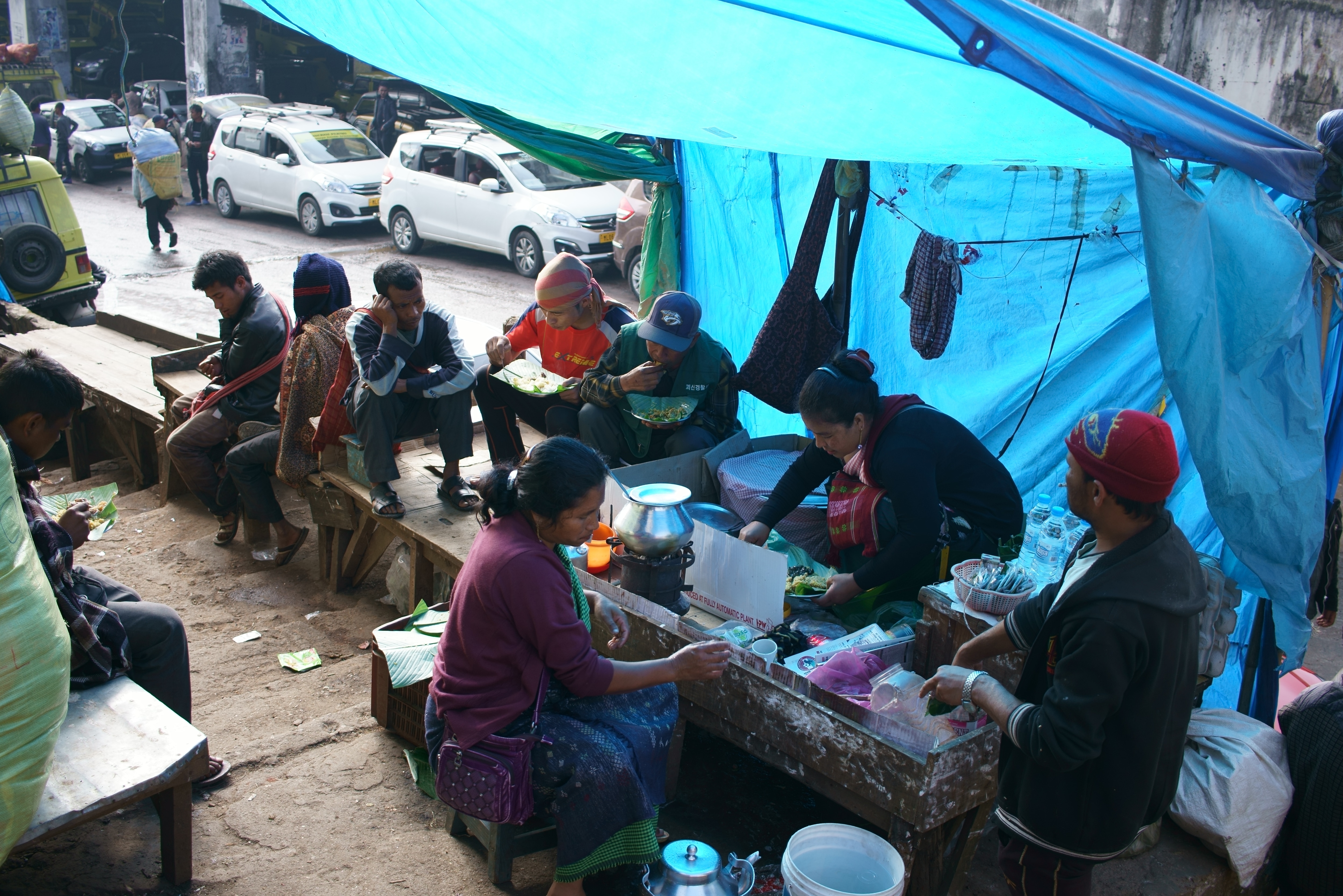
But these indigenous rice cakes are not just artisanal snacks; they are veritable cultural artefacts — repertoires of culinary knowledge and techniques passed down through generations, mother to daughters, masters to students. They are also at the heart of a thriving small-scale cottage industry. Even if these snacks fuel the city, they predominantly come from household kitchens in suburban towns and villages around Shillong.
One rainy morning, I set out to meet one such family, in the suburban town of Mawlai, a short drive out of Shillong — people who have been in the business of making kpu for generations.
The early-morning drive to Mawlai, in a rickety kali-peeli, is scenic in parts. The lush hues of the rain-glossed landscape, dark and brooding under turbid, watercolour skies laden with rainclouds, look beautiful but sombre. We take a left off the highway, up a narrow uphill road into the village of Mawlai Umthlong. I spot Ibaiaineh Mylliem Umlong — aka Iba — or rather, her bright purple umbrella, at the end of a misty road flanked by trees. Soft-spoken and quietly cheerful, Iba greets me with a radiant smile and points towards a narrow alley in the corner that seems to plunge downhill. ‘My house is that way,’ she says, but starts walking in the opposite direction. ‘We’ll go to my aunt’s home first,’ she tells me. Iba’s late aunt’s family is also in the business of making kpu, she says — like a number of other families in the area.
I follow Iba through a large gate and an open area, past the main house, to a summer kitchen of sorts — a large room detached from the main house. Sparsely furnished and immaculately clean, the room’s red-oxide floor stands out against its canary-yellow walls. The upper reaches of the walls are charcoal black, like the ceiling, from the soot rising from the wood fire. The place is bustling with activity, yet there’s a sense of quietude.
I am greeted by a woman sitting on a low stool at a table crowded with stacks of waxy leaves — water glistening on their shiny surface — and a few steel utensils. Her name, she tells me, is Rijanai Mylliem Umlong. ‘And that’s my father, Wanmanik T habah,’ she says, pointing towards an elderly man in a green windcheater and chequered newsboy cap, sitting on a low stool in front of a long row of wood-fired stoves. Bundles of pine-wood logs, used to fuel the ovens, are piled on a shelf built into the wall above the hearth. Thabah pours ladlefuls of thick, pale batter onto black clay plates with concave bottoms and places a lid on top. ‘He is making putharo,’ Rijanai tells me, ‘and the traditional black clay pans are called saraw. They are made in the Jaintia Hills.’ The putharo comes off the plates as soft, fluffy, moon-faced griddle cakes punctured with a few air holes. He tosses them onto a massive salver, called trap, woven out of a kind of reed bamboo and dry palm leaves in two layers. A young girl sits next to the trap with a hooked knife, scraping out the tiniest mark or soot stain on the putharo. There mustn’t be any scars on these moons.
Rijanai, on the other hand, takes scoops of cooked sticky rice — a mix of black and white glutinous varieties grown in the hills of Meghalaya — places them on the leaves, pats and shapes them into rectangles with the edge of her palm, and wraps them up carefully, as if they were gifts. She tells me that she is making ja shulia, and the leaves, locally called sla lamet, are of Phrynium pubinerve, which grows wild in the wet, dark forests of Meghalaya. I have seen these leaves across Shillong, especially in the bazaars. They are used prolifically as packaging material in the region, and kpu typically come wrapped in these leaves that perhaps relinquish some of their fragrance to the delicate cakes they coddle.
‘Ja shulia is eaten with jaggery or sugarcane juice reduced to a thick syrup,’ a woman says with a big smile, as she walks in. She introduces herself as Rijanai’s sister, Stepphyrai. More women drop by, clad in traditional aprons of different hues, with big smiles and kind words. They are all sisters, they tell me, and Thabah is their father. Iba explains to me how in the Khasi tradition the family and clan lineage is traced through the female line. Children take their mother’s last name, and daughters inherit property. When daughters marry, it is their husbands who join their families and clans. In most Khasi villages, fathers are referred to as ki shongkha, loosely translated to mean ‘incoming husbands.’

‘Actually, it is the youngest daughter— called khadduh — who inherits the ancestral household as well as the responsibility of the ageing parents. She must continue to live with them,’ Iba says.
Other daughters could choose to live in their family home or move out. ‘Usually they stay close by,’ says Iba. Even if Khasi society is more gender egalitarian compared to patriarchal societies, men hold ‘ordained structures of power’. …Khasi women have been barred from participating in the traditional political bodies even if they own property, substantially participate in trade and commerce, dominate public spaces, and hold influence within their clans. Khasi dorbars, or village councils and assemblies, have customarily been exclusively male spaces. Domestic responsibilities are also primarily the woman’s. ‘In most Khasi homes the kitchen is a woman’s domain, but more often than not men do help with kitchen and housework,’ Iba tells me.
One among the girls relieves Wanmanik and takes over the putharo station. On a regular day, they make about 1,000 putharo, but it could go up to 2,000 or more depending on orders. It is their specialty. Every morning the sisters begin work as early as five. The rice soaked the previous evening must be sieved, dried, and ground. ‘Nowadays we use a machine, but originally the semi-dried rice would be ground manually using traditional wooden mortar and pestle,’ Stepphyrai says. Pounding rice is a key and essential step in making all these rice cakes.

I think of a folk song from the North Khasi Hills that I had come across recently: ‘Together, O together, jrup, i. / Pounding rice together, brup, ii. / Sticky rice, sticky grain, / Together in the aunt’s tyngkong’
People start dropping by around seven for their morning supply of freshly made kpu to go with their tea, Stepphyrai tells me. As if on cue, a young boy, about ten, saunters in, his eyes still laden with sleep, asking for a dozen putharo. Rijanai quickly wraps a stack of freshly made putharo and hands it to the boy.
‘Some may even bring their tea along,’ Stepphyrai says, placing a plate of ‘rice cakes’ on a small oval table in front of me. Shaped like cupcakes — snow-white and spongy — the rice cakes are riddled with bursts of sugar. I detect floral notes from the rice, which meld with the nuttiness from a dusting of coconut flakes — like freshly fallen powder snow — on top. The rice cakes come with a large glass mug of sha saw — red tea. A fresh bout of rain lashes against the green surroundings….


