
 E-Paper



Review: A Time Outside This Time by Amitava Kumar
An amorphous book that can be read as part journalism, part cultural criticism, Amitava Kumar’s new novel looks at the fickle line between fact and fiction

 Prefer HTon Google


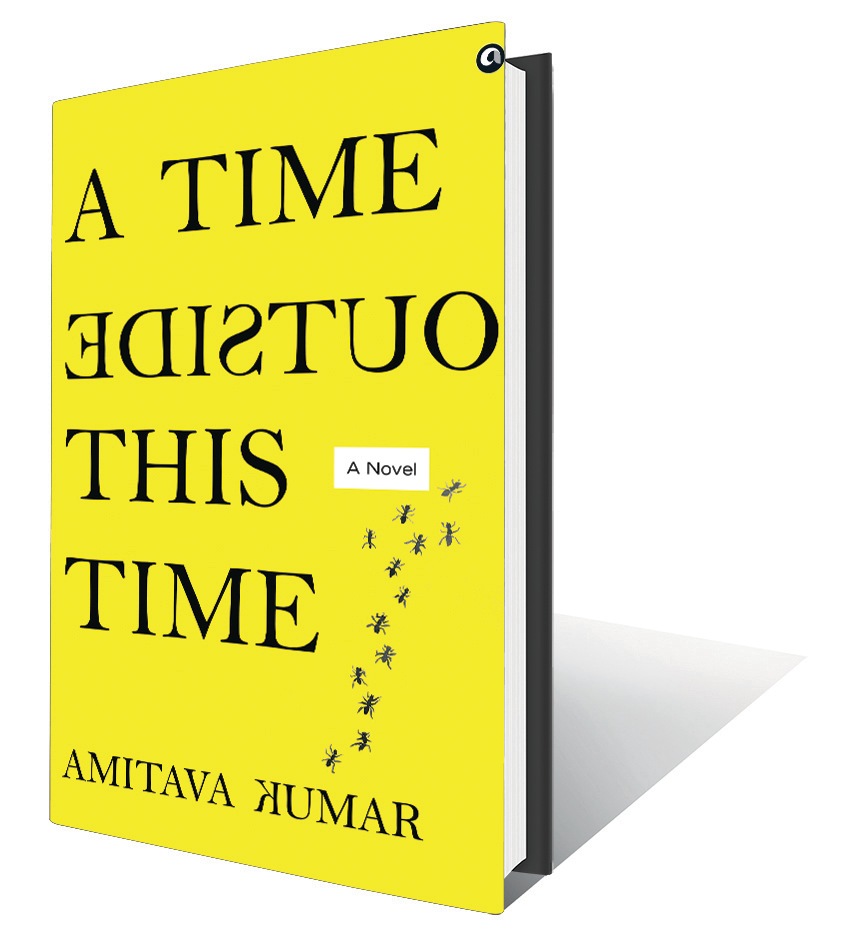
Amitava Kumar’s A Time Outside This Time is an exceedingly meta novel about the news in the time of propaganda and lies.
Like Kumar, Satya grew up in Patna and teaches at a liberal arts college in upstate New York. In the spring of 2020, the pandemic just about beginning to shut the world down, Satya is working on “a novel about reading the news” at an artists’ retreat in Italy. Satya’s Enemies of the People is “a report from the world of #fakenews” — interchangeable by description to Kumar’s novel in which it is contained. Kumar even shares his body of work with his protagonist. A Foreigner Carrying in the Crook of His Arm a Tiny Bomb, Kumar’s 2010 non fiction book interrogating the consequences of America’s war on terror, is attributed here to Satya. In this plotless, amorphous novel, which feels only very loosely framed by fiction, I found myself forgetting Satya almost entirely as he blurred into Kumar. I read this novel mostly as non-fiction, part journalism, part cultural criticism, which, I suppose is kind of the point Kumar (as Satya) is trying to make: “I do not know in which category the book that I’m writing will be put. This is a part of the confusion of our times.”
Satya, through his novel, wants to find answers to the question: Who among your neighbours will look the other way when a figure of authority comes to your door and puts a boot to your face? A Time Outside This Time is essentially a survey of research, memory, reportage and art to interrogate compassion, betrayal, and the fickle line between fact and fiction.
All of these come together in a small section about a Pakistani man who was an informer and translator for the FBI. Satya had met him over several months for a profile. It’s a riveting short story within the novel — this former FBI informant who even went on assignment to Afghanistan, fearing deportation from the US, had married a white American woman and was graduating college when he met Satya. They develop a kind of friendship over the interviews — he borrows money from Satya, sends his wife to his family who found it too expensive to keep her (they had to send for McDonald’s in rural Pakistan for her), but his memory is shifty and his stories change, his wife has another version, but they all still kind of make sense, or maybe not (can memory ever be entirely truthful?)… It’s all such a complicated, even delightful, mess, I’d recommend the book just for this.

Through most of the book though, Satya quotes from George Orwell’s 1984, which he is reading and mulls on famous experiments. The Milgram experiment (which had shocked the world by showing that most people would obey instructions from a figure of authority, even if it meant harming another person), I learnt, is incorrect and incomplete. Further research showed for instance, that if there are two authority figures who disagree with each other, the percentage of participants willing to be as cruel fell to zero, Satya says. There’s the Dunning-Kruger effect (people believe they’re smarter than they really are), research on lying (which he uses to explain Trump), a whole series of experiments carried out on monkeys. He talks about Marina Abramović’s best-known performance, Rhythm O, in which she stood still and invited audiences to do to her as they pleased using any of the 72 objects laid out on a table. They were gentle in the beginning, but turned murderous. One of the participants pointed a loaded gun at her head. But another had pushed it away. “I think Abramović was left with at the end was a question similar to the one with which I started this book: Will the person standing next to the one who is doing tremendous violence to you step in to put a stop to it? To a small extent, this is exactly what happened during the performance,” Satya concludes, offering, in his quest for truth, a quiet assurance.
In a flashback to his childhood, Satya remembers that when it rained, you could do nothing but wait. In this illusion of the permanence of rain, he finds wisdom: “We cannot imagine — I cannot imagine, sometimes — a time outside this time. The people who are in power must also be deluded enough to believe this… The powerful will not be waiting for it but that moment will come. It will mark the beginning of their doom, their end.”
A Time Outside This Time is a time capsule. Kumar (as Satya) goes over major events of 2020 in India and the US. Some of these, like the anecdotes from the early months of the pandemic — the agony and the loneliness of it — I found difficult to read. It all just happened; it’s too soon for nostalgia, too painful to remember. But it is a gift for future generations.
Saudamini Jain is an independent journalist. She lives in New Delhi.


