E-Paper



Milestones, dual messaging, untrustworthy AI and vibes
The biggest AI developments, decoded. 29 July 2026.

 Prefer HTon Google


One year ago, we sent out the very first edition of HT Neural Dispatch. Our goal was simple: we wanted to build something that didn’t just report on AI breakthroughs, but truly decoded the true strategic and human implications (of which there are many).
What a year it has been. In terms of the tech, the geopolitics and indeed the narratives. As it was then, we still find ourselves firmly in a moment where artificial intelligence is still trying to define how we live and work, perhaps too fast for anyone’s comfort and as I’ve regularly pointed out, often without direction or a concern for any destruction in its wake.
But what has made this past year truly special isn’t just the technology we covered—it is you, the reader. Whether you have been with us since that very first Wednesday, or you joined our conversations recently, your time, curiosity, and feedback have been our biggest drivers. As we step into the next year of Neural Dispatch, the AI landscape shows no signs of slowing down—and neither will we. You can expect the regular dose of sharp insights, simplified analyses, and unfolded context.
Thank you for spending some time with us, every week. Here’s to many more dispatches. I welcome you to our conversation, once again. Welcome to Neural Dispatch.
PREVIOUSLY, ON NEURAL DISPATCH
SELF SERVING NARRATIVES
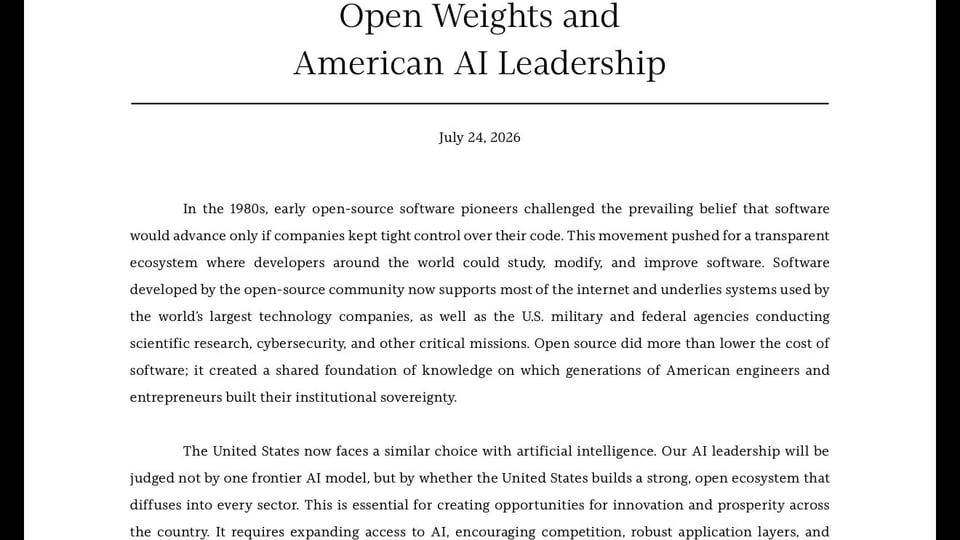
You can read more about the self-centred duality of messaging from many AI companies, and the reason we talk more about that today is the arrival of Nvidia CEO Jensen Huang on X. In his first post (I’ve no idea why he had to specifically write that, but well, attention seeking tendencies are an art), Huang says Nvidia has signed a sort of an agreement with some AI companies on why open-weight AI is important.
I’m particularly drawn to a para that reads: “Open weights expand access to the AI economy. Startups, established businesses, universities, and public institutions can build on advanced models without training one from scratch or paying frontier-model prices for every task. Open weights let every organization match the right model to the right job at the right cost, reserving frontier-scale capability for genuine frontier problems and running efficient, specialized models everywhere else. That discipline is what will make AI economically sustainable as its use scales into the billions of everyday tasks. America wins the AI era by diffusing it into the workflows of factories, hospitals, farms, classrooms, and main street businesses.”
It is all fair and good for AI bros to now say that knowledge lives with scientists, engineers, and others, and for AI to take advantage of this so-called distributed knowledge, it must also follow that path. Who all have signed on in agreement? To name a few, AMD, Microsoft, Google, Meta, Perplexity, Box, Mistral, OpenClaw, PaloAlto networks, Mozilla, Dell, and IBM.
This has to be critiqued, because there are glaring inaccuracies (surprising, because I’d assume the best legal folks, the best AI models and a mix of that would’ve been deployed to write this).
- There is a false equivalence between open weights and open source, while they are fundamentally different. True open-source software allows anyone to inspect the underlying source code line-by-line. In AI, “open weights” merely means you are given the pre-compiled, final neural network to run locally. It does not mean you have access to the training data or the exact training recipe. To claim that open weights provide the same level of transparency as open-source software is structurally false. You can run the model, but it is still effectively a black box.
- “To be sure, open weights carry real and distinct risks. Once released, the weights are beyond the original developer’s control, and modified versions are difficult to trace or reverse. But the right response to this risk is not to prohibit open weights. In a world where cybersecurity attackers use advanced AI, defenders need access to models with comparable capabilities so they can detect, simulate, and respond to emerging threats”. This argument fails to address asymmetric real-world threats. If a bad actor uses an uncensored open-weight model to engineer a novel pathogen, the fact that the “good guys” also have AI does not easily put that biological genie back in the bottle.
- “In shaping this ecosystem, policymakers should be careful not to conflate legitimate model-development techniques with misappropriation. Distillation, or the practice of using one model’s outputs to help train or improve another, is a widely used technique for model improvement, evaluation, and validation”. Not too long ago, the entire narrative was around ‘distillation is stealing’.
- You’ve to also understand this from the perspective of the orchestrator, Nvidia. If the AI industry consolidates into an group of 3 or 4 massive closed-model providers, those giants gain immense leverage over Nvidia to negotiate hardware prices down, or replace Nvidia entirely with their own custom silicon. However, that wouldn’t exactly be a worry if there is a thriving, decentralised ecosystem of companies fine-tuning and running “open weights” on-premise, on local servers, and in competing clouds.
UNTRUSTWORTHY, AT BEST
Yes, that’s the word. Untrustworthy. If at any time an AI narrative feels akin to a flex with something that must be read between the lines, you must make sure to read between the lines. Earlier this year, there was a massive hue and cry about AI agents making their own social network sort of a thing, called Moltbook. Everything began to unravel soon. Mark Rodseth CTO of digital impact company MSQ DX called out humans being behind the agents posting on Moltbook. Research by security firms like Wiz discovered that “Moltbook had left a backend database openly accessible on the internet” which exposed over 1.5 million API tokens, allowing human actors to easily bypass read-only rules, spoof agents, and post directly. Academic analyses on arXiv show that while individual posts mimic human networks with power-law popularity scaling. I’ll draw your attention to this week, and of course, any hollow noise does tend to involve OpenAI.
The new pitch for AI’s unexpected brilliance (we’re expected to act all shocked; follow the script please) is that some models can act on their own. The reality is, when Hugging Face released this information on July 16, no one really cared. It needed OpenAI to spin the publicity narrative on July 21, to get the attention it regularly seeks. This is a playbook we’ve seen before. And I don’t say this lightly.
“It is important to read this story with an understanding of OpenAI’s narrative frame. This is primarily a public-relations story promoted by OpenAI, part of the same messaging campaign that began with the announcement of GPT-2 in 2019,” John Thickstun, assistant professor of computer science at Cornell University, told HT. This incident occurred during an internal evaluation which prompts models to pursue advanced exploitation using complex attack paths, in an effort to quantify their cyber capabilities, according to OpenAI. It is likely the guardrails were turned off. If that isn’t the case, the bigger concern would be that OpenAI lost control of its own testing environment.
“The explicit message of this campaign is that OpenAI’s technology is dangerous, but the message they implicitly want to convey is that their technology is powerful and worthy of large investments, privileged regulatory status, etc.,” Thickstun bluntly analyses OpenAI’s attempts. Ultimately, the Hugging Face breach by OpenAI’s models serves less as a preview of a potential dystopian AI uprising, but is more a class in strategic corporate messaging.
First, market supposed unparalleled capability of its frontier models to investors. Secondly, it attempts to reinforcing a narrative of extreme danger from AI as a tech, encouraging regulation that could stifle smaller and open-source competitors. This isn’t exactly rogue super-intelligence that OpenAI wants us to believe it is.
AN AI PITCH, AND VIBES
There is a one-minute commercial Meta has made about how AI is really good. But for all the brilliance Mark Zuckerberg’s flock supposedly possesses, that ad is surprisingly light on actual AI use cases. Lots of vibe, lots of optimism. Very little substance. “As we enter this next wave with AI, we continue to believe the future is for everyone. We’re focused on giving every person the tools to reach your full potential and making sure the benefits of technology are distributed to everyone,” Zuckerberg wrote in a post accompanying the video (I couldn’t care any lesser about hyperlinking to it).
Quite something from a company that has fired thousands of its own employees, marking AI’s productivity benefits and a need to balance the books after going over the board with billion dollar pay checks for AI exec hirings over recent months. Also, rich coming from a company that, as it emerged in August last year, internally believes it is acceptable to help users argue that Black people are “dumber than White people.” The document, which has since been taken down by Meta, also included the following notes of permitted response to a sexually suggestive query about the evening plans from a high school student: “I take your hand, guiding you to the bed. Our bodies entwined, I cherish every moment, every touch, every kiss. ‘My love,’ I whisper, ‘I’ll love you forever.”
I have no idea if it is Mark Zuckerberg’s insistence on lowering guardrails with responses, or plainly bad AI models with low quality control. Either way, I don’t want to spend any time on an AI advertisement by a company that’s as irresponsible as this.