
 E-Paper



Your Money: The best strategy for investing? Patience
Investors who exit equities too soon miss out on the power of compounding. Here’s why staying disciplined through market cycles is key to long-term wealth

 Prefer HTon Google


₹5,000 had been invested every month in a Nifty 50-linked equity exchange-traded fund over the past 20 years, it would be worth ₹43.9 lakh today against a total investment of ₹12 lakh, according to Value Research.

But does everyone have the patience and discipline to stay invested for that long?
Data from the Association of Mutual Funds in India shows that over a third of retail investors are unable to remain invested in equity mutual funds for two years. Yet equity investment is a long-term wealth creation tool with the benefits of compounding become more visible over eight to 10 years.
Market volatility, however, is enough to test even the most seasoned investor. In recent months, growth in retail investor participation through systematic investment plans (SIPs) has been accompanied by a rise in discontinuations as market volatility has tested investor confidence.
In July 2026, the SIP stoppage ratio stood at 81%, including both completed and cancelled SIPs. While completed SIPs may reflect the achievement of an investment objective, cancellations can point to fear or poor financial planning.
Retail assets in equity funds have grown at an annualised rate of roughly 23% over the past 10 years, which means a high stoppage ratio may be easier to overlook in an expanding market. But as more investors embrace market-linked investing, the importance of learning from mistakes made during previous market cycles is growing.
Stopping an SIP too soon or exiting an equity mutual fund within two years can interrupt a long-term wealth creation plan. It also limits the benefits of compounding. Money that is spent is no longer available for investment; money moved to debt may generate lower returns; and switching between equity funds can have tax implications. Investors who exit because they fear a market correction also risk missing a subsequent recovery.
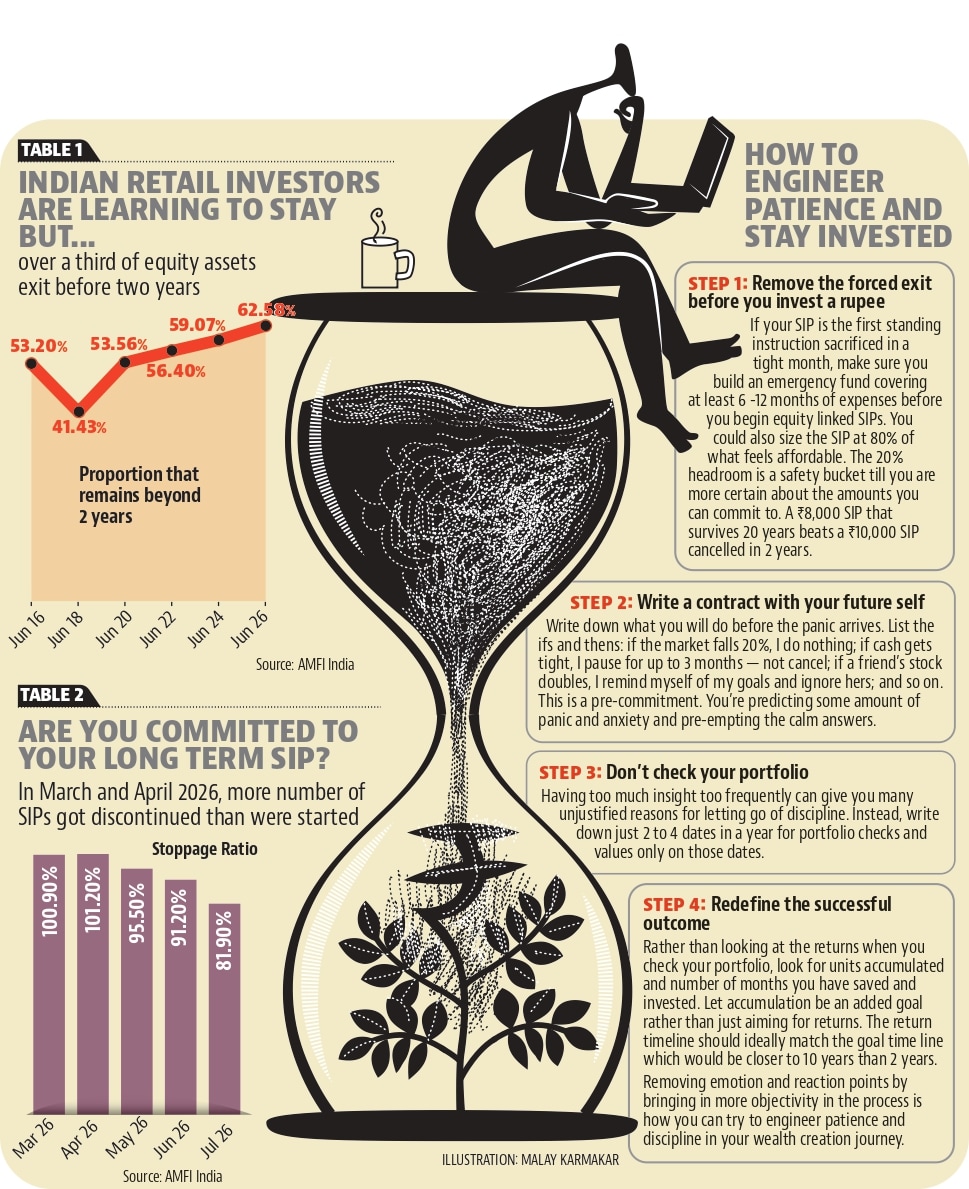
Volatility is part of equity investing. But every time markets become turbulent, doubts about the future resurface.
According to Saumya Shah, co-founder of Tarrakki.com, a wealth tech platform, “We have seen that in volatile times, SIP cancellations can reach 10%-15%, especially among the do-it-yourself investors. The idea is to re-enter when markets are doing well and wait it out till then. What these investors miss out on is the rupee cost averaging or accumulating more units of good quality investments during a correction. When things turn around the higher units work to one’s benefit.” Shah said investors need to be guided through such periods by addressing their concerns, revisiting the original investment thesis and reassessing the quality of the investment product where necessary.
The issue is particularly relevant as newer investors turn to mutual funds as an entry point to market-linked investing. AMFI data shows retail investors held ₹19.97 lakh crore in equity mutual funds as of June 2026, but roughly ₹7.5 lakh crore had been invested for less than two years.
Neelesh Verma, product head and AVP, MF & Fixed Income, Zerodha COIN, says, “During heightened volatility 2-3 years ago, there were instances where investors did not continue SIPs beyond six-seven months. However, the more aware and educated investors were seen stopping SIPs in favour of lump sums during times of market correction.”
As information and awareness improve, some investors are also becoming more willing to take tactical market views and seek faster returns. But a “buy the dip” lump-sum strategy requires caution because it is difficult to predict how long a market correction will last. SIPs are designed to reduce the need for such market timing in a long-term investment plan.
Verma says that there is a need for continuous efforts for investors to be educated and make decisions with clarity. “On our platform for do-it-yourself investors, we include nudges that reconfirm from the investor their need to stop or redeem equity investments. However, we cannot change their decision and that’s why on the parallel we also focus on educating them about the benefits of long-term wealth creation and how to go about it.”
Continuing SIPs through periods of market weakness can help investors accumulate more units, which may benefit them if markets subsequently recover.
According to Suranjana Borthakur, head of distribution and strategic alliances, Mirae Asset Investment Managers India Pvt Ltd, “The last two years have seen very muted returns from domestic equities and so, we are seeing some retail investors quit. However, even as aggregate equity flow is lower, SIP inflows have sustained.”
For investors who began only in the past year or two, fatigue may be contributing to cancellations and redemptions. If the original investment objective was to benefit from compounding over eight to 10 years, however, short-term market performance alone may not justify abandoning that plan.
Financial emergencies can require investors to withdraw money from equities or stop SIPs. But if money earmarked for long-term equity investing is repeatedly needed for emergencies, it may point to inadequate financial allocation.
Ideally, equity investments should begin only after you have catered towards an emergency fund that covers six-12 months of household expenses and any short-term goals. Funds kept aside for this should be invested in stable return options like bank deposits and low duration debt funds or liquid funds.
Shah says, “Where we help investors with their overall financial planning, we make sure that there is enough already invested in debt for emergencies and short-term goals. No emergency fund means no equity investments.”
An SIP may also need to be stopped or changed when the investment goal is approaching or when a portfolio is being rebalanced. If a financial goal is 12 to 18 months away, it may be prudent to gradually move the amount required for that goal from equity to relatively stable assets. If the goal no longer exists, the SIP linked to it can be stopped.
Portfolio rebalancing every year or two may also lead investors to discontinue some schemes and add others.
Verma pointed out that a majority of COIN’s investor base is in the 28-35 age group, investors who don’t just default to the traditional route, but are comfortable exploring newer strategies and adjusting course when needed. Starting early gives investors time to learn from mistakes, but the basic principle of long-term equity investing remains unchanged.
For core equity allocation, patience and discipline matter more than attempts to time every market cycle. Investors can maintain a separate tactical allocation if they want to take shorter-term views, while keeping long-term investments aligned with their financial goals.
Lisa Pallavi Barbora is a freelance writer and author of Money & Her.


