
 E-Paper



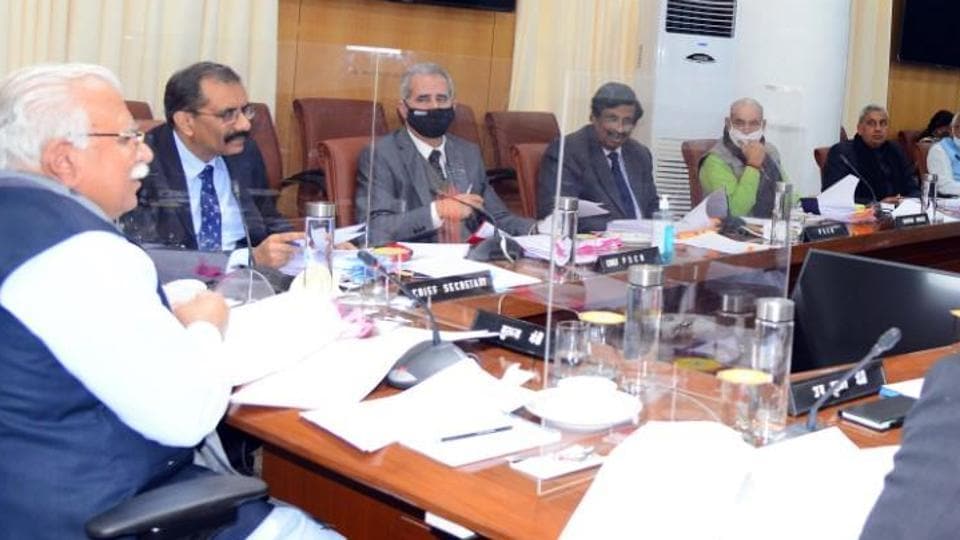
Cabinet meet: Haryana govt approves Delhi-Panipat rapid transport system
The Haryana Enterprises and Employment Policy that aims at attracting over ₹1 lakh crore investment and generating 5 lakh jobs was also approved by the cabinet.

 Prefer HTon Google


The Haryana cabinet on Wednesday approved the implementation of Delhi-Panipat Corridor of Regional Rapid Transport System (RRTS).
The length of the Delhi-Panipat Corridor of RRTS is 103km and it will have 17 stations, including six in Delhi and 11 in Haryana. An official spokesperson said the construction and commissioning of the RRTS will be undertaken in two stages—Sarai Kale Khan to Murthal, including Murthal depot (58.28km) and Murthal to Panipat, including Panipat depot (44.74km).
The cabinet approved gross contribution of ₹4,699 crore as the state government’s share towards the project cost. It also nominated administrative secretary, town and country planning department as nodal officer for signing of agreements and other related documents with NCRTC for implementation of the project.
Apart from this, the cabinet also authorised the chief minister to approve any changes or modifications, if they arise during consultation with NCRTC or Government of India for removing difficulties and bottlenecks in implementation of the RRTS project.
New enterprises and employment policy approved
The Haryana Enterprises and Employment Policy that aims at attracting over ₹1 lakh crore investment and generating 5 lakh jobs was also approved by the cabinet. The policy will focus on establishing Haryana as a competitive and favoured investment destination and building a resilient economy on the back of robust industrial growth, an official spokesperson said.
The policy takes cognizance of emerging trends in supply chain, electric mobility, agri-tech, green manufacturing and climate change and healthcare and pharma and other new avenues for growth.
In order to ensure timely delivery of services to the investors, 41 new services will be included in the Haryana Right to Services Act, 2014 and the single window system will be further strengthened with the integration of additional 36 new services.
Keeping in view balanced regional growth, the state has been divided into four categories blocks (industrially developed, intermediate development, industrially backward areas and industrially most backward areas) based on industrial development.
This policy places a special emphasis on development of the MSME sector and their business growth. It envisages bringing up a paradigm shift from being a regulator to a facilitator of MSMEs. To reduce the cost of doing business in the state and enhance industry competitiveness , the policy offers an array of attractive fiscal incentives to MSME, large, mega and ultra-mega enterprises.
“The Ultra-Mega and Mega and Cluster projects as defined under this policy will also be considered by Haryana Enterprises Promotion Board (HEPB) for special package of incentives,” said an official.
Common cadre for Group-C
The cabinet also approved Haryana Group-C employees (Recruitment and Conditions of Service) Bill, 2020 with the objective of creating a common cadre, equal promotion opportunities and stability of tenure.
Under this move, a common cadre will be constituted for the Group-C employees of all the departments so that they get equal opportunities for further promotion and can be transferred from one department to another under online transfer policy on completion of prescribed tenure or earlier.
Amendments in Affordable Housing Policy
The cabinet approved amendments in the Affordable Housing Policy, 2013, increasing the maximum area limit of project from 10 acre to 30 acre while the minimum area limit for setting up of affordable group housing colony has been reduced from 5 acre to 4 acre.
An official spokesperson said although the minimum area norm is being reduced from 5 acre to 4 acre, the coloniser will provide the community building as per the norms prescribed for 5 acre. As per the amendment, the commercial area has now been increased from 4% to 8% of Net Planned Area. The existing provision of providing 0.5 Equivalent Car Space (ECS) will continue to remain mandatory and non-chargeable. The coloniser will be allowed to provide additional 0.5 ECS parking space per dwelling unit, which will be optional, against which it can allot one car parking space for each dwelling unit. The coloniser will be allowed to recover not more than 5% of the cost of flat against such allotment of car parking space.
In cases where licenses under AHP 2013 already stand granted and building plans stand approved without availing the optional 0.5 ECS per dwelling unit parking space, the colonisers will be required to submit the consent of at least two thirds of the allottees as per the rules.
New MC for Manesar
The state government has decided to constitute a new municipal corporation (MC) at Manesar in Gurugram district by including 29 villages adjoining it.
The 29 villages of Manesar (rural and urban), Kasan, Khoh, Naharpur Kasan, Nawada, Fatehpur, Dhana, Baskusla, Basharia, Kankrola, Bhangrola, Dhorka, Wazirpur, Badha, Sikanderpur Rampur (situated in the revenue estate of Shikohpur village), Shikohpur, Nakhrola, Bar-Gujjar, Naurangpur, Meoka, Hayatpur, Sehrawan, Nainwal, Kukrola, Jhund Sarai (Viran), Jhund Sarai (Abad), Fazalwas, Gopalpur and Garhi-Harsar will be included in the limits of the newly created Manesar MC.
With the inclusion of these villages, the required criterion of minimum population of three lakh will be fulfilled. The total area of the new corporation will be 124.32 square km, according to the present boundaries.
At present, there are 87 municipalities in Haryana, including 10 municipal corporations, 19 municipal councils and 58 municipal committees.
Faridabad metropolitan authority to be RTA for city bus services
The Faridabad Metropolitan Development Authority will now act as the regional transport authority (RTA) for city bus services to be operated by the Faridabad City Transport Services Limited. The government approved the proposal of the department to declare the authority as RTA to specify the routes/areas for the grant of stage carriage permits. It will also issue a time table, working hours of the crew and parking places in respect of the city bus service to be operated by Faridabad City Transport Service Limited.
The development authority will act as the RTA exclusively for the Faridabad City Transport Service Limited in respect of the operation of its city bus services in Faridabad.
Panchayat tax at 2% of electricity bill
The state government has decided to levy “panchayat tax” that will be 2% of the electricity bill. The new tax will be imposed on people within the limits of gram panchayats across the state. It will be applicable on electricity consumed by anyone except agriculture consumers and government.
The CM said this move is expected to generate over ₹100 crore revenue. The panchayat tax will be collected by the Uttar Haryana Bijli Vitran Nigam (UHBVN) and Dakshin Haryana Bijli Vitran Nigam (DHBVN) and paid in the same manner as if it was electricity duty payable to the state government and same will be remitted to the concerned gram panchayat.


